Orient Place

Orient Place
Showing posts with label Hand Wind. Show all posts

Wednesday, 19 August 2026

New Orient Star 75th Anniversary Watches Released


Orient has just unveiled three new watches to celebrate the 75th anniversary of its Orient Star brand. These are new versions of familiar product lines.


M45 F8 Moon Phase

First up is this lovely new dial variant of the brilliant M45 F8 Mechanical Moonphase Hand Winding, a model reviewed on the blog last year.

The new watch, reference RE-BW0008B, looks just as fantastic as the one reviewed, while leaning less into clean simplicity and more into elaborate intricacy. In the words of Orient, the new dial captures the quiet beauty of “the moon drifting through clouds,” inspired by moonlight breaking through a clear autumn sky. Its richly layered dial combines nanoparticle metal multilayering, dimensional printing, and a three-layer moon phase display with mother-of-pearl, creating remarkable depth and the impression of moonlight naturally emerging through the clouds.


Mechanically, it is the same as last year's moonphase release: at its heart is the in-house caliber F8A62, a hand-wound movement with a 70-hour power reserve. The 39.5 mm stainless-steel case is paired with a black cordovan leather strap, while the caseback bears the Orient Star 75th Anniversary inscription and an individual limited-edition serial number.

The watch will be limited to just 140 pieces worldwide.


Open Heart Pair

In addition, a pair of matching open-heart Orient Star watches was introduced: a women's Classic Semi-Skeleton, and a Modern Skeleton. Both feature a similar dial finish, which appears bluish in the images but which Orient describes as a green-gradient dial inspired by the changing colors of the aurora, transitioning from a lighter center to darker tones around the edge.


The Modern Skeleton combines this gradation with expanded openwork, a larger small-seconds display, and a new sandblasted finish, revealing more of the mechanical movement beneath the dial. The more compact Classic Semi Skeleton uses the same aurora-inspired palette, complemented by rose gold-colored accents around the openwork, crown, Roman numeral markers, and Orient Star logo. Both models also feature the serial number and the 75th-anniversary mark on their case backs.

The Modern Skeleton, reference RE-AV0140E, features the cut-out design presented earlier this year. Mechanically, it is the same, 41mm case housing the brand's automatic caliber F6F44. It will be limited to 1,600 pieces worldwide.


The Classic Semi-Skeleton, ref. RE-ND0024E, uses the old (but apparently still fitting) small cal. 55C22. This automatic movement features a 40-hour power reserve. This one is limited to just 800 pieces.


Thursday, 8 January 2026

The Zodiac-Wheel Royal Orient


Exactly 3 years ago, I posted my review of the Polka-Dot Royal Orient, a beautiful rare timepiece, which was among Orient's finest products of the late 1950s. And now, somewhat surprisingly, comes along another member of that famed lineage – the Zodiac-Wheel Royal Orient.

As blog followers may have noticed, I do not tend to acquire multiple versions of what is, essentially, the same watch. There are just so many different models to choose from, why get a duplicate?


Well, that's the rationale, but to every rule there's an exception, and the whole idea of collecting old mechanical watches has little to do with logic anyway, so – here goes! I saw this lovely thing in excellent shape, and bought it.

Mechanically it is identical to that old dotted specimen. At its heart, a 19 jewel N-Type manual wind movement runs smoothly and – as far as I can judge – happily. It's a simple time-only movement where very little can go wrong, and indeed very little does.

On the outside, it uses the same gold-filled 36mm case, with the same lean, long lugs. The hands also appear to be identical to its sibling watch.


So, what's different?

The zodiac wheel is a pretty reasonable decoration for a watch dial. If you're searching for a set of 12 simple images to enhance a dial that already speaks in twelfths, look no further than the astrological signs. It might make more sense in a watch that actually includes a date and month complication, but to be honest that might be too much to ask for. Very few watches actually present a date-accurate zodiac.

The zodiac also seems to lend itself to designers in a fairly unrestricted manner: it seems you can start almost anywhere on the wheel (although I understand "Aries" is the more common starting point), and go different directions – historically, northern hemisphere wheels would go counter-clockwise, but since people got used to watches, you would see many diagrams where the signs are arranged clockwise.


I mean, look at the following image – the version that appears in the book is as legitimate as mine – apparently there were a few variations on the zodiac theme. Neither starts with Aries at the top; in fact, the one in the book starts with Capricorn, which kind of makes sense as that coincides with January, and continues clockwise. The wheel on my dial looks like it has Capricorn in the first position but mine actually goes counter-clockwise, and starts with Aquarius.

None of this matters, of course, unless you take astrology seriously (I don't, although for my grandma this was hard science). But it did force me to spend time on verifying the authenticity of the watch I purchased, making sure the dial was not tampered with in any way.


And the dial is absolutely fine! More than fine actually. The small details are lovely, and most of the decorations withstood the test of time very well.

Just like the other vintage Royal Orient, and like most old Orients, it's a sweet piece, ticking reliably and accurately, and still works great as a dress watch.


Thursday, 23 October 2025

Orient's Use of Silicon in Watchmaking


Silicon is not new to watchmaking anymore. Brands have been experimenting with it for nearly two decades, mainly in the heart of the movement: the escapement. Some use it to achieve higher accuracy, others to improve long-term reliability. Orient entered the field in 2021, introducing silicon parts into its new F8 family of movements.

Silicon can be applied in different ways. Perhaps the most demanding is the hairspring, where silicon replaces traditional alloy and greatly improves resistance to magnetism. This has allowed some watchmakers to offer chronometer-certified models, emphasizing precision as their headline achievement. But producing a silicon hairspring is technically complex and costly, and the benefits mostly target accuracy.

Another path is the escape wheel. Here, silicon’s light weight reduces inertia, and its smooth surfaces lower friction. The result is greater efficiency and stability, helping the watch run longer between windings while also reducing wear. Escape wheels are less challenging to produce than hairsprings but still require precise manufacturing and surface treatment to avoid brittleness. Their advantage lies less in chronometer scores and more in resilience and convenience.


Orient chose this latter approach. Using Epson’s micro-engineering expertise, it designed and treated a silicon escape wheel robust enough for daily use. The outcome was the F8 family, first seen in skeletonized Orient Star models of 2021. Thanks to the lighter and more efficient escapement, these calibers achieved a 70-hour power reserve, a notable leap from the 40–50 hours typical of earlier families. That makes them “weekend proof”: left aside on Friday, still ticking on Monday.

Different watchmakers pursue different goals. In some places, silicon is all about accuracy and COSC certificates. In others, it is used to bolster tool-watch toughness, even if power reserves remain conventional. Orient’s approach is distinctive in that it delivers both durability and a clear performance upgrade in running time, all at prices well below those usually associated with silicon parts.

The F8 family today includes several calibers, each with its own functions:

·         Cal. F8B61, F8B62, and F8B63 (reference prefix AZ) are variations of a hand-winding 22 jewel skeleton movement, having a 70-hour power reserve. They differ in the color of certain visible elements.

·         Cal. F8F64 (prefix BZ) is an automatic 24 jewel skeleton movement, offering 60 hours of power reserve.

·         Cal. F8N64 (prefix BX) is an automatic 24 jewel time and date movement, offering 60 hours of power reserve.

·         Cal. F8A62 (prefix BW) is a hand-winding 20 jewel time and moonphase movement, offering 70 hours of power reserve.


All F8 movements listed include a power-reserve indicator, and are accurate within -5/+15 seconds per day.

Orient's use of F8 calibers is constantly expanding. At the moment, about 14 Orient Star references use this silicon-equipped movement, representing some of the brand's topmost (and most expensive) products.

In the design of all current models, Orient makes the effort to ensure the novelty of the blue silicon wheel is visible. The skeleton, for instance, provides a direct view of this component from the front. With the hand-winding moonphase watch, recently reviewed on the blog, a little cut-out was made in the bridge of the movement to allow a view from the back.


For now, silicon is limited to these flagship movements. The vast majority of the brand's watches, including most Orient Stars, still use the F6 and F7 movements, which rely on metal escape wheels. Whether silicon will eventually find its way into these movements (or their new replacements) or F8 becomes a more common caliber among lower-end models, at least within Orient Star, remains an open question. Other makers in Japan already offer 70-hour calibers in more accessible ranges, and if Orient follows suit, it could bring the same long power reserve and improved stability to a much larger audience.

In the meanwhile, the F8 remains at the forefront of Orient's watchmaking, mixing a bit of modern tech into the works of this fairly traditional brand.


Photos were taken from Orient publications and ads

Sunday, 28 September 2025

Orient Star M45 F8 Moon Phase Hand Winding Watch Review


Orient has been running its line of moonphase watches since 2017, making it one of the brand's more unique offerings. Being the only major Japanese brand offering a mechanical moonphase watch, maintaining an accessible price tag, has earned Orient prestige and admiration.

The last time I did a hands-on review of an Orient moonphase piece was back in 2019, and that was one of the earlier models, which used caliber F7X62. The generation that followed, in 2021, made use of a new movement – cal. F7M63 – which extended the power reserve from 40 to 50 hours.


Earlier this month, Orient announced its latest moonphase movement, this time part of the F8 family of calibers that use the brand's own silicon escape wheel. The new caliber F8A62 now extends the power reserve to 70 hours, and – surprisingly – is a minimalist hand-winding only, no second-hand movement.

I was happy to receive a sample of the non-limited version of this new watch, Orient Star reference RE-BW0004S, for review, courtesy of the team at Orient Europe.


How It Looks

This might just be one of Orient's most elegant releases in recent memory. Hour and Minute hands, power reserve, moon. No date. No text on the dial besides the logo. Not even running seconds. Simple, but far from plain.


The immediate appearance of the watch is so clean, one might be forgiven for thinking this is the product of some Swiss brand or other. So much so that when I met the Orient product manager I said "it's funny none of us is wearing an Orient now" – whereas he was in fact wearing this watch!

The dial bears none of the leftfield quirks Orient often loves to add – like an open heart apertures, complex textures or gradient colors. While such elements often make for fun watches, the brand clearly aimed for something very different here.

It takes a moment to realize how different a watch looks with no running seconds. It makes the dial look more static, but at the same time it also helps one admire little details, like when observing a still photo. And it fits the purpose of a dress watch suitable for a gentleman, one who is not in a hurry to go anywhere. You wear this watch when you meet your client for a two-hour lunch, not a 15-minute Zoom call.


The hour and minute hands are leaf shaped, and well sized – with the tip of the hour hand reaching just a tad short of the hour markers, and the minute hand touching the minute track precisely. The hands are colored a lovely blue, and while most likely not heat-blued (I'm happy to stand corrected here!) they feature the same transition from nearly black to vivid blue in direct light.

The Roman hour markers are particularly thin – I think thinner than in any previous model, although I have obviously not been able to measure all of them. This thinness enhances the clean look of the dial, working well with the overall design.

The power-reserve indicator is of the understated kind, a simple pointer moving between two points – no numbers or framing needed. It too has the same blue color as the minute and hour hands.


The star of show, of course is the moon. Here it is made out of a piece of silvery mother-of-pearl, shining against the dark-blue background. It's a pretty thing. And while perhaps seeming unnecessary, I think the round frame that encircles the would-be track of the moon is a wise aesthetic choice – yes, it takes a bite off the 6 o'clock marker, but this circle within a circle also adds visual depth to an otherwise flat display.

It's not all dial of course (though it mostly is). The case of the watch is relatively simple but well-made. With a slightly rounded profile and neatly polished on all sides, it matches the style of the dial. To be honest, while I appreciate Orient's "contemporary" cases and how their sharpness works well for sportier watches, I feel the moonphase concept works better with the classic case.


All in all, I consider the design of this watch a complete success. And having seen the limited edition black-gradient-dial version, I think this "white" (metallic, really) dial wins. The black one might be sexier with its stealthy looks, but the white is truly the right choice for this sort of timepiece.


How It Wears

Let's start with dimensions. The case of the hand-wound moonphase is 39.5mm wide without the crown, 46.7mm lug to lug, and 11.9mm thick. This is considerably smaller than the "M45 F7 Moon Phase" – 1.5mm narrower, 2.3mm shorter and almost 2mm thinner – bringing it closer to classic dress-watch proportions.

It's still not "easily hide under the cuff" small – it's almost there but not quite. Then again, it is such a pretty thing, why hide it?


Still, the modest dimensions ensure a versatile case that should make the watch quite comfortable, and certainly wearable for most wrist sizes. Weighing just 79g, it is also light, adding to the comfort.

The black cordovan leather strap that comes with the watch is of decent quality, not too thin, not too thick. It feels a little stiff at first, but appears to be softening rather quickly. Note that the JDM version comes with a genuine crocodile strap. Anyway, with its 20mm lug width, finding a different strap would be easy; just stick with black please! That is how it's meant to be worn…


Note that as this watch does not self-wind, there's no need to wear it particularly tightly. While wearing a mechanical watch more loosely can sometimes make the automatic winding rotor less efficient, this has zero impact when discussing pure manual winding.

The watch is equipped with Orient Star's deployment buckle, which is well made and adds to the wearability.

In terms of everyday usability, this is like most dress watches: treat it gently, as this type of highly polished case makes scratches really upsetting. And keep in mind the mere 30-meter water resistance, so just don't get it wet.


How It Functions

One of the most immediate impressions one gets from this watch, is how smooth and quiet its operation is. With no running seconds, the thing is so quiet you can safely wear it on a recon mission behind enemy lines. Not that you should wear a dress watch for recon missions, unless you're James Bond.

Winding is also super smooth, as is setting the time. You just watch the power reserve needle move or the hands go round; again, with no second hand to start and stop, the whole experience is extremely laid-back.


Without running seconds, you also pay less attention to actual accuracy. The model's specifications indicate a deviation of -5/+15 seconds per day, and given Orient's reputation, I assume the watch keeps time as promised. During my testing, it did well while being worn but went a little slow when kept an entire day resting crown-side up.

It's worth mentioning the importance of the power-reserve indicator in a hand-winding watch like this. Besides serving as a decorative element, it is even more useful than in most Orient watches, considering the watch will not wind automatically.

Legibility is good for a no-lume watch. The hands contrast well against the dial, and both hands and dial reflect just enough light to keep visibility in darker conditions – not total darkness of course. The front sapphire uses Orient's excellent anti-reflection coating, so that in itself it hardly glares, further adding to legibility.


Setting the moon phase is done using the inset button at 4. Obviously, you would need some sharp object to push it, but you would also not want to use anything that might scratch the case by accident. I used the tip of a dried-out roller pen; it would have been ideal if Orient actually bundled the watch with some kind of proper instrument, like a stylus. Yes, you'd probably lose it after a while, but at least it will get you started.

Orient advises not to change the moon phase between 9 and 3. Since there's no real way of knowing whether the watch shows AM or PM, this should be taken as referring to both options. Simply, don't use the push button when the hour hand is in the top half of the dial.


Watching the movement through the back is cool, by the way – it's been a long time since Orient has given us a manual winding watch with an exhibition case back! In fact the only other example I've come across is this Royal Orient from about 17 years ago. There is also the 60th anniversary edition, but that one does not have a see-thru back.


Bottom Line

The M45 hand-winding moonphase watch is very hard to find flaws in. Orient clearly aimed for no-nonsense elegance, leaving out any hint of the brand's familiar oddities. And it has achieved its goal.

This Orient Star isn't for everyone. If you are one of many who need their watch to show the date, or find life without running seconds hard, then look elsewhere – and that's fine. You might find what you're looking for among Orient's other moonphase models.

However, if this style of watch speaks to you, then you might have just found your perfect match. Yes, elegance comes at a price, and at over $2,500 USD, this is considerably more costly than other Orient Star moonphase watches due to the F8 movement. That's still less than what a similar watch from a more prestigious – though not necessarily higher quality – manufacturer would cost you.


The blog would like to thank Orient – Epson Europe for providing us this watch for review.

Thursday, 3 July 2025

Orient's Pocket Watches


Pocket watches emerged in the early 16th century, when portable timekeeping was first made possible by compact spring-driven mechanisms. Initially worn as pendants, these early watches were both rare and ornate - more symbols of status than reliable instruments. As craftsmanship improved, so did accuracy and design, and by the 17th century, pocket watches had become flatter and rounder, allowing them to slip more easily into waistcoat pockets - a style shift that coincided with changes in men’s clothing, particularly the rise of the three-piece suit.

Through the 18th and 19th centuries, pocket watches evolved into essential daily tools. They were refined with complications, robust cases, and eventually standardized movements that made them vital not just for gentlemen but for railway conductors, military officers, and professionals across fields. This golden age continued until the early 20th century, when wristwatches - initially a novelty and often considered too delicate or feminine for men - gained prominence during and after World War I, eventually replacing the pocket watch in everyday use.


Today, the pocket watch seems to be enjoying a quiet return, not as a utilitarian object but as a fashion statement. On recent red carpets, particularly high-profile events like the Met Gala, celebrities such as Jenna Ortega and Leon Bridges were seen wearing pocket watches, in a pretty extravagant manner, and in great stylistic sync with one another. A good excuse, then, to talk about Orient's pocket watches!

And indeed, throughout the years, Orient has played with the concept of a pendant or pocket watch a few times. Earliest examples were included with the Orient Star Dynamic line, in the late 1950s.


Both the round version and the triangular one (which was also discussed before on the blog) were pretty uncommon releases at the time, and probably produced in very small numbers. Hence, sample of these are near impossible to find nowadays.

With the brand's focus on wristwatches, it took years – in fact, decades – before considering pocket-watch format again. Indeed I've seen some odd picture of an "AAA 21 Jewel" pocket watch but that looked so out of place I am almost certain it was a re-casing of an old wristwatch. But the next familiar pocket-watch releases I am confident with, were quartz models produced in the 1980s.


All examples I saw of these items were gold-toned, and quite minimalist in design. They seem to have been mainly aimed at female buyers, to be worn as pendants.

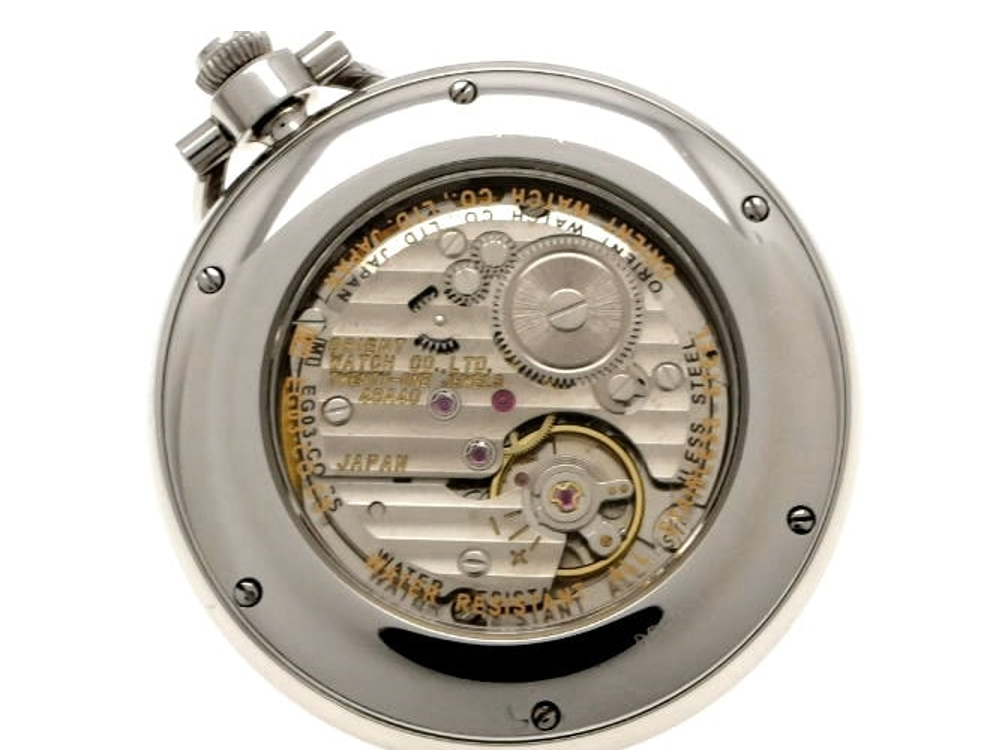
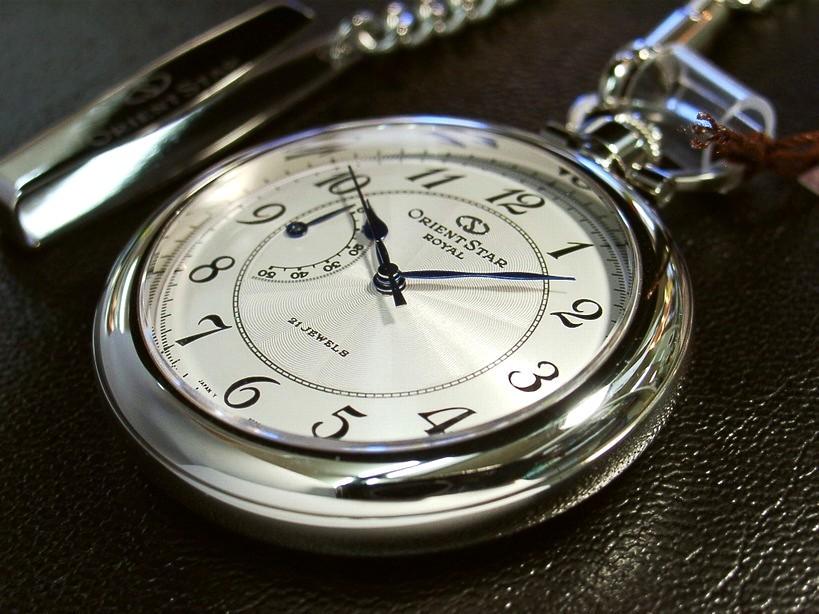
Again it took some time before Orient returned to making a pocket watch. Around 2002 the brand released Orient Star Royal reference WZ0041EG, a truly fine piece in the brand's highest standards of watchmaking at the time. Hand-wound caliber 48A40 ensured an accuracy of +10,-5 seconds per day and 50 hours of power reserve.


A few years had passed and Orient Star Royal became "Royal Orient". Some of the older models were discontinued, but the pocket piece was among the lucky few to get rebranded, and so – we got reference WE0041EG, essentially the same watch but arguably carrying the nicer logo.

Note that these models, despite being of a much higher quality (and price point) than their quartz predecessors, were only produced in Stainless Steel – and I feel the subtle elegance of these was indeed much better suited for the pocket watch concept than the gold paint of the quartz.


Orient's last batch of pocket watches was produced in the early 2010s. These weren't Royal or Star but "regular" models, yet they were quite nicely designed and made. These included WV0011DD and WV0031DD pictured above, and WV0021DD shown below.

The earlier references with Arabic numerals were introduced in 2010, and made use of the then-new caliber 48C40, a downgraded version of the Royal 48A40, having simpler decoration and reduced accuracy of +25/-15 seconds per day. The last version, having the Roman numerals, was added in 2013. That was Orient's last pocket watch, at least for now.


Photos were taken from old Orient catalogs and sale ads, except the "celebrities" photo taken from GQ magazine.

Thursday, 11 January 2024

The Hidden Treasure of the 65th Anniversary

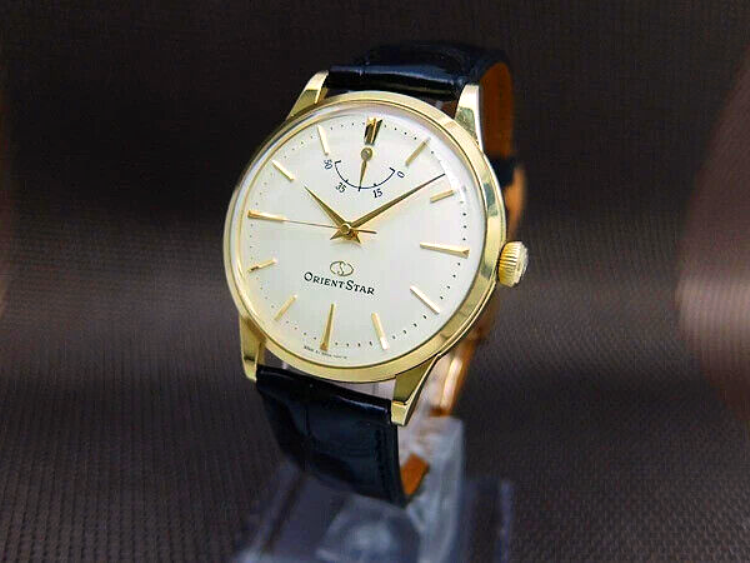
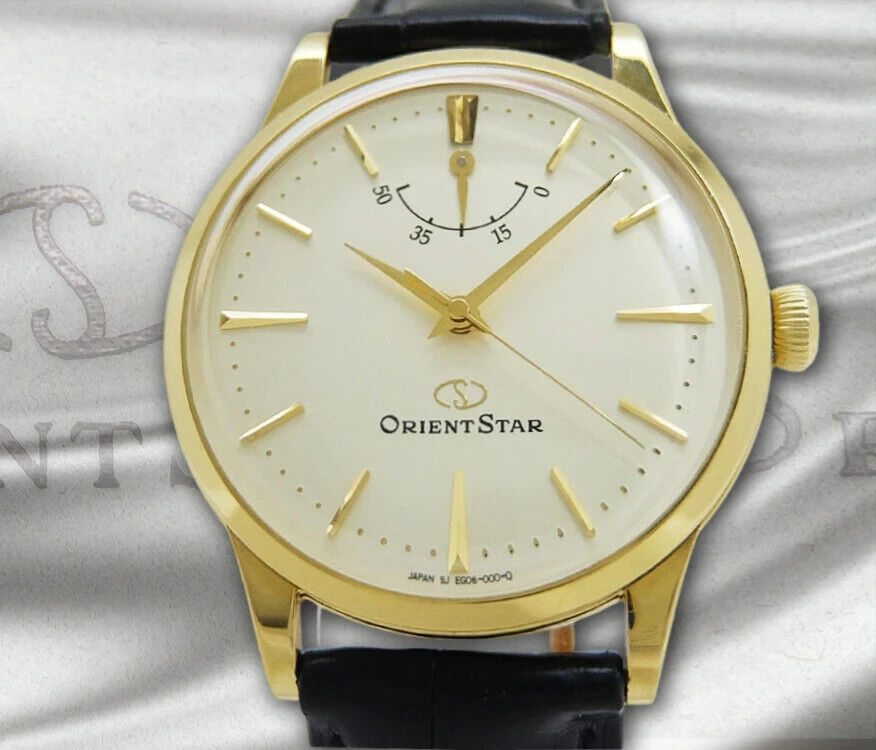
This is the first Orient Place blog post of 2024, so I thought: why not kick off the new year with something that isn't very new, but is quite festive and unique? I give you the hidden treasure of Orient Star's 65th anniversary: the very exclusive, solid gold Reference EG06-AQ.

Back in 2016, Orient celebrated 65 years of Orient Star. Throughout the brand's history, different names were used to present its higher-end products: sometimes it was Royal Orient, other times Grand Prix, but it was "Orient Star" that held on the longest. Orient, therefore, chose to mark its anniversary with something special.

You may recall the story of the Royal Orient ref. WE0011EG, which was mentioned as one of only three gold models made by Orient in modern times; well, apparently, this was not accurate! Indeed, one learns something new every day (almost). Because that "something special" in 2016 turned out to be yet another gold watch.


Orient Star Ref.EG06-AQ was in fact a younger brother to that Royal Orient model, produced some eight years earlier. Both featured a lovely 18K Yellow Gold case, and shared the same 48A40 movement. The main differences are in the dial.

While the Royal version's face was highly elaborate with its intricate textures, the Star version's dial is simpler – but it is far from mundane. The surface seems to be sand-finished matte with a silver-like hue. The overall layout is like an upscale "Bambino", but with the golden hands and markers; the minute markers are also golden, as opposed to the usual printed minute track.


And, of course, there is the power reserve indicator, counting down from the movement's full 50-hour reserve.

The case is slightly larger than the Royal's, at around 36mm wide by 42mm lug-to-lug. As I've mentioned in my review of the Royal Orient model, something about the wrist presence of gold makes these dimensions feel and look bigger. So, while its case is small, this Orient Star still passes as a perfectly sized dress watch. The chubby gold crown also helps in this respect.


Going back to the hand-wound caliber 48A40 hand-wound, it is visible from the back, and is just as beautiful as on the Royal version. Also carrying over the +10/-5 seconds a day accuracy, it is definitely one of the finest movement to feature on an Orient Star.

The same movement by the way was also used to drive the Royal Orient pocket-watch, EG0A-C0-B (or, in its JDM reference, WE0041EG) and the identical watch branded Orient Star Royal, ref. EG03-A00). A very special movement then, found exclusively in some of the brand's top releases.


And the 65th Anniversary Orient Star is not just a top release, but a very rare one. Only 65 pieces were made, making this one of the hardest to find among modern Orients watches. And prices, if you should find one, are well within the four figures, USD.


Pictures that appear in this post were taken from old Orient catalogs and sale ads.