Orient Place

Orient Place

Sunday, 17 April 2022

Orient Place Blog's 4th Anniversary

What do you know? Another year has passed, and the blog now celebrating its 4th anniversary! We're still running strong and not running out of topics to write about, new watches to review, and old mysteries to uncover. Time for our annual wrap-up then…


First, let's look at some stats. We've had about 122,000 views since the previous anniversary, a rise of 22% in traffic. Thank you, readers, followers, likers, sharers, and commenters! If the blog was trading on the stock exchange, our shares would be rocketing through the roof.

Thirty-five stories were posted in the last year, nearly three per month. These included six hands-on reviews of current models, six reviews of vintage or discontinued models, and five articles covering specific topics from Orient's history.

I recently ran a survey on my Instagram account, a sort of popularity contest between watches reviewed on the blog in the last year. Viewers voted for their favorite among eight watches – five of the current models reviewed, and three discontinued (but not particularly old) watches.

Lo and behold, the winner of the people's favorite: it's the Orient Star Retrograde, which in the final battle managed to beat the World Map re-issue with 60% of votes.


The most popular story of the last 12 months was the announcement of new "diver design" models, AKA "Kamasu 2", with over 3,000 views. Far behind, in second place was our hands-on review of the ever popular "World Map" re-issue with about 1,900 views, and in third place – the introduction of Orient's re-issues of the 1964 diver and the retro-future guitar. Generally speaking, then, it shows a major interest in the brand's new models! Well done, Orient.

The blog is active on social media: About 120 followers joined our Facebook page last year, now totaling more than 660, and while my IG account isn't solely about the blog, much of it does feature related content. The most liked Orient watch pictures featured on my Instagram account were the Royal Orient ref. WE0011EG (again... a photo of this beauty was also no. 1 in the previous year!), the Orient Star Classic Semi-Skeleton, and a picture of the 1964 Diver.


Okay then, that was all about last year. What now?

As Orient continues to produce new models, we'll try to keep up. There are a number of new models lined up to launch in the coming months, and there are also watches awaiting their turn for a hands-on review, which in the best tradition of the blog promises to be practical and insightful.

At the same time, we'll continue to take occasional plunges into the brand's history. I've collected plenty of old records and info, and have specific topics in mind, which I'll be covering in the near future.

Thank you all for following the blog, and keep sending in questions and providing feedback!


Sunday, 3 April 2022

Orient's N-Type Movement

Orient's N-Type movement was presented and put to use in 1958. Despite being an important step forward for the brand, and powering some of its most prestigious models at the time, it was not long-lived, and its production ended in 1961.

As with most vintage Orient movements and watches, official info and original documentation pertaining to the N-Type is scarce. A bit of detective work was required to gather information, still leaving plenty of unknowns.


What we do know, is that Orient took great pride in this new caliber. It was considered a major advancement over the previous movements used by the company, primarily the T Type. A thin and modern movement for its time, it was intended to compete with the leading Japanese products, mainly Seiko's Cronos.

The new movement featured improved accuracy and reliability. It had a wider diameter than its predecessor and offered greater precision, and improved shock resistance. It also used the recently invented Nivaflex material for its mainspring.

Some say the first Orient to use the N-Type was a 1958 ultra-rare second iteration of the Royal Jupiter, which in itself was a super-rare higher-end version of the Jupiter.

In any case, Royal Jupiters of all sorts were short-lived and by end of 1958 were replaced by the more familiar line, Royal Orient. It was with these Royal Orients that the N-Type movement found its home.

Early Royal Orients came in a variety of shapes and dial versions, including some pretty fancy ones. These surely deserve, and will receive, a dedicated blog post later on. However, they all made use of the N-Type.

In 1960, a new iteration of the Jupiter name was deemed worthy of this high-end caliber, and so received the N-Type movement as well.


In 1961, Orient introduced the new generation of the N-Type movement with a date wheel – rendering the no-date version granted to the Jupiter somewhat outdated, and less of a generous gift than might have appeared in the first place…

The new movement was installed in three levels of watches: the "Lucky Calendar" which was slightly more pricey than the Jupiter; the yet-more-expensive Royal Calendar; and the top of the line Grand Prix Calendar.

In addition, a high jewel-count version of the no-date N-Type movement was used to drive a new "Special" Grand Prix.


Like Orient movements before it, the N-Type was not wholly original, and its architecture was based on the 1955 FHF 73 caliber (by Fabrique d'Horlogerie de Fontainemelon).

The FHF had various bridge designs, and the one chosen by Orient was similar to the Delvina/Delbana version, also used by other brands. You can see a sample of this movement below, being very much identical to the Orient movement, except it clearly says Swiss...

Orient adopted some variations of the original FHF designs, including the later FHF 73-2 (with a date wheel). They manufactured both the version that had balance screws, and the one that did not, as well as both 17 and 21 jewel versions – again like the original caliber they used as a basis.


Later on, Orient did play around with jewel count, adding a few to the high-end models (as high as 25 jewels for the Grand Prix) and removing a few for the simpler implementations, like the 1961 Jupiter.

All N-Type variants beat at 18,000 BPH, and were hand-winders. Indeed, it was the introduction of automatic movements into Orient's line-up that eventually led to the early demise of the N-Type movement.


Pictures of the N-Type movements that appear on this post were taken from the 1999 Orient Watch Catalog book.

Sunday, 20 March 2022

Three Points About Orient Tri Star

The Orient Tri-Star, or "3 Star" is among the brand's most familiar symbols, an icon of accessible mechanical watchmaking like Seiko's "5" and Citizen's "7". 

Much can be written about the Tri-Star, as it spans so many years and models. There's definitely enough history associated with it to provide content for a dozen articles or more. In this post though, I'll just touch on three (haha) points, possibly less known to new fans of Orient who only recently became acquainted with these watches.


The Three Stars Are Older Than The TriStar

The TriStar line dates to the early 1970s. While there is little information available pointing to the exact birthday of the collection, it was probably around 1971 or a little later, as the early TriStar models used Orient's caliber 469, born in 1971.

Upon its launch, Orient advertised that the three stars stand for three key principles of the collection: representing design, quality, and affordability.

The three-star logo, however, was being used by Orient years beforehand. As early as 1956, in fact, when one of the earliest Jupiter models was adorned with three stars – albeit organized in a triangle rather than lining up.


Later on, three stars in a line could have been observed on other Orients, like the 1967 World Diver. Now, this was far from being the most affordable of the brand's watches, clearly indicating the aforementioned three principles of the TriStar collection were an afterthought.


The TriStar Collection Is Really Diverse

When asked to think of a TriStar, many of us immediately imagine something similar to the sort of design picture below: a fairly small watch with lugs that sit flush on the case, simple dial and markers, and a date-and-day window.


In fact, there are many modern TriStar designs, some of which differ quite significantly from each other. What they do have in common, is that you got quite a lot of watchmaking for your money: a nice design that has its own identity and is decently executed, powered by workhorse movements that should keep ticking for many years.


TriStars Are Missing From Orient's Main Websites

If you were to look for current TriStar models on Orient's global or JDM websites, you would not find a single one.

The only model shown bearing the triple star logo is the "King Master Revival", which is the oldest of the re-issue models presented. Elsewhere, even the World Map Reissue had the original three stars removed.


Of course, TriStar models are still being produced. You can see them on websites such as Orient Watch USA and Orient India, which are run by local distributors, as well as on many retailers' and ecommerce websites.

And, Orient do offer support for TriStar models on their website – you can locate and download instruction manuals for these watches.

Apparently, the reasoning for this goes back to the original concept of offering TriStar models in markets looking for cheaper mechanical watches, and not in the brand's primary markets which, supposedly, are seeking higher-end products.

The fact of the matter is, in every country you will find people who love the simplicity and affordability of these watches, and are looking to buy new, used, and vintage TriStar models.


Pictures of the various watches that appear on this post were taken from Orient Watch USA advertising, Orient catalog and the 1999 Orient Watch Catalog book.

Sunday, 6 March 2022

Orient Star Ladies' Classic Semi Skeleton Hands On Review


Yes, that’s right. After almost four years of activity of Orient Place Blog, and having often posted updates of new women's model releases by Orient, we're finally going hands-on with a ladies watch.

The watch at hand is the Orient Star "Classic Semi Skeleton", reference RE-ND0004S (or, RK-ND0004S in Japan). Note there is a new line of Classic Semi Skeletons, that we've mentioned before; the model we're looking at now is the older version – the classic classic semi skeleton, if you will – which of course is still relevant and on sale.


The Classic Semi Skeleton is immediately recognizable as an Orient Star, and not just because of the logo. The case shape, curved silvery dial with roman numerals, and of course that "open heart" aperture, are obvious giveaways. It essentially an Orient design in a smaller package, which makes sense as Orient often likes to have its ladies' models function within his-and-hers watch pairs.

The smaller package, in this case, is 30.5mm wide, and 36.6mm long lug to lug – same as the newer Classic Semi Skeletons. This is indeed a very "classic" size for women's watches, whereas many brands nowadays offer larger diameters, which are considered as more modern or sportier.


While small, the watch retains the familiar Orient Star attention to details. The small crown is signed, as is the folding clasp. The leather strap is supple, and very similar in style to straps provided with the larger watches – though probably a little less padded, to keep in proportion with the 14mm lug width.


Diving into the finer details does not disappoint either. The dial features a well made pearlescent texture and fine black print. The parts of the movement visible through the open heart are nicely polished. Nothing seems too coarse or neglected.


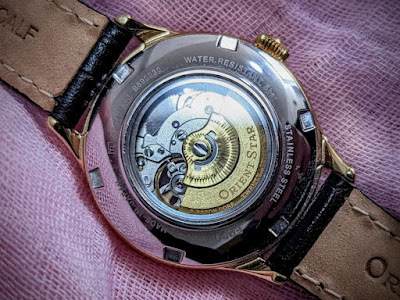
The exhibition case-back reveals the tiny automatic movement, caliber 55C40. The movement itself is not particularly decorated, and I doubt any decoration would be visible to the naked eye anyway – and at this price point, it is absolutely fine. The golden rotor is lovely though, and is probably what makes checking the backside of this watch worthwhile at all.

Speaking of movement, this is where the biggest difference between "his" and "hers" models lies. Orient usually boasts very decent accuracy, with most Orient Star models testing to do around 6-7 seconds per day (and an official +25/-15 range). Caliber 55C settles for a stated +40/-30 seconds per day, and since there's no second hand – its actual accuracy does not matter much.

On one hand, this could make sense considering many women would view their watch as jewelry more than a time-telling device; on the other hand, the same can be said for many male watch-owners. I suppose women who are true watch aficionados will see this as a downside. Of course, this can simply be attributed to constraints resulting from the smaller size of the watch.


Okay then, technically it's all fine, the quality is there. But what do potential buyers think about the watch? I turned to my wife for some answers. It was interesting to learn how different her view of the matter is.

While she appreciated certain design elements, and took my word for the watch being of high quality and very reliable, she takes a more holistic approach. Viewing the watch as a whole, what the missed most was a bracelet; it then occurred to me that of the different watches I got her over the years, as well as ones she got for herself, she only keeps using the ones with a bracelet. Preferably a shiny one.

I wonder now, if women who view the watch more as jewelry, tend to prefer a bracelet over a leather strap; and if those who prefer a leather strap, are more likely to tend to the functional side of the watch, and may care more for the lack of a second hand?

Another point she made was, if she wears a watch she wants to be able to keep it on, everywhere – including the swimming pool, for instance. Clearly a leather strap limits the "go anywhere" option.


This OS Classic Semi Skeleton is officially priced at around $450 USD, and can usually be found at around 350. That is a good price for a well-made automatic watch from a reputable brand.

If you are looking to get yourself a classically styled mechanical watch, then this Orient Star makes a very compelling proposition.

If you are buying this watch for your significant other, you may well be in the right direction, just make sure she will be fine with the strap option, and that she does not mind reading the time to within the nearest minute only. Otherwise, your best option would be the Orient Star "Standard" ladies' watch, a sportier line of models ranging between 33.5-34.5 mm wide cases, all of which equipped with steel bracelets and featuring a date wheel and a second hand.


The blog would like to thank Orient – Epson Europe for providing us this Orient Star Classic Semi-Skeleton watch for review.