Orient Place

Orient Place

Sunday, 10 July 2022

Orients From Mars


Among the various model and sub-branding names used by Orient throughout the years, "Mars Orient" was among the shortest lived. It was introduced in 1957, and its production ended in 1958. And yet, during its short life, it shone bright.

The Mars Orient was produced in a number of versions, differing in materials and design, but most significantly – the movement. Only two little stones separated 19 jewel models from 21 jewel models, but this was enough to position them almost like two different watches, the latter costing almost twice as much as the first.


All Mars Orients utilized the Type T caliber, and were among the last models to use this movement. Only the Women's Orient Star Dynamic and the Para Aimant, which relied on the smaller diameter of the aging movement, kept using it till the end of the 1950s.

The more basic 19j Mars models were generally priced around 4,500 – 6,000 JPY, which at the time was about the same as top-of-the-line Orient Star Dynamic (which came before it) and 19 jewel Royal Orient (which followed in 1958).


These Mars Orients came in a number of variations: there would be either Stainless Steel or Gold-Filled, and either with – or, more rarely, without an Anti-Shock mechanism. Dials designs differed too, and even the branding was not identical in all products, as some featured the Orient Star logo while others did not.

Higher upscale were the 21j Mars Orients. These were less common, and fewer versions were made, all equipped with Anti-Shock devices. The basic model was priced around 9,000 JPY, more than the most expensive Royal Orient back then. A more elaborate version, featuring the Orient Star logo and a uniquely textured dial, cost 9,770 JPY – remaining the most expensive Orient for years to come, until the 1961 launch of the Grand Prix.


So what was so special about these that made them such expensive watches? While the movement was essentially the same old T-type with two more rubies, these got "5 Adjust" marked on them, meaning their accuracy was regulated for five different positions. Finishing was probably the best that Orient could produce at the time.

Still, the actual difference between, say, a 19 jewel anti-shock-equipped gold filled Mars Orient and a 21 jewel one, appears to be less dramatic than pricing would suggest; and certainly, asking price for a vintage Mars nowadays would depend more on the condition of the item than on the movement version.


Pictures that appear on this post were taken from various sale ads and the 1999 Orient Watch Catalog book.


Sunday, 26 June 2022

Orient's Early Antimagnetic Watches


Today we will take a quick look at the early anti-magnetic watches that were introduced by Orient in the late 1950s. But first, a little theoretical background.


Anti-Magnetic Watches

Historically, there is a problem with watch mechanisms and magnets. When their ferrous components get magnetized, they no longer move about freely as intended, instead sticking to each other or themselves. In particular, this affects the balance spring, making it oscillate more quickly – which results in the watch running too fast.

There are generally two approaches to solving this problem – you may either use non-ferrous components, or shield the movement from magnetic fields.

Today, the preferred approach in most cases is the first. Materials like Nivorox (Nickel-Iron alloy) and similar were first put to use, improving magnetic resistance sufficiently so that most watches in recent decades could satisfy the anti-magnetic standard for watches, "ISO 764", namely to resist up to 4,800 A/m (60 Gauss). Lately, more manufacturers turned to using Silicon balance springs, achieving even better results.

Mind you, 60 Gauss might not seem like much when you think of watches such as Rolex Milgauss taking on 1,000 Gauss, but in fact a thousand Gauss is very much, way more than most of us would ever encounter in our daily lives, and 60 is just fine.

The other option, to shield the movement, is basically about placing it inside a "Faraday cage" – an inner casing made usually of soft iron, which is easily magnetized (and de-magnetized). It essentially attracts the magnetic field and prevents it from affecting the movement inside. This method is less common today as it makes for a heavier, more complex construction; and, it loses its effectiveness with any hole put through the cage, preventing such features as a date window and other "complications". However, before non-ferrous balance springs were available, this was the best way to achieve high magnetic resistance.


Orient Para Aimant

In 1958 Orient decided to launch an anti-magnetic watch of its own, which would be the first among the Japanese watchmakers. Naturally, the brand did not have the resources to delve into new material research, and chose the "cage" approach.

By then, Orient had already introduced the modern N-Type movement. However, it chose to build its antimagnetic model around the older T-Type caliber, which was considerably smaller (23.30 vs. 25.50mm). This way they could keep the size of the watch down, despite the added width of the cage.

In the following picture, you can see the main cage, next to the caseback. Not visible in the photo is the metal disc which lies beneath the dial, which closes the lid over the movement, with only two little holes left for connecting the crown and the hands.


Curiously, Orient chose to call this new model "Para Aimant". Now, Paramagnetic is the proper term for the soft iron cage – which by the way isn't really soft, it's just the term used to differentiate it from hard iron, which is harder to de-magnetize. And "aimant" is French for magnet. But, paramagnetic in French would be "paramagnétique"…

Anyway, the cage did its job well enough. The watch was said to withstand 200 Gauss, more than three times the requirement of ISO 764.

A number of Para Aimant versions were made, with movement variations numbering 17, 19, and 21 jewels. These were probably priced in the range of 5,500 – 6,500 JPY, making them more expensive than most T-Type models, and very close to the high-end Royal Orients.


Orient Royal Super-Antimagnetic

Besides its quirky semi-French nomenclature, there was another problem with the Para Aimant: Citizen watch company was using the "para" prefix for its own products. In 1956 Citizen released the "para shock", its first shock-resistant watch; and 1959 saw the introduction of the "para water", Citizen's first water-resistant model.

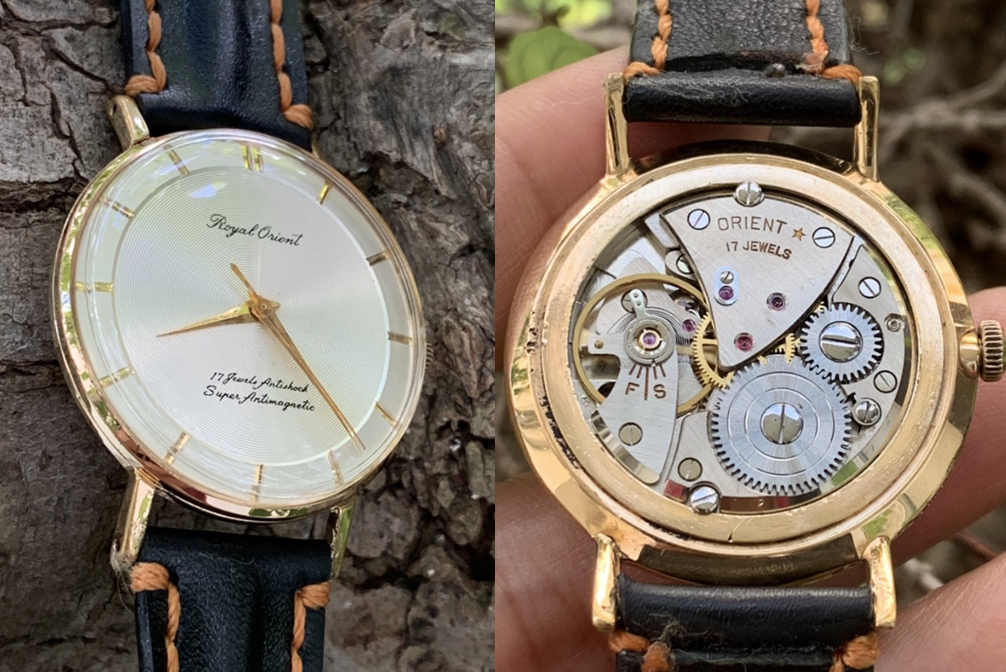
Apparently, Orient wanted to avoid the commercial conflict, and seeing that their antimagnetic watch was already in the Royal Orient price bracket, the brand took a logical step: the Para Aimant was set aside, and in its place came the Royal Super Antimagnetic.


This time around, Orient used the N-Type movement, specifically its 17 jewel variant (likely in order to keep the price down). Photos of the Royal Super Antimagnetic do not reveal a separate cage like the Para Aimant, and Orient did maintain the same diameter with the Royal Antimagnetic as other Royal models – possibly, the case was built with the iron cage already part of it, making the whole construction more compact.

Anyway, to keep things at least a little quirky yet, in best Orient tradition, the Royal Orient's caseback still read "Para Aimant".


Pictures that appear on this post were taken from various sale ads and the 1999 Orient Watch Catalog book.


Sunday, 12 June 2022

Triangular Orients


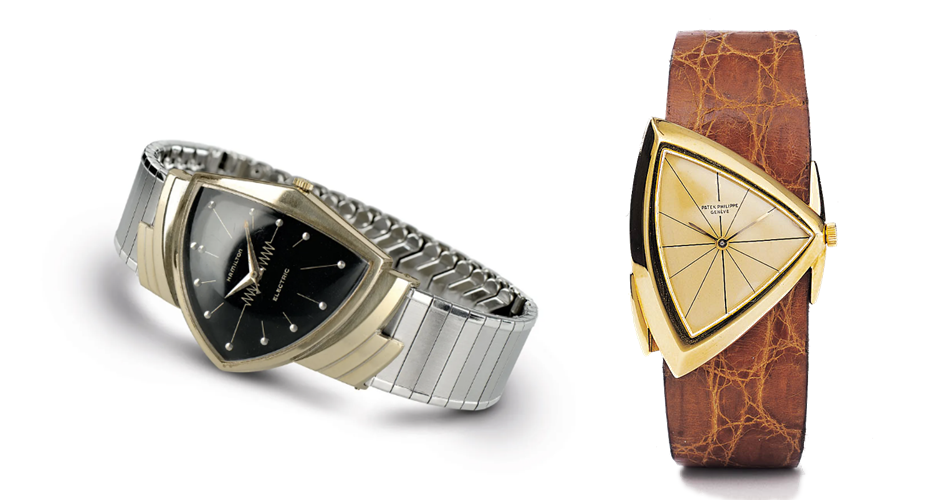
In 1957, Hamilton introduced a revolutionary watch named Ventura. The Ventura was the world's first electric watch – not quartz, mind you, as that took another 12 years to make – and as such, was given a most futuristic case. Designed by General Motor's famed Richard Arbib, it was the Ventura that introduced triangular watches.

The Ventura's design overtook its novel mechanism in becoming the model's signature characteristic, to the point that nobody cares if modern Ventura reissues are mostly automatic; and it made the triangular case desirable, so that even Patek Philippe rushed to do one of their own, and in 1958 presented the reference 3412, designed by another big name: Gilbert Albert.


It was not surprising then that Orient, in one of its periodic attempts to enter European markets by borrowing from a European design, soon followed with its own little triangle.


Orient Star Dynamic

The brand's first go at the triangle concept was released in 1958 under the Orient Star Dynamic name. Produced alongside other Dynamic models with more traditionally shaped cases, this was a very accurate duplication of the first Ventura.

As Hamilton's watch was made in gold, the Orient was 14K gold filled. It was a fairly small watch, 29mm wide, and around 34mm lug to lug. Like other OS Dynamic versions, the triangular piece contained the Type T movement.


Two versions were made – one that had a black dial, and another with a special two-tone, white and golden dial.

Interestingly, Orient also produced a pocket watch version. That version had a symmetric design, as opposed to the wristwatch's asymmetric case.


Orient Olympia Calendar

A few years had passed, and in 1963, Orient returned to the triangle. This time the source of inspiration was Hamilton's Pacer – a model that followed the Ventura, with not as ornate a case – and the platform was Orient's Olympia Calendar, and its 19-jewel Type LC movement.

The Olympia version was larger than its Dynamic predecessor, at 31mm across and 42mm long. Again, it was produced as a gold-filled case, on a steel base.


Orient Weekly AAA

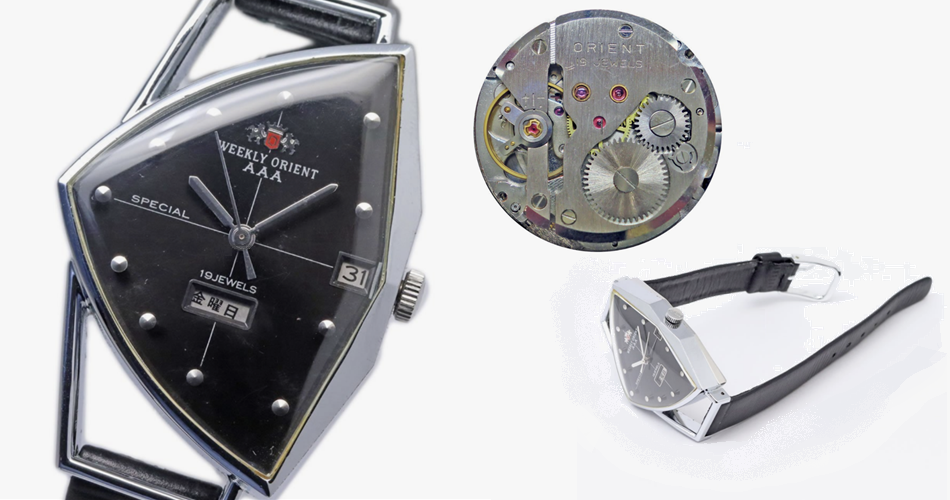
The Orient Weekly Auto AAA was a fairly common model in the mid-1960s. The non-auto Orient Weekly AAA, however, was much rarer – basically having the Auto's movement with its rotor removed, renamed caliber "Type MCY" (there was also a date-only version, Type MC).

In 1965, Orient used the Weekly AAA as the basis for its next triangular design. This time they manufactured a watch with distinctive lugs, different from Hamilton's, and also larger – being 33mm wide, and 52mm long from lug to lug. No gold plating was applied.


Orient Chronoace

Orient introduced the Chronoace line in 1969. It featured a new family of self-winding movements, cal. 42xxx, and numerous models ranging in pricing and design.

In 1970, Orient took caliber 42 and placed it inside the Weekly AAA's triangular case. The Chronoace's familiar date quickset button was omitted, as there was no place for it in the case.


This was the last of Orient's vintage triangular models. Note how each link in the chain added something new to its predecessor: the Olympia added a date; the AAA added the weekday; and the Chronoace added automatic winding.


Reprint

in 1996 Orient chose to release a new triangular watch, paying homage to its vintage ancestors. The new model featured a "Pacer" case much like the Olympia, small 29mm dimensions like the Dynamic, markers much like the AAA and Chronoace, and dauphine hands – again much like the Dynamic.


The new model was branded as Orient Star. Two variants were produced: reference NWAA-A0 (or WZ0051NW in Japan) with a gold-plated case, and ref. NWAA-C1 (or WZ0061NW) in steel. The movement inside was cal. 55141, a small mechanism used primarily for women's watches.


Pictures that appear on this post were taken from various sale ads and the 1999 Orient Watch Catalog book.


Sunday, 29 May 2022

Orient Star Basic Date Hands-On Review

If there's one thing Orient doesn't really seem to excel at, it is naming their models. The brand's history is full of quirky creations like "Para Aimant" (arbitrarily going French with just one model) and "Super Auto Perfect Self-Winding" (is this a name or the technical specification provided to the designers?). I'm looking at you, the unbefittingly, underwhelmingly named "Basic Date"!

Because, even before diving deeper into the details of this Orient Star, it is clear that it is far from basic. And while common reasoning might have you thinking that as "basic" it is positioned below the Orient Star "Standard", the fact of the matter is that it's not – it's bigger and more expensive!

But, enough complaining about names. Let's talk watchmaking. Let's talk about the Orient Star reference RE-AU0404N.


 How It Looks

The second you lay your eyes on this watch, you understand this isn't your standard Orient – not even by Orient Star standards. Having perhaps the most mundane design of the brand's current line-up, which results in very unexciting catalog pictures, Orient has clearly put all of the Basic Date's eggs in one basket: quality.

And indeed, this watch very confidently presents the high level of execution that Orient is capable of. The term "poor man's Grand Seiko" is often used in conjunction with some Orient Stars, and here it seems more accurate than ever. At a fraction of the cost of entry-level Grand Seiko automatic models, you're getting finishing and details that might not be quite up there with the famed Zaratsu-polished masterpieces, but are certainly more than mere "adequate".


The Basic Date family contains a number of versions with different combinations of dial and bezel colors, and even one two-tone reference; from photos, there appears to be a different vibe to each of these variations, so in this review, I can only comment on the one piece I have in my hands. I do have a feeling though, that if I was presented with all versions in person I'd still go for the all-metallic one I now hold.

The sunburst grey-silver dial combines superbly with the case and bracelet to create a visual presence that's confident, tough, and yet very elegant. I cannot help but be reminded of (forgive me watch fam!) a Rolex Oysterdate, despite some obvious differences in the design. Yes, it's also very much an "adults" Orient, the sort of watch that wouldn't be out of place on the wrist of your uncle from Florida when he goes golfing.


Taking a closer look at this Orient Star, it's easy to see where the perceived quality is coming from. The case and bracelet are all finished in very subtle, uniform brushing, with just the bezel and chamfers polished brightly. The dial is sunburst, with the power-reserve section just very slightly differentiated in finishing to create a playful, yet restrained effect.

The hour and minute hands too are very well executed. Multi-faceted, mostly polished but brushed toward the pointy end, these are definitely not an entry-level set of hands. And the markers they're pointing at are also multi-faceted and well made, with polished bevels that reflect light brilliantly and grooved top surfaces providing a more muted reflection granting the dial a sophisticated, understated look.


All these elements are laid out very pleasantly. The dial has more than enough breadth to contain the power-reserve indicator, date window, the logo, and a little bit of subtly-printed text, while maintaining a spacious appearance. Sticking with a strictly monochrome scheme, the dial is kept in perfect balance – albeit possibly a little too somber for anyone looking for that famed Orient quirkiness.

Other elements of the Basic Date – such as the clasp or the parts of the movement visible through the case-back – are clearly more functional than particularly decorative, but they too are adequately finished and do not detract from the excellent overall impression.


 How It Wears

The Basic Date packs heft which, unsurprisingly, is in line with its stout appearance. It is indeed a solidly built piece of steel, and while no official weight figures were released, I can estimate something around 180g on the full bracelet.

That said, this heft is balanced properly around the wrist. The bracelet is thick enough to provide a proper counterweight to the case. The lugs curve down nicely and the whole thing just wears well. Naturally, fans of smaller, lighter watches may object, but then this watch does not replace other, dressier and slimmer options from the Orient Star range. It adds a new option that is sportier and more pronounced, and that usually entails a certain minimum size.


The Basic Date case is 42mm wide without the crown, 50.8mm in length from lug to lug, and 11.5mm thick. These are reasonable dimensions for this sort of watch. Again, it does not replace the smaller Orient Star "Standard", which is 38.5mm across, and despite certain differences, the two can be seen as Midsize and Large versions of the same concept.

Anyway, on the wrist, this watch really wears comfortably. The bracelet is really good: it feels very solid and secure. Thanks to the balanced weight distribution you don't have to wear it too tightly, and even with a decent amount of breathing space the case will not dangle about and would stay pleasantly centered on the wrist. This is a sign of smart watchmaking that considers wearability, and not just visibility and mechanics.

Would this watch work on a leather strap? While in theory it could, I wouldn't recommend it. The bracelet works so well, it's clear that this model just wasn't designed for any other type of strap. And it's not just because of the odd 21mm lug width…


 How It Functions

The movement inside the Basic Date is Orient's in-house caliber F6N43. This movement features automatic and hand-winding, second-hand hacking, and a 50-hour power reserve. Like most Orient Stars it declares a +25/-15 seconds per day accuracy: the unit tested yielded +12 seconds per day.

The crown here is of the non-screw-down type, which is easy to operate but limits water resistance. The Basic Date has a 5 bar (50m) water resistance. The crown is decently sized, not too big or too small, and quite comfortable to handle; however, winding does feel a bit harsh. I would love to have softer, smoother winding in a watch like this, as it would definitely create a more luxurious feel. The rotor itself is generally quiet, and you wouldn't hear it unless the watch is given an intentional shake.


Legibility is generally very good here, especially considering that in this version of the Basic Date there is lower contrast between the hands and dial, compared to other references. The markers really stand out thanks to their highly reflective finishing. The hands too are easy to spot, and have a bit of lume painted onto them.

Now, one might wonder about the practicality of lumed hands when the hour markers are not. Lume dots at each hour would not have compromised the consistency of the design too much (though they would, just a little). It's not completely useless though, as with some orientation you can usually tell the time by looking at the hands, even without markers. Generally speaking then, this isn't the level of legibility you'd find in divers or professional sports watches, but more a halfway between sports and dress watches.

Other than the water resistance, which is just okay, the Basic Date offers decent practicality and durability, with sapphire crystal at the front, and overall construction that feels sturdy. Not a watch you'd take rock-climbing, probably, but certainly good enough for most of your daily activities.


The Bottom Line

Honestly, it's hard to find serious faults with the Basic Date's design and execution. It is a very mature creation, and a fine piece of watchmaking. At an MSRP of around 700 USD and an average "street" (well, online) price closer to 500 USD, this Orient Star makes a very compelling proposal.

This watch would make anyone looking for a hefty, solidly built automatic watch, very happy. Naturally it won't be ideal for somebody with slim wrists, or one looking for a classic dress watch. And it's absolutely okay if you're the sort of person who says 100m or more of water resistance and good night-time visibility are critical. Otherwise though, this is yet another great release from Orient.


The blog would like to thank Orient – Epson Europe for providing us with this Orient Star Basic Date watch for review.