Orient Place

Orient Place
Showing posts with label Dynamic. Show all posts

Thursday, 3 July 2025

Orient's Pocket Watches


Pocket watches emerged in the early 16th century, when portable timekeeping was first made possible by compact spring-driven mechanisms. Initially worn as pendants, these early watches were both rare and ornate - more symbols of status than reliable instruments. As craftsmanship improved, so did accuracy and design, and by the 17th century, pocket watches had become flatter and rounder, allowing them to slip more easily into waistcoat pockets - a style shift that coincided with changes in men’s clothing, particularly the rise of the three-piece suit.

Through the 18th and 19th centuries, pocket watches evolved into essential daily tools. They were refined with complications, robust cases, and eventually standardized movements that made them vital not just for gentlemen but for railway conductors, military officers, and professionals across fields. This golden age continued until the early 20th century, when wristwatches - initially a novelty and often considered too delicate or feminine for men - gained prominence during and after World War I, eventually replacing the pocket watch in everyday use.


Today, the pocket watch seems to be enjoying a quiet return, not as a utilitarian object but as a fashion statement. On recent red carpets, particularly high-profile events like the Met Gala, celebrities such as Jenna Ortega and Leon Bridges were seen wearing pocket watches, in a pretty extravagant manner, and in great stylistic sync with one another. A good excuse, then, to talk about Orient's pocket watches!

And indeed, throughout the years, Orient has played with the concept of a pendant or pocket watch a few times. Earliest examples were included with the Orient Star Dynamic line, in the late 1950s.


Both the round version and the triangular one (which was also discussed before on the blog) were pretty uncommon releases at the time, and probably produced in very small numbers. Hence, sample of these are near impossible to find nowadays.

With the brand's focus on wristwatches, it took years – in fact, decades – before considering pocket-watch format again. Indeed I've seen some odd picture of an "AAA 21 Jewel" pocket watch but that looked so out of place I am almost certain it was a re-casing of an old wristwatch. But the next familiar pocket-watch releases I am confident with, were quartz models produced in the 1980s.


All examples I saw of these items were gold-toned, and quite minimalist in design. They seem to have been mainly aimed at female buyers, to be worn as pendants.

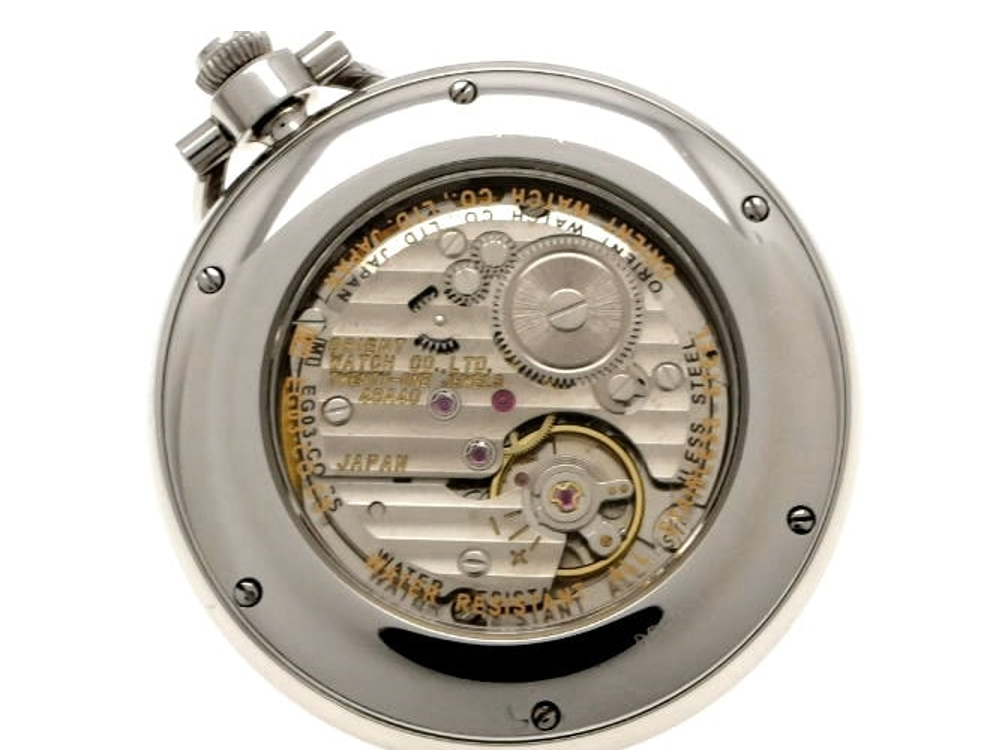
Again it took some time before Orient returned to making a pocket watch. Around 2002 the brand released Orient Star Royal reference WZ0041EG, a truly fine piece in the brand's highest standards of watchmaking at the time. Hand-wound caliber 48A40 ensured an accuracy of +10,-5 seconds per day and 50 hours of power reserve.


A few years had passed and Orient Star Royal became "Royal Orient". Some of the older models were discontinued, but the pocket piece was among the lucky few to get rebranded, and so – we got reference WE0041EG, essentially the same watch but arguably carrying the nicer logo.

Note that these models, despite being of a much higher quality (and price point) than their quartz predecessors, were only produced in Stainless Steel – and I feel the subtle elegance of these was indeed much better suited for the pocket watch concept than the gold paint of the quartz.


Orient's last batch of pocket watches was produced in the early 2010s. These weren't Royal or Star but "regular" models, yet they were quite nicely designed and made. These included WV0011DD and WV0031DD pictured above, and WV0021DD shown below.

The earlier references with Arabic numerals were introduced in 2010, and made use of the then-new caliber 48C40, a downgraded version of the Royal 48A40, having simpler decoration and reduced accuracy of +25/-15 seconds per day. The last version, having the Roman numerals, was added in 2013. That was Orient's last pocket watch, at least for now.


Photos were taken from old Orient catalogs and sale ads, except the "celebrities" photo taken from GQ magazine.

Sunday, 30 April 2023

The Orient Star Dynamic and the T-Type Movement

A couple of months ago I wrote about the birth of Orient's T-S Type movement, and the "Hinomatic" watch built on it. Not long had passed since the 1955 launch of the Hinomatic, and in 1956 Orient introduced a new caliber, the T-Type, which would soon replace the T-S.

The T-Type, too, did not last a long time in production before it was replaced by the N-Type movement, in 1958. However, during its short life it provided the basis for numerous important models and new designs, some of which were later revisited in watches using newer calibers.


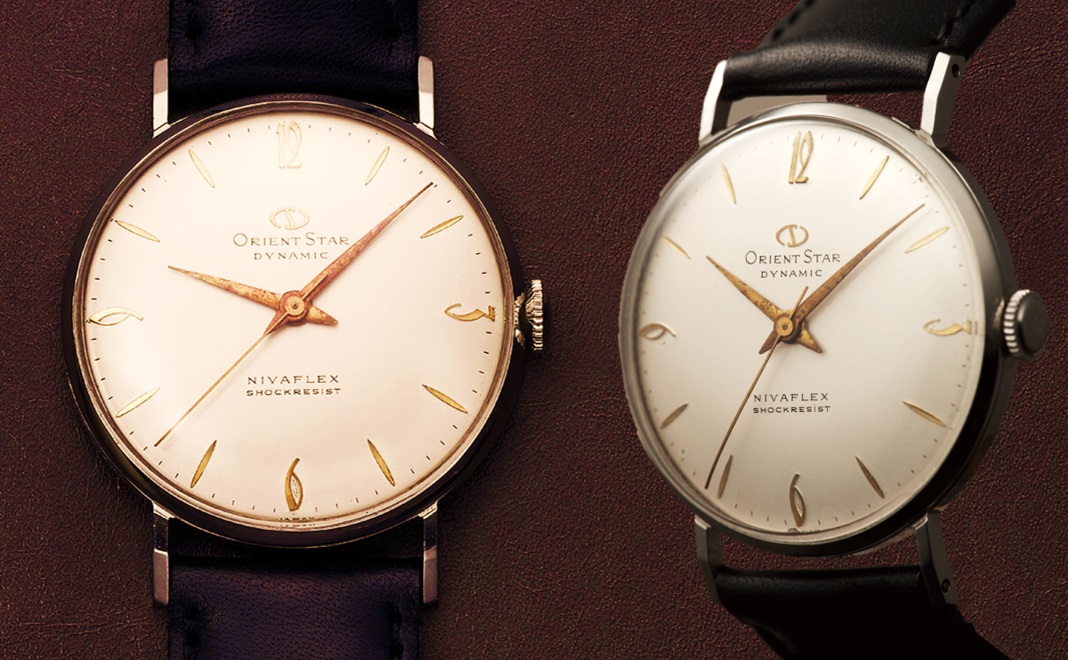
The first and most notable – and popular – model was the Orient Star Dynamic. The Dynamic started life as a fairly standard-looking watch, not much different in appearance from the Hinomatic it replaced.

Having similar looks and a movement that was, in essence, very similar to the T-S, one could be fooled into thinking this was little more than a minor update to the running production line.


However, between 1957 and 1958, at which time the Dynamic line concluded, plenty of fresh and innovative designs emerged.

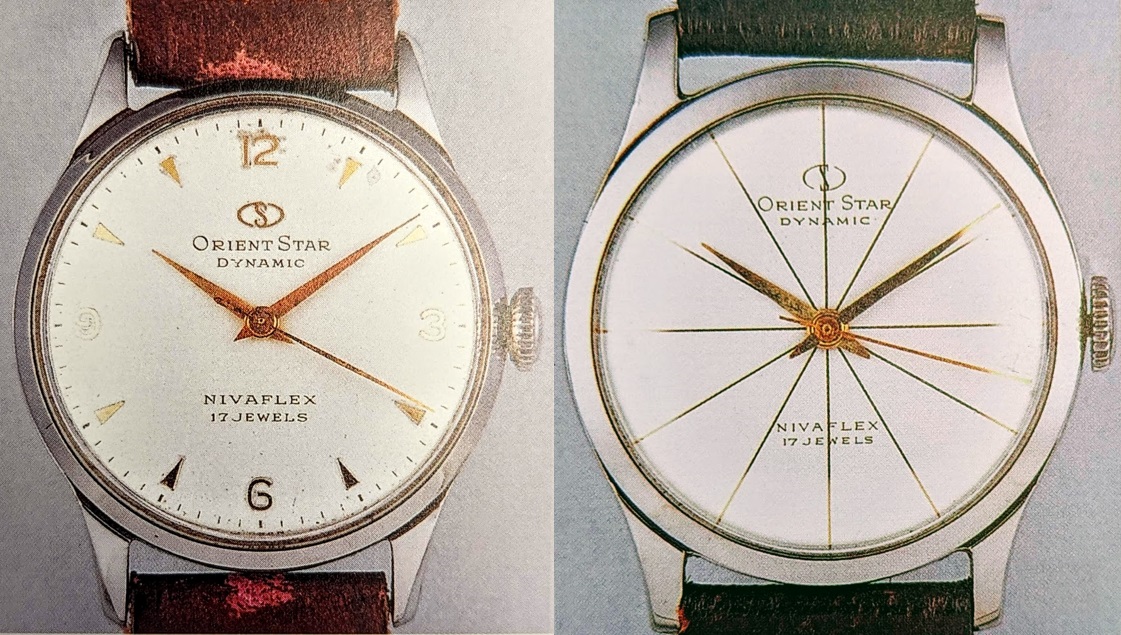
At first, Orient were to play with some fancier dial designs. These also presented a more modern dress-watch style, suitable to the end of the 1950s – as opposed to the Hinomatic's very "early 50s" looks. Differences may appear subtle to us now, but at the time they were probably appreciated for consumers looking for a more current design.


Then Orient produced some more daring creations that went beyond just dial and markers. One example is the "mysterious" watch, where the second hand was replaced with a rotating disc that hid the hour and minute hands, and created a special radiating effect. This design was later reproduced as a Royal Orient.

Another example is the "case within case" design, seen below on the right. This style too was very unique to Orient, and was reused by the brand for its Olympia Swimmer models in the 1960s.


If that wasn't enough, Orient then went on and put the T-Type inside a triangular case, to make its homage to the Hamilton Ventura. This was sold as both a wristwatch and a pocket watch version, as you can see here.

The case-in-case design also received its pocket-watch, or pendant version as you can see below; and an even more unusual product was this table-clock Dynamic, which resembles a lamp.


While the Orient Star Dynamic was the main product line at the time, Orient manufactured more models using the T-Type caliber.

The Jupiter model was presented in 1956, shortly after the Dynamic. It was initially intended as a more basic watch: using versions of the movement having as little as 9 jewels, while Dynamic models usually made use of the 17-jewel version. Later, however, things got a little mixed up with 11 jewel versions appearing in both the Jupiter and Dynamic lines.

In 1957 the Mars Orient was introduced, as a higher end model, with finer regulation and improved shock resistance. These watches used 19 and 21 jewel versions of the T-Type, and the 21-jewel model also featured a higher level of finishing throughout.

Another watch worth mentioning that made use of the T-Type movement was the 1958 "Luminous" with its battery and miniature light bulb, and the antimagnetic Para Aimant. Despite being introduced along with the start of the production of the newer N-Type caliber, these models took advantage of the smaller dimensions of the older movement to pack more "technology" into their cases.

Note, however, that most of the earlier models mentioned – the Dynamic, Mars and Jupiter – had fairly small cases, ranging between 32-34mm. Take this into consideration when looking to buy one of those.


Pictures that appear in this post were taken from the 1999 Orient Watch Catalog book, and old Orient sale ads.

Sunday, 12 June 2022

Triangular Orients


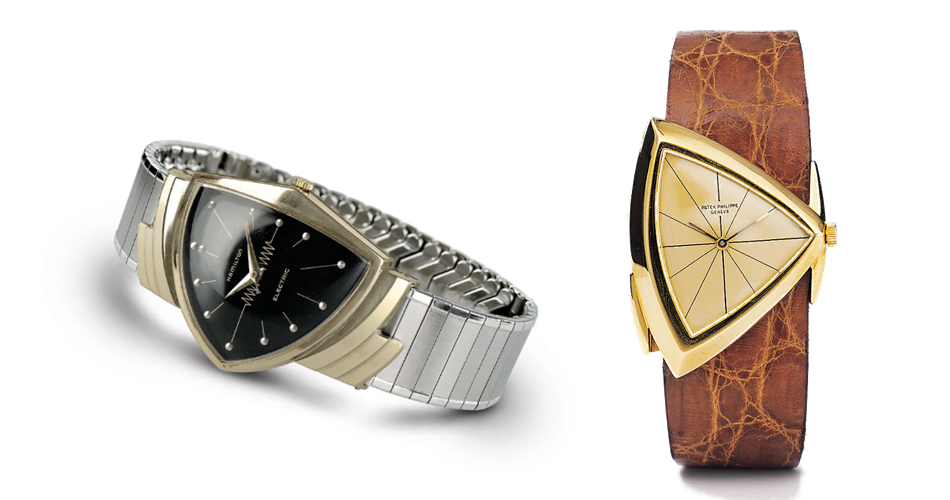
In 1957, Hamilton introduced a revolutionary watch named Ventura. The Ventura was the world's first electric watch – not quartz, mind you, as that took another 12 years to make – and as such, was given a most futuristic case. Designed by General Motor's famed Richard Arbib, it was the Ventura that introduced triangular watches.

The Ventura's design overtook its novel mechanism in becoming the model's signature characteristic, to the point that nobody cares if modern Ventura reissues are mostly automatic; and it made the triangular case desirable, so that even Patek Philippe rushed to do one of their own, and in 1958 presented the reference 3412, designed by another big name: Gilbert Albert.


It was not surprising then that Orient, in one of its periodic attempts to enter European markets by borrowing from a European design, soon followed with its own little triangle.


Orient Star Dynamic

The brand's first go at the triangle concept was released in 1958 under the Orient Star Dynamic name. Produced alongside other Dynamic models with more traditionally shaped cases, this was a very accurate duplication of the first Ventura.

As Hamilton's watch was made in gold, the Orient was 14K gold filled. It was a fairly small watch, 29mm wide, and around 34mm lug to lug. Like other OS Dynamic versions, the triangular piece contained the Type T movement.


Two versions were made – one that had a black dial, and another with a special two-tone, white and golden dial.

Interestingly, Orient also produced a pocket watch version. That version had a symmetric design, as opposed to the wristwatch's asymmetric case.


Orient Olympia Calendar

A few years had passed, and in 1963, Orient returned to the triangle. This time the source of inspiration was Hamilton's Pacer – a model that followed the Ventura, with not as ornate a case – and the platform was Orient's Olympia Calendar, and its 19-jewel Type LC movement.

The Olympia version was larger than its Dynamic predecessor, at 31mm across and 42mm long. Again, it was produced as a gold-filled case, on a steel base.


Orient Weekly AAA

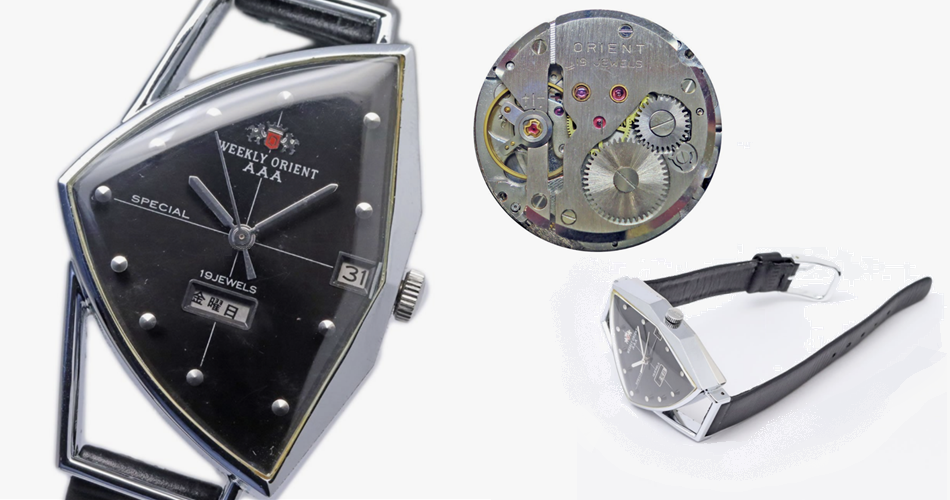
The Orient Weekly Auto AAA was a fairly common model in the mid-1960s. The non-auto Orient Weekly AAA, however, was much rarer – basically having the Auto's movement with its rotor removed, renamed caliber "Type MCY" (there was also a date-only version, Type MC).

In 1965, Orient used the Weekly AAA as the basis for its next triangular design. This time they manufactured a watch with distinctive lugs, different from Hamilton's, and also larger – being 33mm wide, and 52mm long from lug to lug. No gold plating was applied.


Orient Chronoace

Orient introduced the Chronoace line in 1969. It featured a new family of self-winding movements, cal. 42xxx, and numerous models ranging in pricing and design.

In 1970, Orient took caliber 42 and placed it inside the Weekly AAA's triangular case. The Chronoace's familiar date quickset button was omitted, as there was no place for it in the case.


This was the last of Orient's vintage triangular models. Note how each link in the chain added something new to its predecessor: the Olympia added a date; the AAA added the weekday; and the Chronoace added automatic winding.


Reprint

in 1996 Orient chose to release a new triangular watch, paying homage to its vintage ancestors. The new model featured a "Pacer" case much like the Olympia, small 29mm dimensions like the Dynamic, markers much like the AAA and Chronoace, and dauphine hands – again much like the Dynamic.


The new model was branded as Orient Star. Two variants were produced: reference NWAA-A0 (or WZ0051NW in Japan) with a gold-plated case, and ref. NWAA-C1 (or WZ0061NW) in steel. The movement inside was cal. 55141, a small mechanism used primarily for women's watches.


Pictures that appear on this post were taken from various sale ads and the 1999 Orient Watch Catalog book.


Sunday, 12 April 2020

Orient's Special Editions for Thailand


Tomorrow, April 13, Thai people will be celebrating the national holiday of Songkran, the traditional New Year's day.  So today, the blog would be paying respect to the people of Thailand, and we will be looking at some special Orient watches produced to celebrate the Thai culture and national events.


The first thing to keep in mind is the importance of the local language. The Thai take great pride in their unique numerals and alphabet, which are perceived as part of the national identity. Therefore, a key element in watches produced for the local market would be a replacement of Arabic or Roman numerals, with Thai ones. Note in the watches pictured below, that Orient often took the effort of changing numbers not only on the dial but on the date disk as well, as opposed to many other watchmakers that did Thai versions.

Another source of national pride and importance, is the king and the royal family. Thailand is a constitutional monarchy with the current dynasty dating back almost two and half centuries and the kingdom as a whole dating back to the 13th century. Today the king's role might be more symbolic than decades ago, but he is very much revered, and the special occasions of the royal family are still being celebrated widely.

Now, we won't be reviewing all the many limited editions produced by Orient and its local distributors over the years, as there have been quite many. But we can take a look at four interesting examples.


2007: King Bhumibol's 80th Birthday

For the king's 80th Birthday, Orient and local distributor Trocadero partnered to release a number of interesting models. These included:

·         Dual-time model reference CFE04004W based on the FE caliber 46P
·         A pair of beautiful two-tone "his and hers" Orient Star models, references WZ0311ER (larger model) and WZ0361NR (smaller model)
·         A Royal Orient pocket watch
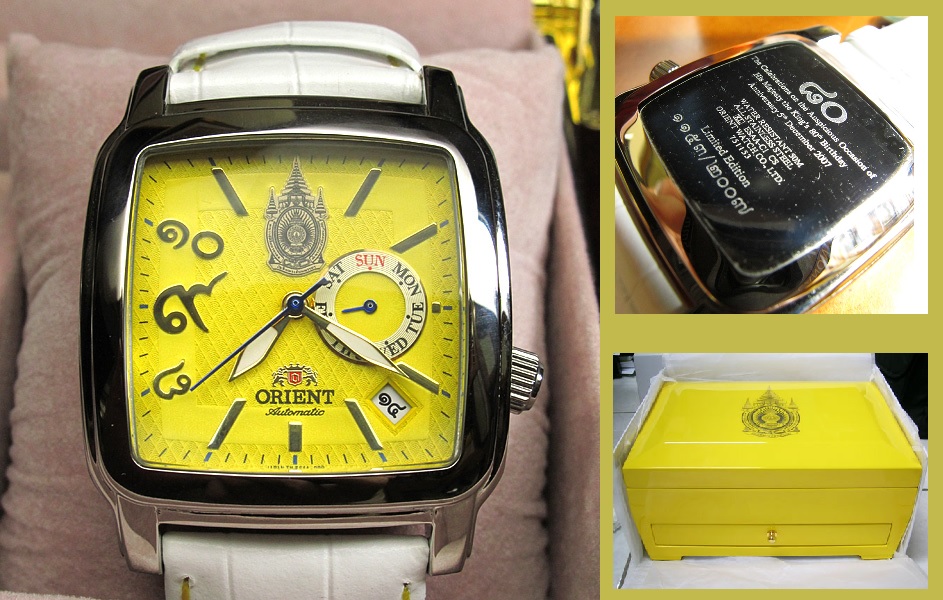
·         And this very yellow model, ref. CESAA005Y


In can be noted that Orient (or their local distributor) took the occasion so seriously, even the serial numbering of the pieces, engraved on the case back, was done in Thai numerals.


2009: Princess Bejaratana's 84th Birthday

To celebrate the Birthday of HRH Princess Bejaratana (Cousin of King Bhumibol), Orient introduced two limited edition models, practically so rare it is nearly impossible to find any information, references and details about them.

·         An elegant, two-tone Orient automatic. Nothing too unusual there…
·         A very unique, and probably very hard to find, version of the Orient Star Dynamic Re-issue. Now that's a properly royal piece!


2014: Orient Thailand Limited Edition

In 2014, Orient produced four "Thailand Limited Editions" of the Bambino, for no particular event other than a celebration of the Thai language and numerals. These special Bambinos includes one rose-gold plated version, one yellow-gold plated version, and two steel models having a white and a black dial.


2015: Princess Sirindhorn 60th Birthday

In April 2015, Orient celebrated the 60th Birthday Anniversary of HRH Princess Maha Chakri Sirindhorn, with a couple of particularly handsome watches.

·         Reference FDB0C006V, a men's watch, nicely combining a royal purple dial and gold plated case.
·         Reference FDB0A00AW, a women's watch, again gold plated, with a dial that's mostly white with just a little touch of purple.


These were only a few examples of the special Orient editions produced for the Thai market. If you are looking to buy any of these rare models, be patient and prepare for a long hunt, as they are quite challenging to find (though possibly some might come up if you search local shops in Thailand).

Happy Songkran!


Some photos and information were taken from official publications by Orient and its former distributor in Thailand, Trocadero. Additional, super-useful and interesting information, was found on this blog

Thursday, 29 August 2019

Orient Watch Reissues


The recent release of the Orient SK reissue seems good excuse to look back at some of Orient's other reissues.

A reissue is generally when a (watch) company either brings back to production, or – more often and more likely – produces a new version which is based on, an old model. The extent of the similarity between the old and new versions is up to the manufacturer. Many watch brands have in recent years launched new models that were very closely based on vintage models, typically adjusted to current market expectations such as larger dimensions, improved water resistance, etc. Seiko's recent series of reissues of their classic divers is one well known example.

Watch brands often resort to old designs when they run out of fresh ideas, or simply when the old designs seem to have retained a loyal fan base that is likely to find a modern version appealing. While Orient does not seem to be out of new ideas, they certainly have plenty of old likeable models to resort to as basis for new editions.

Let's look at some examples of such reissues.

Between 2009 and 2010, Orient re-issued a number of models of historical importance, in respect of its 60th anniversary. For instance, there was the multi-year calendar ref. wv0061fx, a very faithful reiteration of an original 1976 model.


Roundabout the same time they also did a reissue of its famous King Master model of the mid 60s. Curiously, that did not prevent Orient from also reissuing a fairly similar model, the King Diver 21, 5 years later, as the ref. wv0011aa (however they did add one jewel to it, making it a "king diver 22"…)


Another very faithful reproduction was of the 1970 Chrono Ace. These were in fact so similar, that to this day I see sale ads presenting pre-owned re-issue models as "vintage chrono ace". Just remember, a quick tell-tale of the newer model are the lume dots, placed below each hour marker. These did not exist in the original.


Going back even further in time, the 1950's Orient Star Dynamic received a double dose – a proper reissue in 2005 with "Dynamic" on the dial, ref. wz0011eh, and then in 2011 a whole line of "new vintage" watches that hark back to 1950s designs – most notably, and unmistakably, this ref. wz0051dg, that closely resembled the "tuxedo" version of the old Dynamic.


Those were only a handful of examples, many more can be found if one digs deeper into Orient's past models.

Now tell us (in comments below, or on our Facebook page) – what other old models would you like to see Orient go back to and re-issue?


The photos in this post were taken from old Orient catalogs and advertisements.

Sunday, 22 July 2018

Catch Of The Day – The Dynamic Way


It is time for another "catch of the day" piece, where I am looking at some of the more interesting Orient watches that are currently available to buy online. Today's theme is: Dynamic!

First up is this very very uncommon OrientStar Dynamic re-issue, the 55th Anniversary Model reference WZ001EH. I came across this a few days ago, and to be honest – I was not previously aware this model even existed. There's no end to the surprises with Orient!

At 34mm wide without the crown and containing a simple hand-winding movement, it is as true to the original Dynamic model of 1956-7 as possible.


So how does it compare with the original Dynamic? Well, why not check this out for yourself… there's a vintage Dynamic now for sale here, which seems to be in pretty decent condition. This is just one example, and more variations of old Dynamics can be found at this and other websites.


By the way, if you're looking for the specific model that the WZ001EH design is based upon, it is likely going to be a fairly challenging hunt, and none are available to purchase at this moment. This is the one – taken from the Orient catalog (sorry I could not find a bigger photograph):


That's it for today… please come back again – my next article is going to be in the spirit of summertime, I am sure you will enjoy it!

* Please note I have no affiliation with the sellers featured in this article, and do not vouch for authenticity or quality, so buyer's caution is advised!