Orient Place

Orient Place
Showing posts with label Quartz. Show all posts

Sunday, 7 December 2025

Orient's Textured Dials


Textured dials have long been a hallmark of thoughtful watch design, one that goes beyond the basics. Texture can be subtle or flagrant, it can overpower the dial or take the backseat, but it always has an impact.

The appeal isn’t just aesthetic. Textures originated as a practical solution to glare, particularly in the mid-20th century, when both dress watches and field watches relied on matte or grained surfaces to enhance legibility. Over time, these finishes evolved toward more decorative expressions: stamped linen patterns in the 1960s, crisp radial brushing in the 1970s, and more elaborate machine-cut motifs once CNC tooling became widely available. Each era brought its own take on how a dial could play with light.


Traditional crafts also played a role. Guilloché and other machine-turned patterns – once reserved for high-end dress watches – demonstrated how texture could elevate a dial through pure geometry and light. Even when used sparingly, these classic techniques helped establish texture as a legitimate design element rather than just a technical necessity.

The modern resurgence of textured dials owes a great deal to brands that have leaned into nature-inspired surfaces. Grand Seiko’s “Snowflake” is often credited with kicking off the trend; its finely layered, almost paper-like texture showed just how expressive a dial could be without resorting to bold colors or busy layouts. Coupled with the novel spring-drive movement, that watch gave the premium brand a serious boost, and no wonder Grand Seikos kept boasting unique dials ever after.


What makes this design direction especially compelling is that it bridges the gap between traditional craftsmanship and contemporary watchmaking. Stamped textures, laser finishing, and powdered lacquers all coexist today, each offering a distinct visual nuance. And for collectors, especially those who enjoy discovering small details, textured dials offer the perfect blend of subtlety and richness: quiet at a glance, rewarding under the loupe.

Orient, as a brand that's always happy to add a bit of flair to its designs, dipped its toes in the texture pool as well. Considering it is a visual element that requires no changes to the mechanical parts of the watch, it's a trend that aligns perfectly with its watchmaking preferences.


Take, for instance, the 1970 Orient GM. Containing one of Orient's rare high-beat movements (borrowed from Seiko), but housed in a modest case, most GMs were presented with unique dial textures – possibly hinting that something special is ticking inside. The two samples above show one GM with a linen dial (a style that I see as the true ancestor of the snowflake) and one with simpler, but not any less attractive, geometric finishing.

Royal Orient, of course, would also feature plenty of unusual dials, fitting for a high-end product. Pictured below are just two of many, my favorite polka-dot dial and a more obscure model with a dial that looks like a stamped gold leaf.


Modern Royal Orient watches, while they lasted, also had some standout dials. These were largely inspired by classic machine-turning patterns such as Guilloché and tapisserie. While similar patterns can be found on other Orient watches, the "Royal" versions were generally finished to higher standards.

In the 1980s and 1990s, Orient turned much of its attention to quartz watches. These, too, were often adorned with textured dials. Below, for instance, is a golden ladies' watch featuring a pressed pattern resembling linen dials.


In the second half of the 1990s the focus returned to automatic watches. With the renewed interest, proper dial decorations made their comeback – both to the standard models, and to the reintroduced Orient Star label.

Over the past 30 years or so, Orient and Orient Star dials have featured numerous patterns and textures. Only a few examples can be listed here… two of those are shown below, in the Orient Polaris GMT's Guilloché-like weave pattern, and the "Clous de Paris" finishing of the FD series Orient Star.


Even when Orient does semi-skeleton dials, where the open heart aperture is already taking much of the attention (and space) given to the dial, there's always room for a bit of texture. The layered skeleton is one extreme example, where Orient had put together a few bold patterns.

Another example is the classic moon-phase watch, which has a particularly complex dial structure. Here, the center of the dial features a repeated pattern of Orient Star symbols.


Today, I see two new trends in the application of textured dials by Orient. First, in regular Orient models, these are typically offered to highlight limited edition models – such as this 75th anniversary limited edition Mako 40mm, shown below.

A completely different approach is taken at the very high end of the Orient Star range. The new M34 F8 Date models were given unique dial finishes and colors, which, along with the fine polishing and premium specs, convey an unmistakable Grand Seiko vibe. Which is fair enough, given how many different brands (including the 3rd major Japanese brand, Citizen) are attempting the same.


Some photos were taken from Orient publications and sale ads, or other classic watch sales ads; photos of blue GM, gold Royal Orient, moonphase, layered skeleton, sun & moon, blue FD-series model, and polka-dot Royal Orient are copyrighted by the blog.


Thursday, 21 August 2025

Orient Announces a New Model: Stretto


August is a good month for new watch announcements, and this year is no exception: Orient just announced a new model name, complete with its own new family of automatic and solar versions.

The Stretto joins the "contemporary" branch of the brand's portfolio, and as such it features  a modern design, with sharp lines and very "technical" dials, despite the use of Orient's vintage font on the limited editions.


Stretto Date

The "Stretto Date" will probably be the core of the family. This model uses Orient's familiar F6722 automatic movement to present the time and date, wrapped in a 38.5mm wide case. With the 45.5mm lug-to-lug dimension, 11.2mm thickness and 20mm lug width, it's a very practical size that should work for a majority of potential buyers.

The model also features sapphire as the front crystal, and mineral for the exhibition caseback. All versions are water resistant to 50m, or 5 bar.

Four references are on offer at launch:

·         RA-AC0R01S with a silver dial and gold elements (bezel, markers, crowns and more), bundled with a steel bracelet.

·         RA-AC0R02L with a blue dial, and a steel bracelet.

·         RA-AC0R03Y with a brown dial, golden bezel, and a brown leather strap.

·         RA-AC0R04N is a limited edition of 2900 units, featuring a sunburst grey dial, an orange second hand, and Orient's cursive logo.


Semi-Skeleton and Day & Night

Orient further announced two more elaborate versions of the Stretto, each presented as a single "75th anniversary" limited edition reference. Both feature the increasingly popular cursive logo.

The Day and Night model, ref. RA-AK0311N, is limited to 2,500 units. It uses caliber F6B24, similar to Orient's older Sun and Moon watches. Case dimensions are 48mm length, 41.5mm width and 13mm thickness, and it's attached to a 22mm wide steel bracelet. And yes, it is interesting that Orient calls it "Day and Night" rather than "Sun and Moon" – possibly, to avoid confusion with the brand's Moonphase watches.

The Semi-Skeleton model, ref. RA-AR0012N, is limited to 2,800 unit. This ones uses caliber F6S22, another familiar movement, and its case is 40.8mm wide, 48mm long and only 10.9mm thick.


Stretto Solar

In addition to the automatic models, Orient also announced a line of Solar-powered references, clearly designed as women's watches. They are 32.1mm wide, 39mm lug-to-lug and 7.1mm thick. Lug width is 16mm and the crystal is sapphire.

Five references are presented, none limited:

·         RA-WG0601S is a two-tone model, combining steel/silver and gold throughout the case, dial and bracelet.               

·         RA-WG0602L features a blue dial and steel bracelet.

·         RA-WG0603R features a brown dial and steel bracelet.

·         RA-WG0604S with a more glitzy dial, featuring sparkling markers and elements, golden bezel, and a brown leather strap.

·         RA-WG0605L with similarly sparkling elements on a blue dial, and a (non-matching…) black strap.


Notes [August 25 Update]

First, a word on pricing. While Orient did not include pricing in the original press release, we can see that the Stretto Date is listed on Orient UK's online shop, having the same price as the Mako 40mm. The UK price for both is £350.

There is also something curious about the open-heart model. The watch listed as Stretto Semi-Skeleton looked familiar, and indeed, it is actually the same structure as the current contemporary semi-skeleton models, as you can see below; interestingly, the Peanuts version has been retro-fitted with the Stretto name and currently appears as such on Orient UK's website. The standard versions, such as the green dial shown below, were not. 


We're looking forward to seeing these Stretto watches in real life, so we can judge their quality and value for money.

Thursday, 3 July 2025

Orient's Pocket Watches


Pocket watches emerged in the early 16th century, when portable timekeeping was first made possible by compact spring-driven mechanisms. Initially worn as pendants, these early watches were both rare and ornate - more symbols of status than reliable instruments. As craftsmanship improved, so did accuracy and design, and by the 17th century, pocket watches had become flatter and rounder, allowing them to slip more easily into waistcoat pockets - a style shift that coincided with changes in men’s clothing, particularly the rise of the three-piece suit.

Through the 18th and 19th centuries, pocket watches evolved into essential daily tools. They were refined with complications, robust cases, and eventually standardized movements that made them vital not just for gentlemen but for railway conductors, military officers, and professionals across fields. This golden age continued until the early 20th century, when wristwatches - initially a novelty and often considered too delicate or feminine for men - gained prominence during and after World War I, eventually replacing the pocket watch in everyday use.


Today, the pocket watch seems to be enjoying a quiet return, not as a utilitarian object but as a fashion statement. On recent red carpets, particularly high-profile events like the Met Gala, celebrities such as Jenna Ortega and Leon Bridges were seen wearing pocket watches, in a pretty extravagant manner, and in great stylistic sync with one another. A good excuse, then, to talk about Orient's pocket watches!

And indeed, throughout the years, Orient has played with the concept of a pendant or pocket watch a few times. Earliest examples were included with the Orient Star Dynamic line, in the late 1950s.


Both the round version and the triangular one (which was also discussed before on the blog) were pretty uncommon releases at the time, and probably produced in very small numbers. Hence, sample of these are near impossible to find nowadays.

With the brand's focus on wristwatches, it took years – in fact, decades – before considering pocket-watch format again. Indeed I've seen some odd picture of an "AAA 21 Jewel" pocket watch but that looked so out of place I am almost certain it was a re-casing of an old wristwatch. But the next familiar pocket-watch releases I am confident with, were quartz models produced in the 1980s.


All examples I saw of these items were gold-toned, and quite minimalist in design. They seem to have been mainly aimed at female buyers, to be worn as pendants.

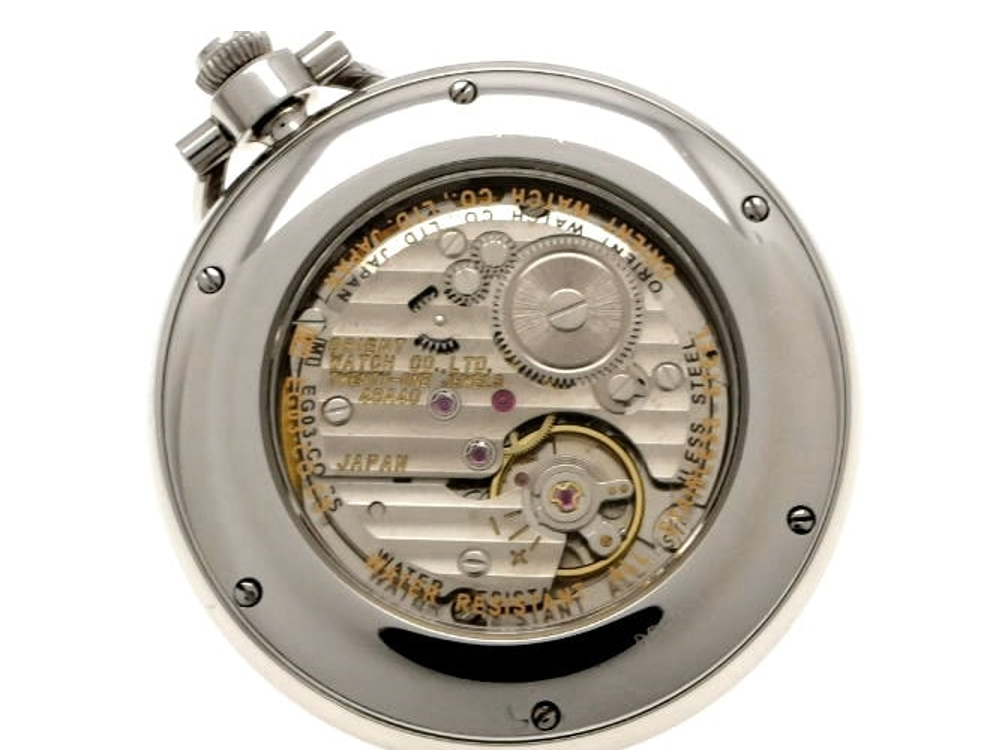
Again it took some time before Orient returned to making a pocket watch. Around 2002 the brand released Orient Star Royal reference WZ0041EG, a truly fine piece in the brand's highest standards of watchmaking at the time. Hand-wound caliber 48A40 ensured an accuracy of +10,-5 seconds per day and 50 hours of power reserve.


A few years had passed and Orient Star Royal became "Royal Orient". Some of the older models were discontinued, but the pocket piece was among the lucky few to get rebranded, and so – we got reference WE0041EG, essentially the same watch but arguably carrying the nicer logo.

Note that these models, despite being of a much higher quality (and price point) than their quartz predecessors, were only produced in Stainless Steel – and I feel the subtle elegance of these was indeed much better suited for the pocket watch concept than the gold paint of the quartz.


Orient's last batch of pocket watches was produced in the early 2010s. These weren't Royal or Star but "regular" models, yet they were quite nicely designed and made. These included WV0011DD and WV0031DD pictured above, and WV0021DD shown below.

The earlier references with Arabic numerals were introduced in 2010, and made use of the then-new caliber 48C40, a downgraded version of the Royal 48A40, having simpler decoration and reduced accuracy of +25/-15 seconds per day. The last version, having the Roman numerals, was added in 2013. That was Orient's last pocket watch, at least for now.


Photos were taken from old Orient catalogs and sale ads, except the "celebrities" photo taken from GQ magazine.

Sunday, 16 March 2025

Orient’s Light-Powered Watches


Orient is best known for its mechanical watches, but the brand has been making solar-powered quartz watches for decades. And with the recent releases of the Solar Mako 40 and Solar Bambino, plus our recent look at the iO collection, which is predominantly solar-powered, now is the perfect time to explore how Orient has been using the power of light to keep time.

The story of Orient’s solar watches begins in 1976, when the brand introduced its first light-powered watch – an LED digital model equipped with a built-in solar cell. This was a time when several Japanese manufacturers were experimenting with solar technology, and Orient was among the early adopters, alongside Citizen and Seiko. However, unlike Citizen, which would go on to make solar technology a defining part of its identity, Orient treated solar watches as an occasional complement to its lineup rather than a central focus.


With time solar technology has evolved, allowing watchmakers to hide the solar cells beneath the dial rather than displaying them as obvious panels. This has enabled Orient and others to incorporate solar movements into more sensible watch designs. Another key trend was the shift from digital solar watches to mostly analog ones.

Through the 1980s and 1990s, Orient produced numerous solar-powered quartz models, though most were limited to the Japanese domestic market. Some of these were released under the “Light Power” series, covering a variety of styles from dress watches to sports models. One particularly interesting example from this period was a solar-powered dive watch, providing a no-maintenance solution for those who wanted a reliable tool watch without the need for battery changes.


Later, in the 2000s, Orient added the solar Neo 70s models, now available with its RR700 radio-controlled movement. I like the Neo 70s design so I think I'll dedicate a separate article to those… and more recently, we saw the introduction of a "Mako Chronograph" featuring Orient's VS752 light powered movement.

While many of the earlier solar watches featured unique designs, in recent years Orient began incorporating solar technology into their mainstream models, keeping the aesthetics unchanged while adding what many would see as modern convenience. This kind of reminds me how early electric vehicles all tried to resemble a streamlined Prius shape, while later models began to just look like "normal" cars.


The first major step in this direction came with the Mako 40, a mechanical dive watch that was recently reintroduced in a solar-powered quartz version. The Solar Mako 40 maintains the look and feel of its automatic predecessor but now runs on Orient’s VS422 solar quartz movement, offering a 12-month power reserve on full charge. With 200 meters of water resistance, a sapphire crystal, and the same classic case design that made the mechanical Mako 40 so popular, this new model gives buyers a set-it-and-forget-it option that never needs winding and will not require battery replacements until some distant future.

Shortly after the Solar Mako 40 came another surprise – the Solar Bambino, a light-powered version of Orient’s most famous dress watch. Long considered one of the best entry-level automatic watches, the Bambino has always been known for its clean, classic design and its appeal to first-time mechanical watch buyers. The new solar-powered Bambino, released in six variations, keeps the familiar 38.4mm case and V2 dial design, but replaces the automatic movement with a solar quartz no-date caliber VS213, capable of running for six months on a full charge. Both this and the Mako's caliber offer an accuracy of +/- 20 seconds per month


With these recent releases, Orient’s solar watches do not lag far behind Seiko’s Solar and Citizen’s Eco-Drive offerings. Performance-wise, modern Orient solar movements have 6 to 12 months of power reserve, can charge under both sunlight and indoor light, and maintain accuracy within ±20 seconds per month. However, Citizen still leads in solar innovation, with some of its Eco-Drive models storing power for years in total darkness, and its higher-end models offering premium features like extreme accuracy and extra thinness.

Orient’s strength, as always, lies in value for money. And Orient’s solar lineup is steadily growing, suggesting that the brand is committed to expanding its offerings.


All photos in this story were taken from old Orient publications and sale ads.

Wednesday, 25 September 2024

New Orient Bambinos and Solar Makos


Orient has announced a few new watches today, expanding its range of solar models and adding more members to the Bambino 38 family.


Solar Powered Mako

It appears as though Orient has put more emphasis on solar-powered models recently. It makes sense that many buyers of watches in the lower end of the price range are looking to get more practicality for their money, and a decent solar powered movement can deliver just that, with both quartz accuracy and not having to replace batteries often.

So, with this in mind, Orient are presenting a bunch of watches combining their "diver design" (aka Mako) with their solar movement. This movement features a -20/+20 seconds per month accuracy, and about 12 months of power reserve on full charge.

Five references are being presented – of which four are in global distribution:

·         RA-WJ0001E (RN-WJ0001E in Japan) with a green dial

·         RA-WJ0002L (RN-WJ0002L) with a blue dial

·         RA-WJ0003S (RN-WJ0003S) with an ivory dial

·         RA-WJ0004Y (RN-WJ0004Y) with a brown dial

·         RN-WJ0005L (Japan only model) with a light-blue dial


Interestingly, these new models combine the case size of the Mako 40 with the dial design – including markers and hands – of the more classic Mako II (42 mm). Like their mechanical siblings, the solar versions feature a sapphire crystal, screw-down crown, and 200m water resistance. They are about 10% cheaper than the mechanical Mako 42 (which itself costs a little less than the Mako 40).


Bambino 38

Orient have also just added a couple of new references of the Bambino 38mm model, which now has more color options than the original Bambino case.

Five references are being presented – of which four are in global distribution:

·         RA-AC0M14L (RN-AC0M14L in Japan) with a light-blue dial, limited to 6,500 pieces (of which 50 are in Japan)

·         RA-AC0M15Y (RN-AC0M15Y in Japan) with a copper-colored dial, limited to 2,500 (of which 50 are in Japan)

Both models are bundled with a leather strap, and are generally similar to the existing models in the Bambino 38 range.


Wednesday, 21 August 2024

Orient's August 2024 Releases


After a mostly quiet summer, Orient are now releasing a bunch of new models – a few Bambinos ("Classic and Simple" as they like to call it), and some solar chronographs. Let's see what's new.


Bambino 38 On a Bracelet

First, let's look at the new Bambinos. These are variants of the 38mm model, and for the first time – we're getting the Bambino 38 on a steel bracelet.


The new bracelet seems humble but nice enough – classic and simple indeed. It definitely adds a bit of sportiness to this generally dressy watch. Having a 20mm lug width, one can always swap the bracelet for any sort of leather strap, especially with such colorful dials, but having a properly fitted steel bracelet is a great option.

We're getting three new references in this series:

·         RA-AC0M09E with a dark, "grass green" dial;

·         RA-AC0M10L with a blue (but also a bit lavender-purple, from the pictures) dial;

·         RA-AC0M11Y with what Orient refer to as "copper" dial. They do try to avoid using the term "salmon"…


All dial versions are sunburst and quite pretty. These are not overly versatile shades, but given the entry-level pricing of Bambinos, it is not inconceivable that one might wish to add 2-3 of these watches, in different colors, to their collection.

Like the previously released Bambino 38, these are all 38.4mm wide cases, 44mm lug to lug, 12.5mm thick, and powered by Orient's automatic caliber F6724. The crystal is mineral and water resistance is 3 bar.


Solar Chronographs

Orient are expanding their range of solar chronograph watches with nine new references. Six of these are added the brand's "Contemporary" collection, characterized by the sharp case shape.


The new watches are all different variations of the "panda" theme, with black sub-dials over various main dial colors.

·         RA-TX0301G has a gold color plated case with a champagne dial;

·         RA-TX0302S is a two-tone style watch, and a white dial;

·         RA-TX0303L has a steel case with navy-blue dial;

·         RA-TX0304L has a light blue dial;

·         RA-TX0305S is classic panda, with a white dial;

·         RA-TX0306S is the only model coming on a leather strap, with golden bezel and hands over a white dial.


The solar chronographs are powered by an Orient quartz movement, with power reserve said to last up to 6 months on full charge. The watch have a 40mm wide case that is 48.2 mm long lug to lug, and 11.1mm thick. The crystal is sapphire, and water resistance is 5 bar.

In addition, Orient also introduce three new solar chronographs in its "Diver Style" collection (aka "Mako"). While technically similar to the Contemporary models, these look and wear quite differently.


·         RA-TX0206L has a light blue dial, and black diver's bezel;

·         RA-TX0207R has a red dial and black bezel;

·         RA-TX0208L is the limited (3000 pieces) edition, dedicated to the Mako's 20th anniversary, with a dark blue gradation dial and a black-and-blue bezel.

The Mako-style chronographs are 42.8mm wide, 48.1mm lug to lug, and 13.1mm thick. With a sapphire crystal and a screw-down crown, they have a 20 bar (200m) water resistance.

Prices for all August releases have not yet been disclosed.


Sunday, 14 July 2024

Roundup of Orient Brazil Releases


Many Orient fans are fond of the brand's Latin offspring, Orient Brazil, despite (or maybe because of) how difficult its models are to obtain outside its home market. It has been a while since I last covered the Brazilian products, so – let's do a little roundup of what is currently on offer from that watchmaker.

Following are just a few standout items, that caught my attention, out of the brand's many watches.

First, a recent release in the Flytech line, a family of pilot watches and flight-inspired designs. Much of the Flytech line-up is quartz, but this – reference F49PP033 – is an automatic, a limited edition of 500 pieces.

Like many Orient Brazil watches, this one is fairly large, measuring 44mm in diameter. However, having a lugless titanium case and rubber band, it should be quite comfortable. There's also an inner rotating bezel, sapphire crystal, and 100m of water resistance, making it a pretty robust and functional watch. Costing the equivalent of roughly $400 USD, this is excellent value for money.

I noticed this quartz chronograph in one of the brand's ads, and I thought it was kind of funny: if you want a reasonably sized man's watch in Orient Brazil's range, go for a women's model. However, this one is still fairly large at 43mm, and with the steel case it's probably heavier than that flytech piece. In fact, on the website it is classified as a man's watch. So why did the ad present it differently?

Well, honestly it doesn't matter. You can call it a unisex model. Some of the colors (like the blue-grey ref. FTSPM004) are perfectly fitting for either gender. It looks good, fashionable, and costs only about $150 USD.


The brand has got many unmistakably feminine models too. One of these is this stylish 34mm model featuring a simple dial that's enhanced by the faceted mineral glass. I think the designer has done a good job here.

50m water resistance is considered pretty decent for this type of watch, compared with the more common 30m rating, price is in the $100 USD range, so that is a compelling package.

It appears as though Orient Brazil are also putting more effort into its solar-charged watch range, compared to the fairly minimal solar range by the Japanese parent company. Take, for instance, this really nice-looking diver, ref. MBSS1471 (same for both colors, curiously).

It's big and bulky with a 47mm wide steel case, features a nicely textured dial and 200m water resistance. At around $180, it is an interesting option for anyone looking for a quartz diver-style watch, and is quite unlike anything on the Japanese range.

A different type of solar watch is this family of elegant chronographs. They are more reasonably sized at 42mm, feature a nicely curved mineral crystal, and are very different from the brand's more masculine sports watches.

Once again Orient Brazil is making references a rather obscure thing, as both blue and grey models on the bracelet are ref. MBSSC265 while the one on leather is different (MTSCC050). Anyway the all cost about the same, around $220 USD.

Another solar model that I really liked is this digital-analog watch. Orient Japan used to have these, but do not produce any at the moment. Orient Brazil have numerous ana-digi options, but this one I think stands out with its sleek design.

At around $220 you're getting a 42mm case, and very retro look somewhat reminiscent of Seiko's "recraft" range. I particularly like this green-dial reference GTSPA001.

Here's a nice quartz (regular, not solar) model that caught my attention. Like some of the other quartz pieces in the brand's catalog, it walks a fine line between "fashion watch" design and true brand DNA, but at least in the brand's advertising pictures, the end result seems quite attractive.

The watch case is 44mm of steel, it's rated to 100m water resistance, and at under $100, it presents a cool offering with its chunky design and interesting dial/hands combination. You get reference MBSS1486 with the dark grey dial, ref. MBSS1473 with a blue dial, and – if you really want to go overboard with this – the gold-plated MGSS1272 for an additional $40 or so.

Still not impressed? Well, maybe this will do it: Orient Brazil also has an XL line, for those who find 47mm watches puny. For instance, check out this 52mm beast featuring a chronograph and three time-zone displays. If you get stranded in the jungle and need rescue, this watch can also serve as a helicopter pad.

Why do I like this? Maybe because it reminds me of Orient's classic Mechatrenics. Anyway, you can choose your helipad colors, with such options as the all-white ref. MBSCT005, all-black MPSCT004, or others. At a little over $270, this is a great price per m².

The Tristar range has, for decades, been a go-to product line for customer seeking a simple yet reliable watch at decent price. While unfortunately, it is now gone from Orient Japan's catalog, Orient Brazil still has a range of tristar-badged watches.

The one Tristar model I liked in particular was this barrel-cased series, a shape sadly also missing in Japanese production nowadays, and I have to admit to particularly eyeing the golden one (ref. F49GG030). The watch has a modest 40mm wide case and a cool retro look (not unlike that ana-digi model discussed above). Costing between $200 (steel) - $220 (gold plated), this is a lovely design and, assuming the brand's usually good build quality, value for money worthy of the Tristar moniker.

Wrapping up this review is the skeleton watch. While Orient Japan now only offers skeleton watches under the Orient Star brand, starting at over $1,500 USD for any of the new models, this here will set you back a mere 300 – 350 USD.

Indeed it's not as impressive as any of the Orient Star watches, but still: a 42mm case with a Japanese automatic movement from the Epson group, visible from the front in raw metal color (reference NH7SS004), gold toned (ref. NH7SS005 or NH7SS006) or black IP plated (NH7YY001).


All pictures are taken from the Orient Brazil website and advertisements