Orient Place

Orient Place
Showing posts with label Three Star. Show all posts

Sunday, 2 August 2026

Eastern Arabic Numerals on Orient Dials


In watch terminology, an “Arabic numeral dial” normally means a dial using familiar numbers such as 1, 2, 3, and 4, as opposed to Roman numerals or simple hour markers. However, this common description creates a certain irony: the numerals most watch collectors call Arabic are not necessarily the ones they would encounter on signs, documents, and clocks in much of the Arabic-speaking world.

The symbols ٠ ١ ٢ ٣ ٤ ٥ ٦ ٧ ٨ ٩ are generally known in English as Eastern Arabic numerals or Arabic-Indic numerals. Their familiar Western equivalents are 0 1 2 3 4 5 6 7 8 9. Both belong to the broader Hindu-Arabic numeral system, which originated in India and was developed and transmitted through the Islamic world before reaching Europe.

The term “Eastern” is important because the numerals are not used uniformly across every Arabic-speaking country. They remain common in the Arabian Peninsula and the eastern Arab world, while Western numerals are widely used in parts of North Africa and are also frequently seen alongside Eastern numerals elsewhere. There is also a related Persian form, in which some of the characters differ slightly. A watch described simply as having an “Arabic dial” may therefore require a closer look at exactly which numeral style it uses.


On a watch dial, Eastern Arabic numerals offer more than a change of language. Their rounded and flowing forms give a familiar watch design a noticeably different character. Depending on the typeface, they can appear highly traditional, almost calligraphic, or surprisingly modern. Even collectors who do not read Arabic can usually learn to recognize them quickly, since their position around the dial provides an immediate reference.

Such dials are often associated with watches made for the Middle Eastern market. Rolex is probably the best-known historical example. The company produced watches with Arabic-language day and date displays and Eastern Arabic hour numerals for prominent customers and regional markets decades ago, particularly within the Day-Date collection. Modern Eastern Arabic numeral Rolex models have helped renew international collector interest in the style, although the idea itself is far older than the current fashion surrounding them.

Part of their appeal comes from rarity. In many cases, an Eastern Arabic dial was offered only through particular distributors, in certain countries, or as part of a small regional edition. This can turn an otherwise familiar watch into a much less common variation. At the same time, the numerals should not be treated merely as an exotic design theme. For many buyers, they are simply the natural local way of displaying numbers.


All this information comes to mind following a recent batch of Eastern-Arabic versions of the Bambino, which popped up on Orient USA website (but not on the international / Japanese site). I can only assume these are also available on certain local distributors in the Middle East.

The watches released include reference RA-AC0035E with a green dial and golden markers and hands, ref. RA-AC0036L with a blue dial, RA-AC0037R with a red dial, RA-AC0038S with a white dial and gold-colored markers and hands, and reference RA-AC0039Y with an ivory dial.

Mechanically, they are identical to standard 40.5mm Bambinos and use the same F6724 movement. Hence, the date wheel still features standard "western" numbers, which is not surprising, although it would have been nice if the dates were also printed using Eastern Arabic digits.


Older appearances of Eastern Arabic numerals on Orient dials are quite rare – ignoring, of course, various cheap re-dialed watches you can find online. However, a number of Tristar models with Arabic dials do exist, and interestingly, those watches, which feature a day-of-week disc as well, were sold with the days written in Arabic.

Eastern Arabic numeral dials have never been a major part of Orient's catalog, making releases like these all the more interesting. Together with the earlier Arabic Tristars, they show that while uncommon, the style is by no means new to the brand. Hopefully, this won't be the last time Orient revisits it – perhaps next time even extending the treatment to the date and day displays for a truly complete Arabic dial.


Photos were taken from various current and old Orient publications and sale ads.


Sunday, 31 August 2025

Orient Brazil Roundup #2


Last year I posted a round-up of watches released by Orient of Brazil, so I thought: why not make this a habit? These South American people make some nice models. So here goes Brazil Roundup #2: Return of the Big Watch! Orient Brazil have been known for producing some seriously hefty wrist-beasts, and while some of the watches below are quite normally-sized, lovers of generously sized cases are not going to be disappointed.


Divers

Actually, why not get this one out of our way right now. It's another one the brand's famed 300m divers, the sort that Orient Japan seems to have deserted in recent years…


Yes, the alpha-male of the pack measures 48.4mm across its case, with a big heavy-looking steel bracelet to match. You can get it with either a black dial, blue or green. I like the blue, which gives it a slightly lighter impression.

As watches go, this does not make a very subtle statement. With its mineral glass and rough lines it is unrefined, but at under 400 USD, why wouldn't it be? It will not doubt get the job done.


If you are looking for a bit more finesse, and willing to settle for 200m of water resistance, here is a nice option. Measuring "only" 44mm in width, and featuring a very Orient-ish dial with an open heart, power reserve, and 24 hour sub-dial, this one costs roughly 50% more than the aforementioned monster. But it does come with a sapphire crystal and a ceramic bezel, and you can get it in blue, black, green and grey.

Alternatively, positioned somewhere in between in terms of price and features, is this blackened 200m tri-star diver, which you can also get in non-plated steel, but why would you? It is only 43.5mm wide, but it compensates for its tiny size with its bold orange highlights and textured dial.


Tristar Models

Orient tri-star watches are generally a good VFM deal, offering attractive designs with reliable automatic movements and decent quality, and usually costing less than the diver above. The three examples below are well under 300 USD.


Here, for instance, is a properly good looking watch, combining some classic pilot details with modern touches. Reasonably sized for a sports watch at 42mm, it's equipped with sapphire crystal and a stylish leather strap. The brand offers some other pilot-watches with different dial designs, but I like the clean contemporary look of this one.

Or take the next one: a solid, versatile design for daily wear in a convenient 40mm case (yes, you'll notice every model on this blog post is smaller than the one before…). Like the pilot one it's resistant to 100m and has sapphire crystal, has the day and date, and generally everything you'll want from a watch at this price. This model comes with either a white or beige dial.


The last tristar for today (although there's plenty more from the brand) is a little different. Case size is 42mm, water resistance only 50m, crystal is mineral; and if I am not mistaken, Orient Brazil references starting with NH indicate the use of Seiko movements, probably NH36 in this case.

In fact, it remind me very much of a Seiko Recraft I used to own, also having a very three-dimensional green dial with gold colored markers (that one used 7S26, the predecessor of the NH36).


Quartz

Wrapping up today's list is one for those who favor the accuracy of quartz movements – particularly the convenience of solar-powered one. For under 200 USD you can get this cool, vintage-inspired chronograph.

Yes, it is also mineral crystal, and only 50m water resistant, and I believe the bracelet is very basic. But still, it looks good, and I'm sure would be very satisfactory after swapping the stock bracelet for a nice, sporty leather band.


There's plenty more watches from Orient Brazil, these are only a few items I liked. Follow the blog for more from this faraway but never forgotten branch of the brand…


All pictures are taken from the Orient Brazil website and advertisements 


Sunday, 14 July 2024

Roundup of Orient Brazil Releases


Many Orient fans are fond of the brand's Latin offspring, Orient Brazil, despite (or maybe because of) how difficult its models are to obtain outside its home market. It has been a while since I last covered the Brazilian products, so – let's do a little roundup of what is currently on offer from that watchmaker.

Following are just a few standout items, that caught my attention, out of the brand's many watches.

First, a recent release in the Flytech line, a family of pilot watches and flight-inspired designs. Much of the Flytech line-up is quartz, but this – reference F49PP033 – is an automatic, a limited edition of 500 pieces.

Like many Orient Brazil watches, this one is fairly large, measuring 44mm in diameter. However, having a lugless titanium case and rubber band, it should be quite comfortable. There's also an inner rotating bezel, sapphire crystal, and 100m of water resistance, making it a pretty robust and functional watch. Costing the equivalent of roughly $400 USD, this is excellent value for money.

I noticed this quartz chronograph in one of the brand's ads, and I thought it was kind of funny: if you want a reasonably sized man's watch in Orient Brazil's range, go for a women's model. However, this one is still fairly large at 43mm, and with the steel case it's probably heavier than that flytech piece. In fact, on the website it is classified as a man's watch. So why did the ad present it differently?

Well, honestly it doesn't matter. You can call it a unisex model. Some of the colors (like the blue-grey ref. FTSPM004) are perfectly fitting for either gender. It looks good, fashionable, and costs only about $150 USD.


The brand has got many unmistakably feminine models too. One of these is this stylish 34mm model featuring a simple dial that's enhanced by the faceted mineral glass. I think the designer has done a good job here.

50m water resistance is considered pretty decent for this type of watch, compared with the more common 30m rating, price is in the $100 USD range, so that is a compelling package.

It appears as though Orient Brazil are also putting more effort into its solar-charged watch range, compared to the fairly minimal solar range by the Japanese parent company. Take, for instance, this really nice-looking diver, ref. MBSS1471 (same for both colors, curiously).

It's big and bulky with a 47mm wide steel case, features a nicely textured dial and 200m water resistance. At around $180, it is an interesting option for anyone looking for a quartz diver-style watch, and is quite unlike anything on the Japanese range.

A different type of solar watch is this family of elegant chronographs. They are more reasonably sized at 42mm, feature a nicely curved mineral crystal, and are very different from the brand's more masculine sports watches.

Once again Orient Brazil is making references a rather obscure thing, as both blue and grey models on the bracelet are ref. MBSSC265 while the one on leather is different (MTSCC050). Anyway the all cost about the same, around $220 USD.

Another solar model that I really liked is this digital-analog watch. Orient Japan used to have these, but do not produce any at the moment. Orient Brazil have numerous ana-digi options, but this one I think stands out with its sleek design.

At around $220 you're getting a 42mm case, and very retro look somewhat reminiscent of Seiko's "recraft" range. I particularly like this green-dial reference GTSPA001.

Here's a nice quartz (regular, not solar) model that caught my attention. Like some of the other quartz pieces in the brand's catalog, it walks a fine line between "fashion watch" design and true brand DNA, but at least in the brand's advertising pictures, the end result seems quite attractive.

The watch case is 44mm of steel, it's rated to 100m water resistance, and at under $100, it presents a cool offering with its chunky design and interesting dial/hands combination. You get reference MBSS1486 with the dark grey dial, ref. MBSS1473 with a blue dial, and – if you really want to go overboard with this – the gold-plated MGSS1272 for an additional $40 or so.

Still not impressed? Well, maybe this will do it: Orient Brazil also has an XL line, for those who find 47mm watches puny. For instance, check out this 52mm beast featuring a chronograph and three time-zone displays. If you get stranded in the jungle and need rescue, this watch can also serve as a helicopter pad.

Why do I like this? Maybe because it reminds me of Orient's classic Mechatrenics. Anyway, you can choose your helipad colors, with such options as the all-white ref. MBSCT005, all-black MPSCT004, or others. At a little over $270, this is a great price per m².

The Tristar range has, for decades, been a go-to product line for customer seeking a simple yet reliable watch at decent price. While unfortunately, it is now gone from Orient Japan's catalog, Orient Brazil still has a range of tristar-badged watches.

The one Tristar model I liked in particular was this barrel-cased series, a shape sadly also missing in Japanese production nowadays, and I have to admit to particularly eyeing the golden one (ref. F49GG030). The watch has a modest 40mm wide case and a cool retro look (not unlike that ana-digi model discussed above). Costing between $200 (steel) - $220 (gold plated), this is a lovely design and, assuming the brand's usually good build quality, value for money worthy of the Tristar moniker.

Wrapping up this review is the skeleton watch. While Orient Japan now only offers skeleton watches under the Orient Star brand, starting at over $1,500 USD for any of the new models, this here will set you back a mere 300 – 350 USD.

Indeed it's not as impressive as any of the Orient Star watches, but still: a 42mm case with a Japanese automatic movement from the Epson group, visible from the front in raw metal color (reference NH7SS004), gold toned (ref. NH7SS005 or NH7SS006) or black IP plated (NH7YY001).


All pictures are taken from the Orient Brazil website and advertisements 

Thursday, 2 November 2023

The Weekly Auto Orient AAA


This will not be the first "AAA" covered on the blog. I've already posted a story about the Orient AAA Deluxe a while back. This time though, I felt like going for something more classic-looking, and whereas that DXO was quite distinctively Japanese, the model I'm looking at now is clearly influenced by Swiss designs.

More specifically – the influence of the Rolex Day-Date. That iconic watch – the first to display the full day of the week along with the date – was introduced in 1956, and by the mid-1960s when this AAA was produced, its design had already become an object of admiration and source of inspiration for watch designers worldwide.


This AAA, while clearly not a "replica" and having a fairly distinct and more simple-looking dial, displays such clear day-date elements, like the fluted bezel, cyclops, and of course – the combined day and date display.

At the time Orient released numerous versions of the Weekly Auto, differing in jewel count (generally ranging between 19-25, with some rare models going as high as 30) and in their dial layout – with a few featuring the arched day window (like the Rolex) while others having a rectangular window.

This particular piece I'm holding is the 21 jewel, rectangular day type. I do like that it's quite different from my other Weekly Auto (which is the King Diver with the arched window) and as mentioned, also different from my other AAA.


The hands on this watch seem a bit short, as both minute and second hands do not reach the hours markers. I was wondering if the hands were possibly replaced at some point; however, I did see numerous photos of weekly auto's with a similar set of hands (as well as variants with longer hands). So possibly this is original. 

Also, while lumed hands often got replaced when the paint degraded, these watches generally had simple metal hands with no paint, so hands rarely needed a change. And this watch is generally in excellent condition – the case is nicely kept, the dial is clean and the crystal and cyclops without any visible scratches – so the hands should not have been damaged.


Indeed upon close inspection one can appreciate the nicely brushed dial, well-polished markers and aperture frames. While lacking the more intricate design elements of the Deluxe (like more elaborate marker design and matching hands), it's still a handsome watch.

The fluted bezel was first used by Rolex on their cushion-case Oyster in 1926, but it received its familiar iconic shape when it got attached to the round case of the Datejust in 1945. It adds sparkle and elegance to the watch, even if it is not made of gold…  


The cyclops too was a Rolex novelty, just another one of their numerous inventions in the prolific 1950s. What is it about this little extra piece of crystal that goes so well with fluted bezels, I don't know. Perhaps we just got used to this combination so much. Anyway it's a nice addition. It's hard to estimate its magnification here, but it helps to read the date. As for the weekday, you'll have to wear your glasses.

Then there's the beads of rice bracelet, another key component of this model's style, though not actually a day-date thing; while Rolex did use some BoR bracelets in the 1940s, it later adopted its self-designed Jubilee bracelet instead. BoR did remain a favorite of other top-tier brands looking for an elegant alternative to Milanese bracelets.

The BoR bracelet here (Orient's original) is of the quite common 7-link type, with the broad outer links. It is a very comfortable bracelet, and visually makes a perfect match for the bezel. Quality is more than adequate and it does not pull any hair.


Let's look at dimensions. The case width is 38mm without the crown, and lug to lug it is 45mm. That's a perfect size of a dress watch even by today's standards. It's also larger than older Weekly Auto AAAs that had a 37mm wide, 43mm long case. And maybe that even holds an explanation to the short hands.

All in all, a very nice watch. In typical Orient manner (and indeed like other Japanese brands), the brand paid homage to a design that became popular in Europe a few years earlier, but while doing so it added some of its own distinctive styling. Despite all Rolex elements, the dial is still very "Orient" with the logo, AAA and tristar symbol, and of course – the push-button for changing the date.


Prices for Weekly Auto AAAs today generally go between 200 to 400 USD, depending on condition. A watch in good condition, with clean dial, original crystal with cyclops, and original bracelet, would probably go for closer to the upper end of the range.


Monday, 14 August 2023

Orient Brazil Celebrates 50 Years With New Model


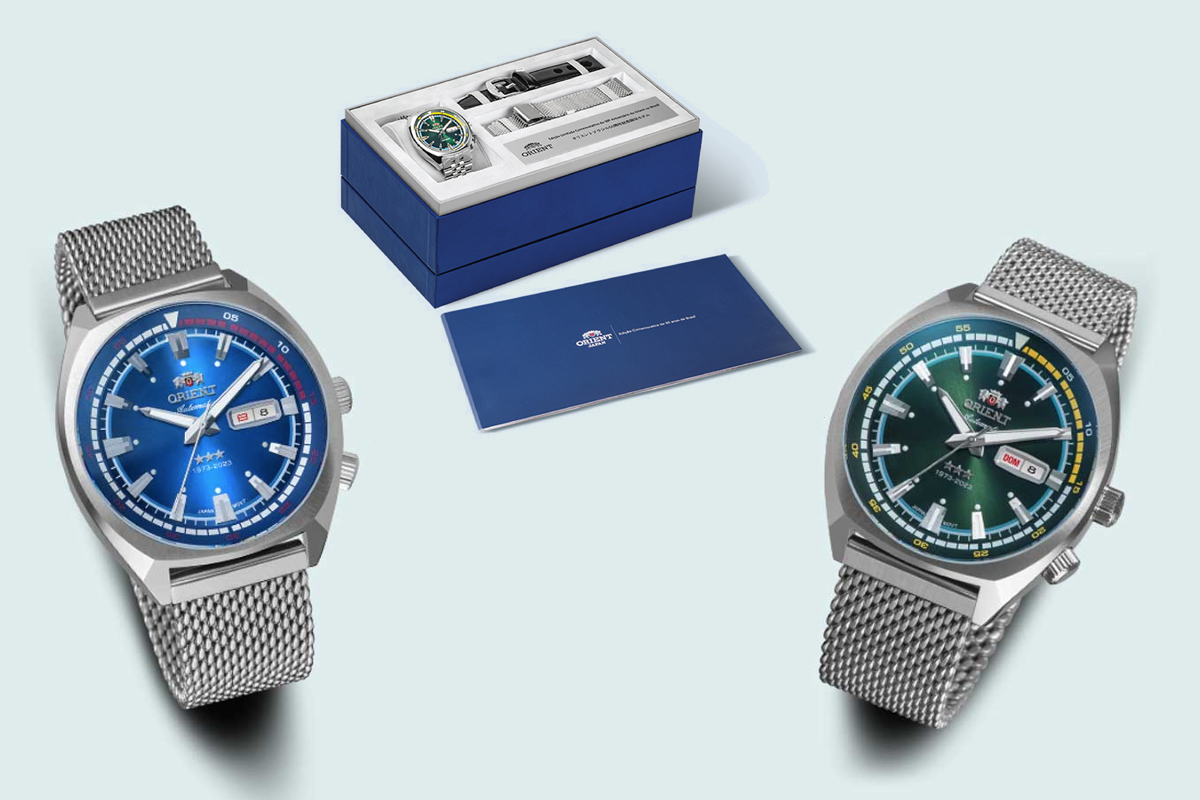
Orient Brazil is celebrating 50 years since its transformation from an independent local importer to an Orient company (although local manufacturing began five years later). To commemorate the event, the company has just released a special model which goes by the sexy name "F49SS029".

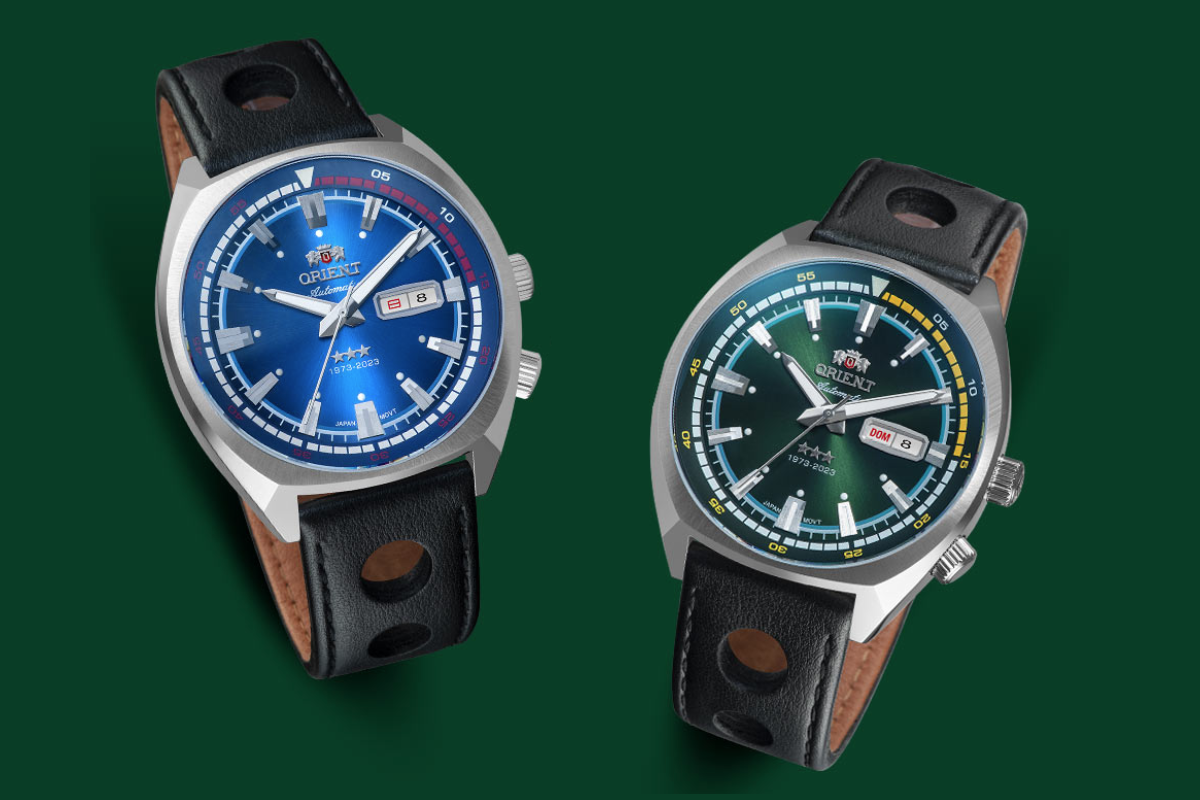
While the Brazilian watchmaker's product lines do not always follow its Japanese origins, the new release has proper Orient DNA. Its shape is classic Orient, with the bulky case, colorful dial, tristar symbol, rotating inner bezel, and two crowns.

The movement is Orient's good old F4902. It is almost identical to the caliber 46943, except that the day and date can both be changed from the crown in 2nd position (instead of using a button). Like the 469 this movement is automatic, with about 40 hours of power reserve, and does not offer hand-winding or hacking.


The new watch has two versions, each in limited numbers, and the numbering actually tells a story: watches numbered 1-972 are the "Japan" version, having a blue dial with some red markers; while those numbered 973-2023, 1973-2023 being the years now celebrated, are the "Brazil" version. Of course, the Brazilian website does not forget to mention blue and green are their countries' respective football team uniforms.

The watches measure 44mm wide and 50mm lug to lug, making them slightly larger than the similar offerings from Orient Japan such as the Neo Classic Sport and World Diver Reissue. Front crystal is sapphire, and the case-back is decorated with a golden medallion in true vintage style.

Orient Brazil often provides its watches with generous packaging and this one is no exception, as the box includes a set of three straps: a sporty leather strap, steel mesh and – very thoughtfully – a jubilee-style bracelet: after all, this is a jubilee being celebrated!

The watches currently sell (in Brazil only, as always) for around $2700 Real, which is close to 550 USD. Pretty decent value, if you can get your hands on one.


Sunday, 11 December 2022

Orient's Direct-Read Watches

When one looks for unconventional watch designs, one usually need look no further than Orient. Historically, "Jump Hour" watches provided a cool alternative to the standard hour-hand, minute-hand setup – and Direct Read provided a simpler substitute to Jump Hour movements.

Before continuing, it might be worthwhile to clarify the distinction: while both types of display show the hours and minutes using rotating discs with digits printed on them, Jump Hour keeps the hour indication more or less immobile until the minute disc returns to zero and pushes the hour forward. With Direct Read, the hour wheel just keeps turning, in the same way as the hour hand would normally.

While a Jump Hour mechanism is easier to read, as the hour is steady, and more akin to digital displays, Direct Read watches are simpler to build, since they just use regular movements and replace hands with discs. Orient typically leans toward simpler movements, at least in non-Star models – so when looking to provide a "mechanical digital" design, sometime in the mid-2000s, it adopted the Direct Read approach.


Reading this display is, well, fairly direct and simple – though it requires some getting used to. In the picture above, for instance, the time is about 10:08:36. You can see the thin red horizontal line pointing between 5 and 10 on the inner circle; look more closely and it's just past the 8. Those are the minutes. The thicker red line you see is actually the second hand.

It's funny as this would be the time you'd normally see a watch in Orient catalogs – with the hands arranged in the "smiley" configuration. Of course it's quite meaningless when no hands are involved…

The date wheel is standard, appearing here as the outermost disc. The date is read as usual through the small window at the bottom.

During the roughly ten years of producing direct read watches, Orient made three main models, each having numerous versions differing mainly in colors and choice of strap/bracelet. All of them have been discontinued a few years ago.


The most familiar model, and the one that's easier to find online nowadays, is the lugless design also known as the "Orbit" (a nickname given to it by Orient USA I believe).

The Orbit's case was 35mm wide and 40mm long, and 12mm thick. Fairly modest dimensions that were given enhanced wrist presence by its 28mm lug width, fitted out of the box with a double-hole strap that did not taper too much.

Inside the Orbit was Orient's caliber 48743, a reliable and robust movement that had no problem turning those discs around. Cal. 487 variants are typically identified in Orient's references as "ER". When searching the web for this model, you could look for codes including "ERAM" or "ERAK", as well as "Orbit".


The same movement was placed in a more conventional case to produce the "Masquerade". It had considerably larger dimensions – 35.5mm width, 47mm lug to lug, and 13.5mm thickness. The strap was narrower than the Orbit's though, at 25mm, enabling a single-hole structure.

When searching the web for this model, you could look for codes including "ERAP" or "Masquerade". Note that some sellers incorrectly refer to all Direct Read models by this name, so you might find some Orbits that pop up when looking for the Masquerade.

Another important note (that is, if you care about these things…) concerns the movement. Apparently, at some point, this model was mistakenly advertised as utilizing Orient's 46S50 movement, and this mistake was repeatedly copied onto various articles and publications. That is not true – 46S50, recognizable by having "FH" in the reference, was a completely different, no-date, small seconds caliber, used solely in semi-skeleton watches.


Orient also produced a smaller version of the lugless model, a "mini-Orbit" if you will, designated as a women's watch. This model looked almost identical to the larger Orbit, having similar proportions and dial layout. It was, however, only 28mm wide and 31mm long.

This model had a lug width of only 20mm – narrow enough to allow for wearing it on a bracelet. The watch was indeed offered having both a steel bracelet and a leather strap, similar to its bigger sibling.

Orient fitted the watch with its caliber 557, a smaller movement typically reserved for ladies' watches (and which, despite its age, is still being used in some current models). Cal. 557 has the same 40 hour power reserve as the larger caliber 487, however its accuracy is not so impressive at +40 / -30 seconds per day, compared to the 487's +25/-15.

Caliber 557 is identified by the letter "NR", and this model's reference would typically include NRAK. When searching or shopping for an Orbit, make sure you're looking at the right model – so you don't end up ordering a watch that's too small, or too big.

Prices for pre-owned Orient direct-read models typically range between USD 100-250. Personally I think paying up to USD 200 would be sensible, for a watch in mint condition.


Photos in this post were taken from various old Orient publications and sale ads.


Sunday, 20 March 2022

Three Points About Orient Tri Star

The Orient Tri-Star, or "3 Star" is among the brand's most familiar symbols, an icon of accessible mechanical watchmaking like Seiko's "5" and Citizen's "7". 

Much can be written about the Tri-Star, as it spans so many years and models. There's definitely enough history associated with it to provide content for a dozen articles or more. In this post though, I'll just touch on three (haha) points, possibly less known to new fans of Orient who only recently became acquainted with these watches.


The Three Stars Are Older Than The TriStar

The TriStar line dates to the early 1970s. While there is little information available pointing to the exact birthday of the collection, it was probably around 1971 or a little later, as the early TriStar models used Orient's caliber 469, born in 1971.

Upon its launch, Orient advertised that the three stars stand for three key principles of the collection: representing design, quality, and affordability.

The three-star logo, however, was being used by Orient years beforehand. As early as 1956, in fact, when one of the earliest Jupiter models was adorned with three stars – albeit organized in a triangle rather than lining up.


Later on, three stars in a line could have been observed on other Orients, like the 1967 World Diver. Now, this was far from being the most affordable of the brand's watches, clearly indicating the aforementioned three principles of the TriStar collection were an afterthought.


The TriStar Collection Is Really Diverse

When asked to think of a TriStar, many of us immediately imagine something similar to the sort of design picture below: a fairly small watch with lugs that sit flush on the case, simple dial and markers, and a date-and-day window.


In fact, there are many modern TriStar designs, some of which differ quite significantly from each other. What they do have in common, is that you got quite a lot of watchmaking for your money: a nice design that has its own identity and is decently executed, powered by workhorse movements that should keep ticking for many years.


TriStars Are Missing From Orient's Main Websites

If you were to look for current TriStar models on Orient's global or JDM websites, you would not find a single one.

The only model shown bearing the triple star logo is the "King Master Revival", which is the oldest of the re-issue models presented. Elsewhere, even the World Map Reissue had the original three stars removed.


Of course, TriStar models are still being produced. You can see them on websites such as Orient Watch USA and Orient India, which are run by local distributors, as well as on many retailers' and ecommerce websites.

And, Orient do offer support for TriStar models on their website – you can locate and download instruction manuals for these watches.

Apparently, the reasoning for this goes back to the original concept of offering TriStar models in markets looking for cheaper mechanical watches, and not in the brand's primary markets which, supposedly, are seeking higher-end products.

The fact of the matter is, in every country you will find people who love the simplicity and affordability of these watches, and are looking to buy new, used, and vintage TriStar models.


Pictures of the various watches that appear on this post were taken from Orient Watch USA advertising, Orient catalog and the 1999 Orient Watch Catalog book.

Sunday, 14 October 2018

Orient's 60th Anniversary Models


We all like to celebrate our anniversaries (until we start feeling too old, that is…) and so very often do watch brands. Orient, founded in 1950, celebrated its 60th anniversary in 2010 with a bunch of very cool limited edition pieces.

Among the models released were the cool "rock star" duo, the WV0361PM and its female counterpart – WV2371NQ, limited to 300 pieces each, and the Orient Star "Retro Future" ref. WZ0071DK – also limited to 300 pieces and fairly expensive.       


Then there was the impossibly hard to find, Royal Orient ref. WE0011DU, limited to only 12 pieces. More than just a unicorn, this is a legendary beast never seen in the wild. Other than its catalog photos, I have yet to see proper wrist shots of the WE0011DU. If you ever come across one, please share with me!


For my personal collection, I picked up the more classically elegant of the 60th anniversary releases – ref. WV0021DT. I think this might be one of Orient's nearest to perfection dress watches to date.


The watch features a 39mm case, boxed mineral crystal glass, and numerous design elements common with some of Orient's popular dress watches – albeit here in very pure form, blending a gold plated case and a finely textured silver dial.


This model does include two more unique elements, one more obvious – the other hidden inside. Immediately apparent is the use of a vintage version of the Orient logo; while I have nothing against Orient's current logo, I know many people dislike it, and there is no doubt that the logo on this edition looks classy and really matches its dressy nature well.


The second unique component is the hand winding movement Orient chose to use with this model. Orient does not often use hand-winding (i.e. no automatic winding) calibers in its modern pieces. In the last decade it had one such caliber that was being used with slight variations in a number of watches, most recently the "Monarch". However to the best of my knowledge all recent Orient hand-winders, such as the Monarch's caliber 48C40, were time only (plus power reserve) – whereas the 60th anniversary caliber 48N40 features the date as well.


A perfect dress watch then, suitable for celebrating the 60th anniversary of a brand well known for its dress watches. The ref. WV0021DT, and the non-gold-plated version WV0011DT, were each limited to 1,500 pieces – and can still be found occasionally on EBay and various online stores at mostly reasonable prices (500-600 USD) for used items, and higher if claimed little or no wear.


It is also worth mentioning, that with the abundance of models released by Orient in 2010 (both anniversary editions and other new releases), there was also one miscarriage, a model that was spoken of but never actually released: a 60th anniversary limited Orient Star Classic Retrograde. Who knows what this watch would have been like? Well, Orient, your 70th anniversary is just around the corner – you can still surprise us!

* All photos of the WV0021DT are mine; photos of other models featured above are taken from Orient's catalogs.