Orient Place

Orient Place
Showing posts with label Jupiter. Show all posts

Sunday, 30 April 2023

The Orient Star Dynamic and the T-Type Movement

A couple of months ago I wrote about the birth of Orient's T-S Type movement, and the "Hinomatic" watch built on it. Not long had passed since the 1955 launch of the Hinomatic, and in 1956 Orient introduced a new caliber, the T-Type, which would soon replace the T-S.

The T-Type, too, did not last a long time in production before it was replaced by the N-Type movement, in 1958. However, during its short life it provided the basis for numerous important models and new designs, some of which were later revisited in watches using newer calibers.
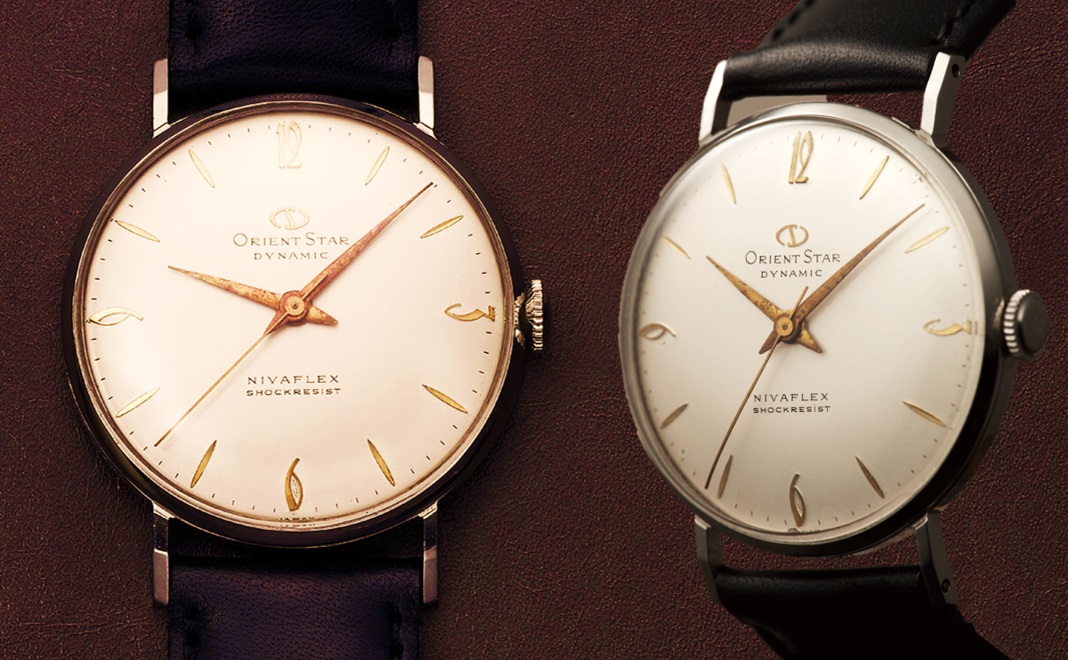

The first and most notable – and popular – model was the Orient Star Dynamic. The Dynamic started life as a fairly standard-looking watch, not much different in appearance from the Hinomatic it replaced.

Having similar looks and a movement that was, in essence, very similar to the T-S, one could be fooled into thinking this was little more than a minor update to the running production line.


However, between 1957 and 1958, at which time the Dynamic line concluded, plenty of fresh and innovative designs emerged.

At first, Orient were to play with some fancier dial designs. These also presented a more modern dress-watch style, suitable to the end of the 1950s – as opposed to the Hinomatic's very "early 50s" looks. Differences may appear subtle to us now, but at the time they were probably appreciated for consumers looking for a more current design.
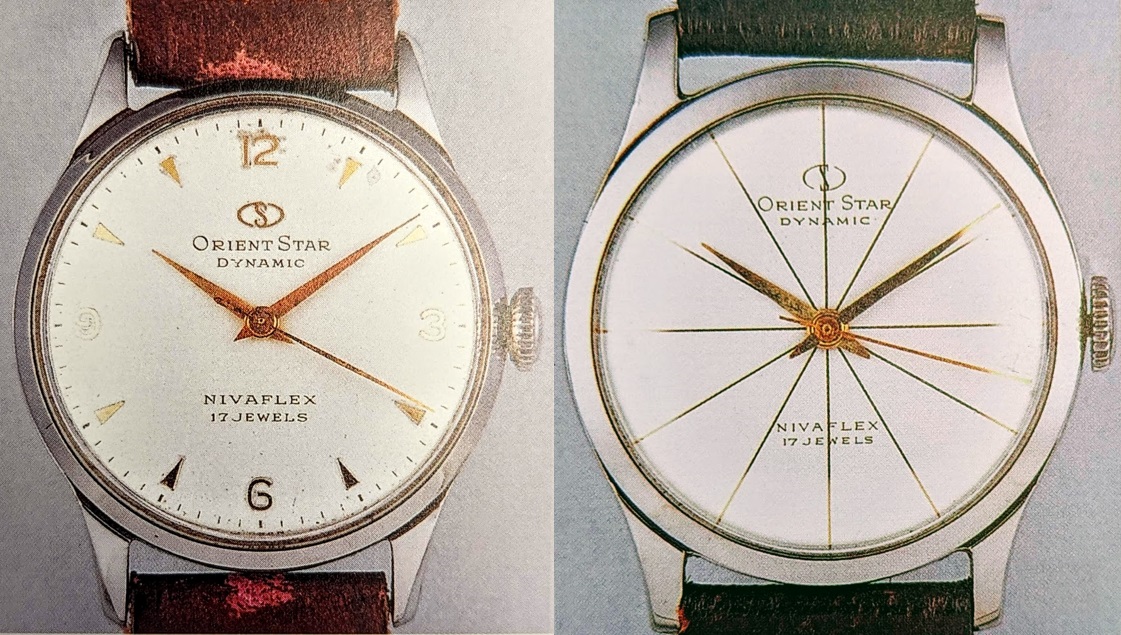

Then Orient produced some more daring creations that went beyond just dial and markers. One example is the "mysterious" watch, where the second hand was replaced with a rotating disc that hid the hour and minute hands, and created a special radiating effect. This design was later reproduced as a Royal Orient.

Another example is the "case within case" design, seen below on the right. This style too was very unique to Orient, and was reused by the brand for its Olympia Swimmer models in the 1960s.


If that wasn't enough, Orient then went on and put the T-Type inside a triangular case, to make its homage to the Hamilton Ventura. This was sold as both a wristwatch and a pocket watch version, as you can see here.

The case-in-case design also received its pocket-watch, or pendant version as you can see below; and an even more unusual product was this table-clock Dynamic, which resembles a lamp.


While the Orient Star Dynamic was the main product line at the time, Orient manufactured more models using the T-Type caliber.

The Jupiter model was presented in 1956, shortly after the Dynamic. It was initially intended as a more basic watch: using versions of the movement having as little as 9 jewels, while Dynamic models usually made use of the 17-jewel version. Later, however, things got a little mixed up with 11 jewel versions appearing in both the Jupiter and Dynamic lines.

In 1957 the Mars Orient was introduced, as a higher end model, with finer regulation and improved shock resistance. These watches used 19 and 21 jewel versions of the T-Type, and the 21-jewel model also featured a higher level of finishing throughout.

Another watch worth mentioning that made use of the T-Type movement was the 1958 "Luminous" with its battery and miniature light bulb, and the antimagnetic Para Aimant. Despite being introduced along with the start of the production of the newer N-Type caliber, these models took advantage of the smaller dimensions of the older movement to pack more "technology" into their cases.

Note, however, that most of the earlier models mentioned – the Dynamic, Mars and Jupiter – had fairly small cases, ranging between 32-34mm. Take this into consideration when looking to buy one of those.


Pictures that appear in this post were taken from the 1999 Orient Watch Catalog book, and old Orient sale ads.

Sunday, 10 July 2022

Orients From Mars


Among the various model and sub-branding names used by Orient throughout the years, "Mars Orient" was among the shortest lived. It was introduced in 1957, and its production ended in 1958. And yet, during its short life, it shone bright.

The Mars Orient was produced in a number of versions, differing in materials and design, but most significantly – the movement. Only two little stones separated 19 jewel models from 21 jewel models, but this was enough to position them almost like two different watches, the latter costing almost twice as much as the first.


All Mars Orients utilized the Type T caliber, and were among the last models to use this movement. Only the Women's Orient Star Dynamic and the Para Aimant, which relied on the smaller diameter of the aging movement, kept using it till the end of the 1950s.

The more basic 19j Mars models were generally priced around 4,500 – 6,000 JPY, which at the time was about the same as top-of-the-line Orient Star Dynamic (which came before it) and 19 jewel Royal Orient (which followed in 1958).


These Mars Orients came in a number of variations: there would be either Stainless Steel or Gold-Filled, and either with – or, more rarely, without an Anti-Shock mechanism. Dials designs differed too, and even the branding was not identical in all products, as some featured the Orient Star logo while others did not.

Higher upscale were the 21j Mars Orients. These were less common, and fewer versions were made, all equipped with Anti-Shock devices. The basic model was priced around 9,000 JPY, more than the most expensive Royal Orient back then. A more elaborate version, featuring the Orient Star logo and a uniquely textured dial, cost 9,770 JPY – remaining the most expensive Orient for years to come, until the 1961 launch of the Grand Prix.


So what was so special about these that made them such expensive watches? While the movement was essentially the same old T-type with two more rubies, these got "5 Adjust" marked on them, meaning their accuracy was regulated for five different positions. Finishing was probably the best that Orient could produce at the time.

Still, the actual difference between, say, a 19 jewel anti-shock-equipped gold filled Mars Orient and a 21 jewel one, appears to be less dramatic than pricing would suggest; and certainly, asking price for a vintage Mars nowadays would depend more on the condition of the item than on the movement version.


Pictures that appear on this post were taken from various sale ads and the 1999 Orient Watch Catalog book.


Sunday, 3 April 2022

Orient's N-Type Movement

Orient's N-Type movement was presented and put to use in 1958. Despite being an important step forward for the brand, and powering some of its most prestigious models at the time, it was not long-lived, and its production ended in 1961.

As with most vintage Orient movements and watches, official info and original documentation pertaining to the N-Type is scarce. A bit of detective work was required to gather information, still leaving plenty of unknowns.


What we do know, is that Orient took great pride in this new caliber. It was considered a major advancement over the previous movements used by the company, primarily the T Type. A thin and modern movement for its time, it was intended to compete with the leading Japanese products, mainly Seiko's Cronos.

The new movement featured improved accuracy and reliability. It had a wider diameter than its predecessor and offered greater precision, and improved shock resistance. It also used the recently invented Nivaflex material for its mainspring.

Some say the first Orient to use the N-Type was a 1958 ultra-rare second iteration of the Royal Jupiter, which in itself was a super-rare higher-end version of the Jupiter.

In any case, Royal Jupiters of all sorts were short-lived and by end of 1958 were replaced by the more familiar line, Royal Orient. It was with these Royal Orients that the N-Type movement found its home.

Early Royal Orients came in a variety of shapes and dial versions, including some pretty fancy ones. These surely deserve, and will receive, a dedicated blog post later on. However, they all made use of the N-Type.

In 1960, a new iteration of the Jupiter name was deemed worthy of this high-end caliber, and so received the N-Type movement as well.


In 1961, Orient introduced the new generation of the N-Type movement with a date wheel – rendering the no-date version granted to the Jupiter somewhat outdated, and less of a generous gift than might have appeared in the first place…

The new movement was installed in three levels of watches: the "Lucky Calendar" which was slightly more pricey than the Jupiter; the yet-more-expensive Royal Calendar; and the top of the line Grand Prix Calendar.

In addition, a high jewel-count version of the no-date N-Type movement was used to drive a new "Special" Grand Prix.


Like Orient movements before it, the N-Type was not wholly original, and its architecture was based on the 1955 FHF 73 caliber (by Fabrique d'Horlogerie de Fontainemelon).

The FHF had various bridge designs, and the one chosen by Orient was similar to the Delvina/Delbana version, also used by other brands. You can see a sample of this movement below, being very much identical to the Orient movement, except it clearly says Swiss...

Orient adopted some variations of the original FHF designs, including the later FHF 73-2 (with a date wheel). They manufactured both the version that had balance screws, and the one that did not, as well as both 17 and 21 jewel versions – again like the original caliber they used as a basis.


Later on, Orient did play around with jewel count, adding a few to the high-end models (as high as 25 jewels for the Grand Prix) and removing a few for the simpler implementations, like the 1961 Jupiter.

All N-Type variants beat at 18,000 BPH, and were hand-winders. Indeed, it was the introduction of automatic movements into Orient's line-up that eventually led to the early demise of the N-Type movement.


Pictures of the N-Type movements that appear on this post were taken from the 1999 Orient Watch Catalog book.

Sunday, 20 March 2022

Three Points About Orient Tri Star

The Orient Tri-Star, or "3 Star" is among the brand's most familiar symbols, an icon of accessible mechanical watchmaking like Seiko's "5" and Citizen's "7". 

Much can be written about the Tri-Star, as it spans so many years and models. There's definitely enough history associated with it to provide content for a dozen articles or more. In this post though, I'll just touch on three (haha) points, possibly less known to new fans of Orient who only recently became acquainted with these watches.


The Three Stars Are Older Than The TriStar

The TriStar line dates to the early 1970s. While there is little information available pointing to the exact birthday of the collection, it was probably around 1971 or a little later, as the early TriStar models used Orient's caliber 469, born in 1971.

Upon its launch, Orient advertised that the three stars stand for three key principles of the collection: representing design, quality, and affordability.

The three-star logo, however, was being used by Orient years beforehand. As early as 1956, in fact, when one of the earliest Jupiter models was adorned with three stars – albeit organized in a triangle rather than lining up.


Later on, three stars in a line could have been observed on other Orients, like the 1967 World Diver. Now, this was far from being the most affordable of the brand's watches, clearly indicating the aforementioned three principles of the TriStar collection were an afterthought.


The TriStar Collection Is Really Diverse

When asked to think of a TriStar, many of us immediately imagine something similar to the sort of design picture below: a fairly small watch with lugs that sit flush on the case, simple dial and markers, and a date-and-day window.


In fact, there are many modern TriStar designs, some of which differ quite significantly from each other. What they do have in common, is that you got quite a lot of watchmaking for your money: a nice design that has its own identity and is decently executed, powered by workhorse movements that should keep ticking for many years.


TriStars Are Missing From Orient's Main Websites

If you were to look for current TriStar models on Orient's global or JDM websites, you would not find a single one.

The only model shown bearing the triple star logo is the "King Master Revival", which is the oldest of the re-issue models presented. Elsewhere, even the World Map Reissue had the original three stars removed.


Of course, TriStar models are still being produced. You can see them on websites such as Orient Watch USA and Orient India, which are run by local distributors, as well as on many retailers' and ecommerce websites.

And, Orient do offer support for TriStar models on their website – you can locate and download instruction manuals for these watches.

Apparently, the reasoning for this goes back to the original concept of offering TriStar models in markets looking for cheaper mechanical watches, and not in the brand's primary markets which, supposedly, are seeking higher-end products.

The fact of the matter is, in every country you will find people who love the simplicity and affordability of these watches, and are looking to buy new, used, and vintage TriStar models.


Pictures of the various watches that appear on this post were taken from Orient Watch USA advertising, Orient catalog and the 1999 Orient Watch Catalog book.

Sunday, 23 January 2022

The Orient Jupiter

Some names that pop up repeatedly throughout Orient's history bear much weight, like King Diver, M-Force and Royal Orient. Others seem to just float about, light and foamy, without drawing too much attention. Such is the name Jupiter.


Because it is such an unassuming side note in Orient's chronicles, not much has been written about it. But still, there were enough nice Jupiters produced over the years, it's worth mentioning a few of them.

We'll start off, rather surprisingly, with the most recent of them. The relatively-modern Orient Jupiter was a rather faithful rendition of one of the 1950's model – in fact it was so faithful, Orient even modified one of its then-current automatic, time-and-date movements, removed the date wheel and rotor, and squeezed it into the authentically small 34mm case of the reissue.


Honestly, other than its minute dimensions, this is a lovely watch. Now in hand-winding guise, a "19 jewel" text decorates the dial instead of the usual "automatic", and the crown's "ghost-position" in-between winding and setting the time reveals its movement's origin.

Orient produced two versions of this Jupiter: the gold-plated reference Tn33502G, and stainless steel Tn33503S.


The original Jupiter of the mid 1950s was not much different, if we can imagine it being clean and shiny (not many photos now exist of shiny 1950s Jupiters…)

Also measuring 34mm across, with a simple yet elegant dial, this was positioned below the Orient Star models of that era. And speaking of Stars and Jupiters, Orient must have been looking to the sky for names then, as that was also when an even more obscure model by the name Mars Orient was produced.

The original Jupiter with its T-type movement was replaced in the early 1960s by a new "showerproof" model, containing the newer N-type caliber, still with no date function.


Between the 1950s and 1990s, the Jupiter name was occasionally attached to different models, both automatic and quartz. Among those were a diver, some dressy models, and even a couple of curious looking moon-phase models having a fairly un-orient-like design – which might have been the reason for branding them "Jupiter" (with no mention of Orient on the dial).


So this was a brief review of a name of no particular importance in the history of Orient… but still, one that might yet be of interest for a collector of inconspicuous old watches.


Pictures of the various watches that appear on this post were taken from various old sale ads.