Orient Place

Orient Place
Showing posts with label GMT. Show all posts

Thursday, 27 August 2026

Orient Mako GMT Hands-On Review


Earlier this month, Orient announced the new Mako GMT – a first new GMT model by the brand in years. I was able to spend some time with this new watch, and specifically – with the limited edition, gradient-blue dial reference RA-BC0005L.


How It Looks

The watch is immediately recognizable as a Mako, or at least a very close relative of it. It shares the main design characteristics of the standard Mako, such as case shape, markers, and hands. That's not a bad thing, as Orient's classic diver-design model is quite handsome and, of course, enjoys considerable popularity and a good reputation.

The main visual differences are the addition of a 24-hour hand, and the removal of the day disc, leaving only the date indication. While day-of-week displays have their proponents, I don't think it's a major loss, and since the date window is roughly the size of the hour markers, it actually allows for a more balanced dial.


The 24-hour hand is deliberately and rightfully more subtle and does not stand out against the dial as much as the familiar hour, minute, and second hands. In this particular version, the watch face is painted in a deep, rich shade of blue, and the 24-hour hand is lighter blue.

The rotating bezel presents 24 hours, allowing the wearer to adjust the time pointed to by the 24 hour hand. It complements the dial colors with a very pleasing combination of blue for the upper half, and dark grey – titanium-like shade – for the lower half.


While most of the case and bracelet metal is left in its natural color, the crown and bezel sides are blackened. I'm not sure how much that enhances the look of this watch, but it is the sort of thing Orient likes to include in its special editions. I'd be happier without this black plating, at least on the crown, but it is not a big deal.

All in all, if you like how the standard Mako looks, then you will not be disappointed by the Mako GMT.


How It Wears

The Mako GMT is larger than the standard, non-GMT version. Case width is 42.8mm (instead of 41.8), lug-to-lug length grew from 46.8 to 49.5mm, and thickness grew from 12.8 to 13.4mm. It also feels proportionally heavier, though I do not have the exact weight at the time of writing.

Despite the size, it is still quite comfortable, but I suppose the extra dimensions might make it less attractive for people at the lower range of wrist sizes, for whom the non-GMT watch was still a good fit.


The bracelet was never the Mako's strongest point, and that has not changed with the new models. When you just hold the watch in your hand and play with the bracelet, it is noticeably rattly and even a bit squeaky. When worn, however, it feels fine, and the loose feeling nearly disappears.

Lug width is 22mm, so finding replacement straps should be easy. I do not think any aftermarket bracelets designed for the standard Mako (or other Orient models) would fit here, unfortunately, but until vendors come up with suitable end-links, a decent blue or black rubber band might do the trick.


How It Functions

The watch uses a new movement, caliber F6P22, which hints at its old relative that also featured a 24-hour hand, caliber 46P. The new movement still offers a 40-hour power reserve, automatic and hand-winding, and second-hand hacking. It's simple, and with most of the mechanical parts identical to the familiar F6 movements, expect workhorse reliability and easy maintenance.

As far as GMT watches go, this is of course a "caller GMT", which means you don't have a local time setting. Instead, you can use the second time zone, as indicated by the 24-hour hand and the bezel, to follow an "away time", presumably someone you need to call at their convenient time, hence the name.


Personally, I would have loved to see a true ("traveler") GMT functionality – but I guess that depends on how much one actually gets to travel in different time zones. The caller GMT, I believe, is more a stylistic feature than a very useful function. A 24-hour hand, however, helps when setting the time and date, ensuring one does not try to set the date close to midnight.

The screw-in crown works well here, and I had no problem locking and unlocking it. Other than not having a weekday to set, it all feels much like the non-GMT version.


Legibility, as with all Mako models, is excellent, in the daytime as well as nighttime, thanks to the good lume on the hands (including the GMT hand) and markers. The front crystal is sapphire, and together with the bulky case and reliable movement, you're getting what seems like a good everyday watch you can keep on your wrist no matter what work you need to get done.


Bottom Line

The last GMT watches made by Orient were some very fancy Orient Star models. This is not an Orient Star and does not need to be compared to those models. What it is, is a Mako – the good old beater watch we all know and (most of us) love, only slightly larger and with an additional GMT function.

As such, it does not disappoint. It is wearable, useful, and attractive, and priced roughly 15% above the standard Mako, it is still well within the value-for-money price range.


The blog would like to thank Orient – Epson Europe for providing us this Mako GMT for review.


Wednesday, 19 August 2026

New Orient Mako GMT, Bambino 36mm No-Date, and Mako 42mm


Orient today unveiled its Autumn/Winter 2026 collection, led by an entirely new Mako GMT family, accompanied by a new no-date Bambino 36mm collection and four colorful additions to the Mako lineup.

All three collections are being released under Orient's 75th anniversary celebrations. Interestingly, while the company has traditionally referred to 1950 as the beginning of the brand, the Orient name itself first appeared in 1951, as discussed in our recent article about the first Orient watch. So from the branding perspective, 2026 is indeed the 75th anniversary.


The First Mako GMT

The most important release in this collection is undoubtedly the new Mako GMT.

While Orient has produced GMT watches before, this is the first model to carry the Mako name while offering GMT functionality. It is also the first entirely new GMT platform introduced by Orient in many years, and debuts a new movement developed specifically for the purpose.

The new caliber, designated F6P22, is closely related to the familiar F6922 found in many current Mako models. Orient removed the day display, retained the date display, and added a fourth hand together with a 24-hour scale, creating a cleaner dial while introducing dual-time functionality.

Like the movement's predecessor, the F6P22 offers hacking, hand winding and a 40-hour power reserve.

The new movement operates as a caller GMT rather than a traveller GMT. The GMT hand cannot actually be adjusted, and instead uses the rotating 24 hour bezel to track a second time zone.


The watches are slightly bigger than the regular Mako, and measure 42.8mm in diameter, 49.5mm lug-to-lug and 13.4mm thick. Like the regular Mako the GMT offers 200 meters of water resistance and comes attached to a stainless steel bracelet.

Five versions are being introduced:

·         RA-BC0001B – Purple

·         RA-BC0002E – Black

·         RA-BC0003L – Green

·         RA-BC0004Y – Orange

·         RA-BC0005L – Gradient Blue (Limited Edition)

The orange version is perhaps the most striking of the regular production models, while the limited edition combines a deep gradient blue dial with a matching blue-and-grey GMT bezel.


A New No-Date Bambino 36mm

The second major release is one that many collectors might find particularly appealing, as it is the closest that the Bambino range has come to the most canonic definition of a pure dress watch.

Earlier this year Orient introduced a no-date Bambino in 38mm. Longtime readers may also remember the 36mm Bambino introduced back in 2019. The new collection combines those two ideas, resulting in the first no-date Bambino in the 36mm case size.

The watches use the familiar Bambino architecture, featuring a domed crystal, slim bezel and elegant proportions. The dial follows the popular V4 Bambino layout, with simple applied baton markers and dauphine-style hands, now presented without a date window.

The case measures 36.4mm in diameter, 42.2mm lug-to-lug and 12.3mm thick. Inside is the F6524 automatic movement with hand winding, hacking and a 40-hour power reserve.


The collection includes four references:

·         RA-BB0101S – White dial with gold-tone case

·         RA-BB0102E – Green dial

·         RA-BB0103S – White dial

·         RA-BB0104Y – Ivory dial

Among the four, the ivory dial may be the most interesting, paired with blue hands and a warm vintage-inspired tone that suits the Bambino particularly well.


New Colors for the Mako

Completing the collection are four new versions of the standard Mako.

Unlike the GMT models, these watches are primarily a refresh of an existing platform. They retain the familiar 41.8mm case, F6922 automatic movement, day-date display, 200-meter water resistance and overall specifications of recent Mako generations.

The new references are:

·         RA-AA0824L – Blue

·         RA-AA0825S – White

·         RA-AA0826Y – Orange

·         RA-AA0827V – Purple (Limited Edition)


Stay tuned, as I was able to receive samples of all new models, and detailed hands-on reviews will follow in the very near future!


Sunday, 7 December 2025

Orient's Textured Dials


Textured dials have long been a hallmark of thoughtful watch design, one that goes beyond the basics. Texture can be subtle or flagrant, it can overpower the dial or take the backseat, but it always has an impact.

The appeal isn’t just aesthetic. Textures originated as a practical solution to glare, particularly in the mid-20th century, when both dress watches and field watches relied on matte or grained surfaces to enhance legibility. Over time, these finishes evolved toward more decorative expressions: stamped linen patterns in the 1960s, crisp radial brushing in the 1970s, and more elaborate machine-cut motifs once CNC tooling became widely available. Each era brought its own take on how a dial could play with light.


Traditional crafts also played a role. Guilloché and other machine-turned patterns – once reserved for high-end dress watches – demonstrated how texture could elevate a dial through pure geometry and light. Even when used sparingly, these classic techniques helped establish texture as a legitimate design element rather than just a technical necessity.

The modern resurgence of textured dials owes a great deal to brands that have leaned into nature-inspired surfaces. Grand Seiko’s “Snowflake” is often credited with kicking off the trend; its finely layered, almost paper-like texture showed just how expressive a dial could be without resorting to bold colors or busy layouts. Coupled with the novel spring-drive movement, that watch gave the premium brand a serious boost, and no wonder Grand Seikos kept boasting unique dials ever after.


What makes this design direction especially compelling is that it bridges the gap between traditional craftsmanship and contemporary watchmaking. Stamped textures, laser finishing, and powdered lacquers all coexist today, each offering a distinct visual nuance. And for collectors, especially those who enjoy discovering small details, textured dials offer the perfect blend of subtlety and richness: quiet at a glance, rewarding under the loupe.

Orient, as a brand that's always happy to add a bit of flair to its designs, dipped its toes in the texture pool as well. Considering it is a visual element that requires no changes to the mechanical parts of the watch, it's a trend that aligns perfectly with its watchmaking preferences.


Take, for instance, the 1970 Orient GM. Containing one of Orient's rare high-beat movements (borrowed from Seiko), but housed in a modest case, most GMs were presented with unique dial textures – possibly hinting that something special is ticking inside. The two samples above show one GM with a linen dial (a style that I see as the true ancestor of the snowflake) and one with simpler, but not any less attractive, geometric finishing.

Royal Orient, of course, would also feature plenty of unusual dials, fitting for a high-end product. Pictured below are just two of many, my favorite polka-dot dial and a more obscure model with a dial that looks like a stamped gold leaf.


Modern Royal Orient watches, while they lasted, also had some standout dials. These were largely inspired by classic machine-turning patterns such as Guilloché and tapisserie. While similar patterns can be found on other Orient watches, the "Royal" versions were generally finished to higher standards.

In the 1980s and 1990s, Orient turned much of its attention to quartz watches. These, too, were often adorned with textured dials. Below, for instance, is a golden ladies' watch featuring a pressed pattern resembling linen dials.


In the second half of the 1990s the focus returned to automatic watches. With the renewed interest, proper dial decorations made their comeback – both to the standard models, and to the reintroduced Orient Star label.

Over the past 30 years or so, Orient and Orient Star dials have featured numerous patterns and textures. Only a few examples can be listed here… two of those are shown below, in the Orient Polaris GMT's Guilloché-like weave pattern, and the "Clous de Paris" finishing of the FD series Orient Star.


Even when Orient does semi-skeleton dials, where the open heart aperture is already taking much of the attention (and space) given to the dial, there's always room for a bit of texture. The layered skeleton is one extreme example, where Orient had put together a few bold patterns.

Another example is the classic moon-phase watch, which has a particularly complex dial structure. Here, the center of the dial features a repeated pattern of Orient Star symbols.


Today, I see two new trends in the application of textured dials by Orient. First, in regular Orient models, these are typically offered to highlight limited edition models – such as this 75th anniversary limited edition Mako 40mm, shown below.

A completely different approach is taken at the very high end of the Orient Star range. The new M34 F8 Date models were given unique dial finishes and colors, which, along with the fine polishing and premium specs, convey an unmistakable Grand Seiko vibe. Which is fair enough, given how many different brands (including the 3rd major Japanese brand, Citizen) are attempting the same.


Some photos were taken from Orient publications and sale ads, or other classic watch sales ads; photos of blue GM, gold Royal Orient, moonphase, layered skeleton, sun & moon, blue FD-series model, and polka-dot Royal Orient are copyrighted by the blog.


Thursday, 17 April 2025

Orient Place Blog's 7th Anniversary


So here we are again – another lap around the sun, and Orient Place blog turns seven. As always, it’s time to take a moment to look back at the past twelve months, to reflect, analyze, and share a few thoughts.

Over the past year, the blog recorded 183,000 views – a marginal increase over the 182K we reached last year. That means growth has plateaued, which isn't surprising considering the shifting patterns of online readership. Still, the numbers show there's continued interest in Orient watches, and the blog remains a point of reference for many collectors and fans around the world.

Twenty-seven stories were posted this year. That’s a little fewer than in previous years, but the mix of topics was rich and varied. There were two reviews of new modern models and two of older pieces; ten posts covered new releases; and ten articles looked at different product lines, features, or design themes. The rest were a mix of commentary and general watch talk. The focus may have shifted slightly away from individual model reviews, but the substance was still all about Orient, I don't seem to run out of topics…


Once again, the Mako 40mm proved its staying power. The hands-on review I posted the previous year remained the most-read article this year as well, drawing over 4,000 additional views. This makes it the top post for two years running – a rare feat on the blog, and a sign that this model continues to generate interest. The most-read new article this year was “Orient Does Snoopy”, which covered the unexpected co-branded release and drew more than 2,000 views. This was followed closely by an older post on the smaller Small-Seconds Bambino, which continues to perform well, and a newer preview of the "Classic and Simple" line for 2025, which earned around 1,500 views.

The same themes extended to social media. The Snoopy watch topped the Instagram charts as well, being the most liked photo I posted this year. It was followed by a shot of my Royal Orient WE0011EG – a personal favorite that never fails to attract attention – then an unboxing of my green Contemporary Standard, the arrival of the EX0D M-Force, and a vintage King Diver making a quiet, confident appearance.


Looking at Orient’s strategy this year, the most obvious direction has been variation rather than innovation. We've seen many new dial colors for familiar models – particularly the Mako and the Bambino – often in pastel and warm tones that seem to follow the trend that began with Rolex’s colorful OPs. At the same time, Orient introduced solar-powered versions of both the Mako and Bambino, marking a subtle yet significant expansion of the lineup into eco-friendly quartz territory. These aren’t technological revolutions, but they are relevant, practical evolutions that make sense for a brand whose strength lies in everyday value.

That said, there’s always more fans would like to see. Speaking for myself, I’d love to see Orient’s newer long power reserve movements – those 60 to 70-hour calibers – make their way into more affordable models, and not remain exclusive to the top-tier Orient Star references. I’d also love to finally see a proper GMT, particularly a true (traveler-style) GMT, something that Seiko has been able to deliver recently. Here's what GPT imagines such a GMT Bambino might look like…


And yes, I do miss some of the quirkier stuff. Orient has a history of creating bold and unique designs, and I’d be thrilled to see some of that daring spirit return – not just in Orient Star, but in the more accessible lines as well. A modern take on something like the old Direct Read models, for instance, would be cool.

Looking at the wider industry, not just Orient, it's clear the trend continues to shift upscale. Watches & Wonders 2025 gave us more of the same – brands chasing the high-end buyer, innovation reserved for five-and-six-figure pieces, and very little happening at the more accessible price points. Grand Seiko, meanwhile, keeps pushing out new models at a dizzying pace. Which makes me wonder – isn't it about time we saw the return of Royal Orient?

As always, I want to say thank you. To all of you who read the blog, follow the Instagram account, leave comments, ask questions, and send messages – you’re the reason this keeps going. I’d love to hear even more from you in the year ahead. Not just on individual blog posts, but your thoughts on new Orient releases, your experiences as owners, questions about service or quality – all of it. The more conversations, the better.

Here's to another year of watching watches!


Sunday, 7 April 2024

Orient's "Alpinist"


In 2007, Orient presented a curious model of Orient Star Sports. It looked like a GMT, but it was not. What was it then? Let's dive in and find out.

The most obvious influence that likely pushed forward this design, was the introduction of Seiko's SARB series Alpinist the year before – a watch that became an instant classic (while actually duplicating the brand's own decade-old SCVF series, or "red" Alpinist).

The Alpinist featured an internal compass bezel, rotated using the crown at 4 o'clock – that actually looked more prominent than the main crown, as it was not hiding between crown guards.

Orient's design, albeit quite different and as far away from a copy as possible, takes two key elements from the Seiko: the internal compass bezel, and the crown at four. Hereafter begin the differences.

The model had four versions, which were references WZ0071FE, WZ0081FE, WZ0091FE and – the one I am looking at now for the writing of this review: WZ0101FE. The four differed in their dial color, and in that all but the WZ0101FE came bundled with a steel bracelet, whereas the latter was sold with a leather strap.

Now, I don't usually read a watch's instructions manual unless it is particularly complicated. So when I got this watch I immediately wanted to pull out the crown and set it… so the first surprise was that it's a screw-in crown. Why was that a surprise, I don't know, it just didn't strike me as one; at the time most of Orient's crowns were just pull-out, except for the more expensive models – which this wasn't.


The second surprise was when I tried to rotate the bezel. No crown position or winding direction seemed to do that, so went online to read about the model and found out that indeed the bezel is fixed!

When you think about it, this actually makes sense. Why would you rotate a compass bezel? The angle of the North has nothing to do with the time or the dial. You can just move entire the watch around (never mind that the whole thing is just decorative and carrying an actual compass when you're out and about would probably be a lot more helpful).


But then you think some more and once again, the logic is gone. Because this watch uses Orient's caliber 46P, which drives a 24-hour hand, and was used in some of the brand's earlier GMT watches. And indeed this watch features the 24 hour hand – and its internal bezel, besides the directions of the compass, also shows the 24 hours of the day! This thing really ought to be moving! But it does not.

So I believe we have established that from a functional point of view, this watch is rather silly. I mean, not completely – it does show the time, it is rated to a reasonable 100m of water resistance and it has a front sapphire crystal. But still, there's plenty of silliness to it.


Other than that it is a very nice piece. A 39mm wide barrel case which is practically lugless makes a very wearable watch that would fit most small-to-slightly-larger-than-average wrists. The lug width is 20mm, so changing straps is easy and you can even fit a standard steel bracelet without having to find a suitable end-link.

The dial looks good, and in fact – if you ignore the functional drawbacks, the entire watch is properly handsome. The black and red combo on this reference is sporty and sharp; other variants are a little different, with the white dial version a bit more elegant and the red – maybe more "interesting".


The dial colors are also nicely contrasting, making the watch very legible. The hands and markers have a decent lume too. It's a comfortable watch, then, sufficiently durable and useful. So maybe we were a bit quick to judge its functionality harshly.

As an Orient Star, it is also well made – although the finishing perhaps is not as impressive as most current OS production. The case has radial brushing on top and polished sides, and the overall curvature of it makes it look a little more upscale than it actually is.

The bottom line is this: it is a fine little watch. It looks good and is kind of special. If only that bezel would rotate it would be so much nicer… but still, it is what it is.


Sunday, 12 April 2020

Orient's Special Editions for Thailand


Tomorrow, April 13, Thai people will be celebrating the national holiday of Songkran, the traditional New Year's day.  So today, the blog would be paying respect to the people of Thailand, and we will be looking at some special Orient watches produced to celebrate the Thai culture and national events.


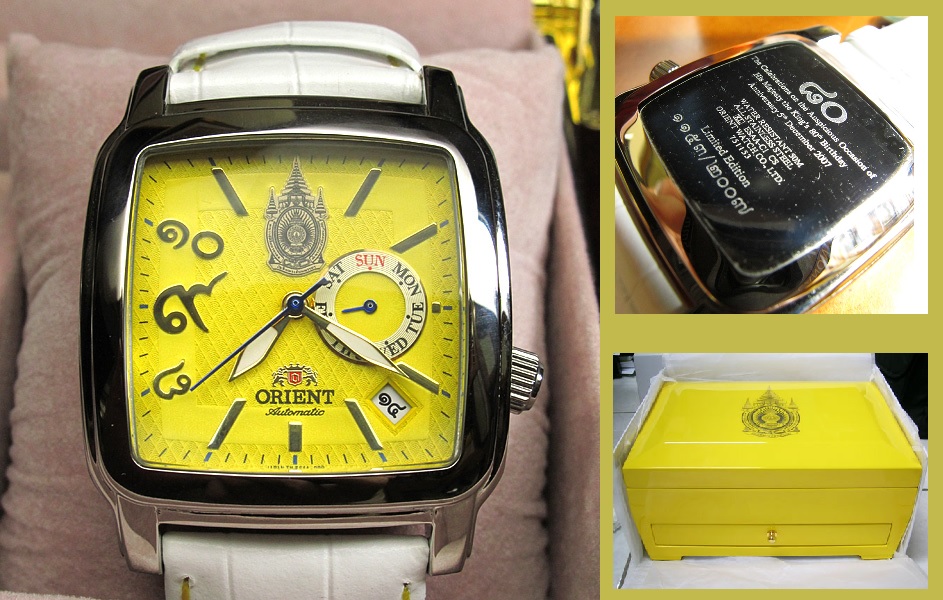
The first thing to keep in mind is the importance of the local language. The Thai take great pride in their unique numerals and alphabet, which are perceived as part of the national identity. Therefore, a key element in watches produced for the local market would be a replacement of Arabic or Roman numerals, with Thai ones. Note in the watches pictured below, that Orient often took the effort of changing numbers not only on the dial but on the date disk as well, as opposed to many other watchmakers that did Thai versions.

Another source of national pride and importance, is the king and the royal family. Thailand is a constitutional monarchy with the current dynasty dating back almost two and half centuries and the kingdom as a whole dating back to the 13th century. Today the king's role might be more symbolic than decades ago, but he is very much revered, and the special occasions of the royal family are still being celebrated widely.

Now, we won't be reviewing all the many limited editions produced by Orient and its local distributors over the years, as there have been quite many. But we can take a look at four interesting examples.


2007: King Bhumibol's 80th Birthday

For the king's 80th Birthday, Orient and local distributor Trocadero partnered to release a number of interesting models. These included:

·         Dual-time model reference CFE04004W based on the FE caliber 46P
·         A pair of beautiful two-tone "his and hers" Orient Star models, references WZ0311ER (larger model) and WZ0361NR (smaller model)
·         A Royal Orient pocket watch
·         And this very yellow model, ref. CESAA005Y


In can be noted that Orient (or their local distributor) took the occasion so seriously, even the serial numbering of the pieces, engraved on the case back, was done in Thai numerals.


2009: Princess Bejaratana's 84th Birthday

To celebrate the Birthday of HRH Princess Bejaratana (Cousin of King Bhumibol), Orient introduced two limited edition models, practically so rare it is nearly impossible to find any information, references and details about them.

·         An elegant, two-tone Orient automatic. Nothing too unusual there…
·         A very unique, and probably very hard to find, version of the Orient Star Dynamic Re-issue. Now that's a properly royal piece!


2014: Orient Thailand Limited Edition

In 2014, Orient produced four "Thailand Limited Editions" of the Bambino, for no particular event other than a celebration of the Thai language and numerals. These special Bambinos includes one rose-gold plated version, one yellow-gold plated version, and two steel models having a white and a black dial.


2015: Princess Sirindhorn 60th Birthday

In April 2015, Orient celebrated the 60th Birthday Anniversary of HRH Princess Maha Chakri Sirindhorn, with a couple of particularly handsome watches.

·         Reference FDB0C006V, a men's watch, nicely combining a royal purple dial and gold plated case.
·         Reference FDB0A00AW, a women's watch, again gold plated, with a dial that's mostly white with just a little touch of purple.


These were only a few examples of the special Orient editions produced for the Thai market. If you are looking to buy any of these rare models, be patient and prepare for a long hunt, as they are quite challenging to find (though possibly some might come up if you search local shops in Thailand).

Happy Songkran!


Some photos and information were taken from official publications by Orient and its former distributor in Thailand, Trocadero. Additional, super-useful and interesting information, was found on this blog

Sunday, 15 March 2020

Orient's World Time and GMT Watches


World time watches are intended to allow one to check the time in different parts of the world. Orient's fascination with world timers goes back many decades, to some of the brand's oldest designs, like the world diver and SK.

At first, these were very simple devices, using a 24-hour bezel to allow one to check the time against a layout of world cities manually. Later on, smarter options popped up, like the "FE" line up, where caliber 46P operated a 24 hour hand (which still had to be checked manually against a world cities bezel).

However, in the early 2000s, Orient began introducing more useful movements and traveler watches. Today we will be looking at these proper world time and GMT watches.

The following table contains the different movements produced by Orient that included a functional 24-hour disk or hand. For each caliber, you can get an indication of the movement code (that is also part of specific watch references) and the sub-brand in which it was used: "regular" Orient, Orient Star, or Royal Orient.

Caliber

Code

Launch Year

Used in

Jewels

Hack-ing

Hand Wind

Seconds Indicator

Date Indicator

24 Hour

46L

FB

2003

ROYAL/ STAR

 21

yes

yes

center seconds

pointer @ 9:00

Disk

46T

FL

2003

ROYAL

23

yes

yes

sub seconds @ 9:00

pointer @ 6:00

Disk

46K

FA

2003

ORIENT/ STAR

21

no

no

center seconds

pointer @ 6:00

Disk

46H

EY

2007

ORIENT

23

no

no

sub seconds @ 6:00

pointer @ 9:00

Disk

48H

FZ

2008

STAR

 23

yes

no

sub seconds @ 6:00

pointer @ 9:00

Disk

40P

DJ

2010

STAR

22

yes

yes

center seconds

window @ 3:00

Hand

48K

DH

2012

ORIENT

21

yes

yes

center seconds

subdial @ 6:00

Disk

40H

JC

2013

STAR

24

yes

yes

subdial @ 6:00

subdial @ 9:00

Disk


The earlier movements (before caliber 40P of 2010) used a 24 hours disk that was synchronized with the time; however – as opposed to the simple 24-hour hand of caliber 46P – the wearer would be able to adjust the disk to a specific time zone, in half-hour intervals. This way, you could use the central hour as your local time, and the disk to check the time in other places. The typical design would also have a world city bezel that could be aligned with the disk so that you could tell the time in every city.

Here are some photos from a 2003 catalog, showing these early world timers:


A GMT watch would typically differ from a world timer in that it shows one additional time zone, allowing a much clearer observation of the time in that time zone compared to world timers.

Orient's first true GMT watch was introduced in 2010, featuring an adjustable 24-hour hand, in the shape of caliber 40P. The beautiful watch housing this movement became an instant classic, and received the much-inspired nickname "Star Seeker". Over time, a number of different watches used this caliber:

·         References WZ0011DJ (shown at the top of this post) and WZ0021DJ, the original star seeker GMTs with black and white dials respectively, with an internal rotating 24 hour bezel, a steel bracelet and a "cyclops" over the date window.
·         Ref. WZ0031DJ, with a black dial and leather strap.
·         WZ0041DJ and WZ0051DJ, introduced in 2011 with black and white dials respectively, were very similar to the 2010 release, however without the cyclops.
·         WZ0061DJ and WZ0071DJ, introduced in 2014, featured a simpler design and let go of the internal rotating bezel. The first featured a black dial, while the latter had a beautiful blue dial, both on a steel bracelet.
·         And then last but not least, came the limited edition WZ0081DJ, similar to the 2014 release, and featuring a fantastic grey dial and brown leather strap.


In-between the "DJ" models, Orient also presented a new line of world timer style of watches, the "JC" line-up. References WZ0011JC, WZ0021JC, and WZ0031JC featured black, blue, and white (or rather, ivory) dials, respectively. More variants were later introduced in 2017.


Since 2017, Orient did not introduce new World Timer or GMT models. Isn't it time for a new, caliber F6-based GMT watch from Orient? Many fans of the brand would surely love one! For now, we'll have to wait and see.


Some of the data in the table of movements was taken from Dan's (watchmandan.com) very useful list of movements. Photos of the 2003 catalog were taken from the archive of Yeoman Seiko's fantastic old blog. Other photos are from official Orient publications.