Orient Place

Orient Place
Showing posts with label World Time. Show all posts

Thursday, 27 June 2024

Orient's Complicated Dials


What does a watch brand do if it wishes to present to compete with higher-end watchmakers but it does not have the capacity to produce high-complication movements? What can it do to attract the more sophisticated buyers, who are looking for elaborate designs?

One way to go is, make the watches look more complicated than they actually are – and where a watch is made that does contain some level of fancy technical intricacy, emphasize it as much as possible. And this, Orient always knew how to do.


First of all, let me return to my thesis, which I first mentioned when discussing multi-year calendars, which date back to the 1960s. Back then, decades before the arrival of the smartphone, the wristwatch was the most advanced (and often, the only) piece of technology a person would carry around. The watch was not only functional as a time-telling device, it was the only item one could show off anywhere or fiddle with at times of boredom. Making it complicated, then, made sense.

Indeed, the multi-year calendar presented Orient's busiest-looking dial at the time. Showing a full month calendar, a year disc, the date, and, of course, time, owners had plenty to keep them interested.


Another great way to add interest (and visual heft) to a watch dial, is a World Time complication. A world timer bezel, with names of cities from all time zones, can become a pretty dominant part of a dial – particularly when coupled with a 24-hour track, as is not always – but often – the case.

Since the early 2000s, Orient also often included numerous sub-dials with its world time / GMT models – e.g. for the date, seconds, and power reserve – adding to the impression of a very sophisticated product.


Speaking of sub-dials, that is also a proven method of complicating things, in a good way. Add a small-seconds sub dial (instead of a central second hand), a power reserve etc., and you got yourself a smart-looking dial. Even if the sub-dials don't really add much information, they give the impression that they do.

And indeed, even the humble Bambino can benefit from an upgrade to its plain dial! Or does it?... many would prefer the basic, yet elegant, dress-watch design.


And then, of course, is the skeleton – particularly the semi-skeleton approach, which Orient so often uses. In its simplest, "open heart" form, it adds a bit of technical flair to otherwise standard dial layouts; but other times, it can be turned into a much more elaborate element and become the focus of the watch design.

Orient has indeed often did just that: while relatively limited in its ability to produce highly complicated movements, the brand's designers often excelled in delivering very imaginative expressions of time-telling, in watches like its "retro-future" series, or more recently the avant-garde skeletons.


Luckily, I'm fond of the Orient design philosophy. While I have much appreciation to a well-executed time-only dress watch, I find a busy watch dial to be entertaining – and when properly done, also very aesthetic.

And how about you…?


The pictures of the Avant-Garde skeletons and Bambino variants that appear in this post were taken from Orient catalogs. Other pictures that appear in this post are copyright of the blog. 

Sunday, 28 January 2024

The Sky Sports Orient Star ref. WZ0021FZ


Orient Star's 2008 catalog featured what may have been the brand's most attractive product range since the 1960s. In it you could see the 300m Saturation Diver (still with the FD movement and syringe hands); the mighty Clubman Chronograph; some of the brand's last cushion-cased models (including the very first open heart model, WZ0011FH, still selling at the time); numerous Retrofuture watches; and more.

And, in that year, Orient also introduced a new series of sports models, dubbed the "Sky Sports" line, presumably to take the place of pilot watches alongside the brand's divers and outdoor models. While possibly not as famous as some of the aforementioned watches, these were no less cool and special.


The Sky Sports range featured four versions:

·         Reference WZ0011FZ with a mostly black dial, and some black ion plating on the bezel and bracelet.

·         Ref. WZ0021FZ with a "reverse panda" dial, and mostly black IP on the case and bracelet.

·         Ref. WZ0031FZ, the more elegant of the lot, with a gold-plated case (and black IP bezel) and a sporty leather strap.

·         Ref. WZ0041FZ with a completely stealthy case and dial, except some dark-orange hands and markers.

All versions share common dimensions and features. The lug-less barrel case is 44mm wide (without the crowns and the tiny crown guards), roughly 46mm long, and 14mm thick. The bracelet width is 24mm at the case, with the steel bracelet tapering down to 18mm at the clasp. Lug width (though, as mentioned, it's lug-less…) is just 22 mm, so that would be the width of a leather strap, if you choose one.

The movement denoted by the "FZ" code is Orient's caliber 48H world timer. Technically belonging to Orient's vintage 46/48 family of movements, it does not hand-wind and only features 40 hours of power reserve; it does hack, however, and as you'll see below, it offers some really nice features.


To take a closer look at what makes the Orient Star Sky Sports special, let's focus on one particular watch – in this case, a lovely WZ0021FZ in mint condition.

Like many other Orient models, this piece is characterized by a purposely complicated dial. And again, like in numerous other watches reviewed on the blog in the past, Orient manages to nicely balance the abundant details with legibility.


The dial layout, dictated by caliber 48H, includes the central hour and minute hands; a sub dial for small seconds at 6; the date pointer at 9; and the power reserve at 12. In addition you get the 24 hour disk, surrounding the dial; and then there is the internal rotating bezel, presenting twenty-four time zones.

Closer inspection reveals the intricate textures of the dial. The main plate has a subtle grainy surface, as does the date sub-dial, while the seconds and power reserve sub-dials are finished with a very light sunburst effect.

The overall design style of the dials is meant to resemble flight instruments. This is particularly evident in the small seconds sub-dial. This design, together with the World Timer function, produces the "aviation theme", justifying the Sky Sports moniker.


The case and bracelet also participate in this game of mixed finishes. Where there is IP coating, it is smooth matte, while the uncoated steel is mostly brushed, with some more finely polished pieces adding some sparkle. The side panels on the case match the bezel, here as on the other references in the series. Even the crowns are finished in black and metal.

The only elements that add a bit of color here are the orange "GMT" sign and the transparent pointer at the top of the dial.

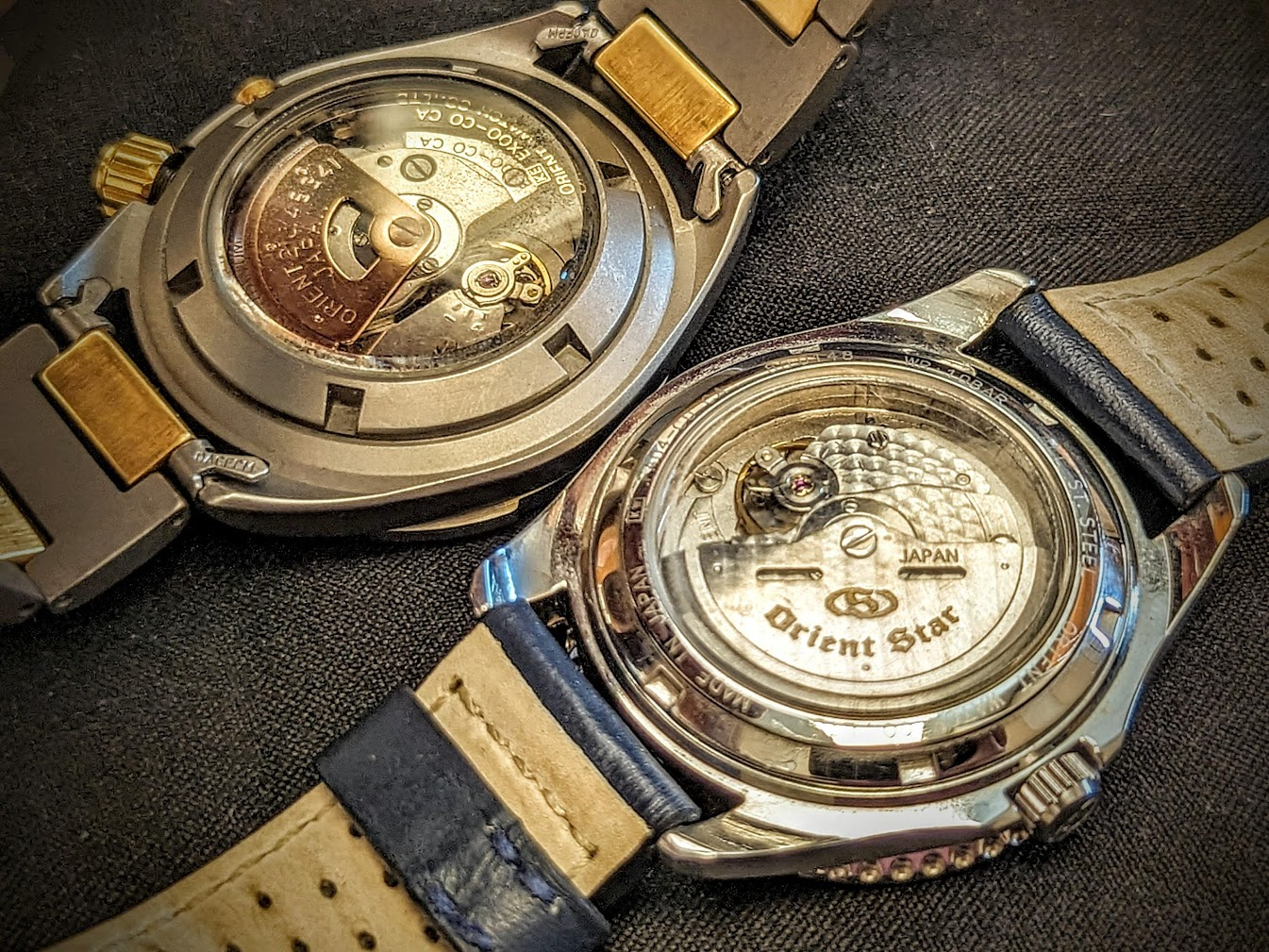
Some more color can be found in the back, in the orange-tinted mineral glass. It also continues the aviation theme with some flight-related text, like "VFR" (visual flight rules) and "IFR" (instrument flight rules), and some additional stuff relating to flight height and angles. Hopefully, your pilot would not need to resort to reading the caseback in midflight to land you safely at your destination.


Watch operation is similar to other Orient World Timers, such as the WZ0091FA reviewed here a few years back, except that the main crown here is a screw-in type. Once unscrewed, pull it to the first position and turn clockwise to advance the 24-hour disk in half-hour intervals.

Use the second crown at 4 to rotate the timezone bezel – and it doesn't really matter how you set it up, as long as the current hour sits against the current zone you're in. Although it might be more visually pleasing, to those of you with OCD, if you place the GMT time on top of the yellow pointer, and then set the disk accordingly. Once set, the disk just moves with the main time.


Otherwise, operation is fairly standard. Turn the crown counter-clockwise to set the date, and pull it to the third position for setting the time. As there is no hand winding, there is nothing to do with the crown in the first position. A slight nudge or setting of the time forward, however, is enough for the movement to start ticking.

On the wrist, this is a very comfortable watch to wear. Not particularly heavy for its size, at 175g; actually it's not really that big for its size… one of the advantages of a lugless case design. The tapering bracelet also helps in inducing a lighter wearing experience.

It's also practical enough (100m/10atm water resistance, front sapphire crystal) and feels tough enough to serve as a daily wear or tool watch.


So there we have it, another great watch by Orient Star, from one of the best periods in the brand's history. If you like the styling, it is definitely worth looking for this model, or one of its siblings in the FZ/Sky Sports range.

Despite the quality and relative rarity (though I would not say it is at the top rarity level for Orients), watches in this series sell at very reasonable prices, typically asking around 500 USD for a watch in very good condition (like the one pictured here)

Thursday, 6 July 2023

Orient's Caliber 46

Orient's 46 family of automatic movements is perhaps the best-documented piece of this brand's history. This probably owes to both the importance of the 46, and to its extremely long life spanning all the way from 1971 until… well, pretty much today, actually!

So while there's not a lot I can write about factually that hasn't already been written and posted before by watch historians, this blog cannot be complete without offering the story of cal. 46, with some added personal perspective.


Origin

Throughout the first two decades of its existence, Orient used numerous mechanical movements. We've covered some of those on the blog, like the T-Type, N-Type, and L-Type. At some point, management must have realized that adopting one architecture and sticking with it, would be more profitable and allow them longer-term planning.

So, Orient turned to the Seiko, their older, bigger neighboring watchmaker, to source some know-how and designs. It has been said that Seiko at the time believed their future lies in the newly introduced quartz movement, and so they figured making a little extra money off of an aging technology made sense.

Orient happily licensed Seiko's latest movement, caliber 7006 (Seiko mechanical movement engineers apparently kept working arduously despite any mocking grins from fellow quartz people!). They added Seiko's old and proven Magic Level winding system and, hey presto, caliber 46 was born.


Iterations

During its five decades of production, the movement went through numerous updates, and spawned many variations. These variations offered different dial layouts, additional "complications", and occasional changes to the main plate and bridges, required to accommodate the various new parts.

Some of the functions presented with cal. 46 versions included Power Reserve indicators, World Time indication, 24-hour hands and AM/PM indicators, and more. Some versions included the day, the date, both – or none.

The top-level versions, used in Orient Star Royal and Royal Orient, such as the 46L, 46M, and 46T, were equipped with hand-winding and second-hand hacking. These were also regulated to a higher accuracy of +10/-5 seconds per day, compared to the usual +25/-15 of the regular caliber 46.

The following table contains the different versions of caliber 46.


Key Models

It's impossible to list all the significant watches released by Orient with caliber 46 inside. But here are a few highlights…

Orient HiAce, or HA, was one of earliest product lines using caliber 46 (as well as the similar spec cal. 48). Many versions of Orient HA were produced between the early to mid-1970s, offering a great variety of designs.


Another line of watches that's been around since the early 1970s is the SK (Sea King or Super King, depends on who you ask). This was the 46-based heir to Orient's earlier divers (World Diver and King Diver).


The ever so popular Orient "President" or "Day Date" Rolex homage was also a member of the family – specifically the 46E variant, with its full-weekday display.


In 2004 Orient launched its highly successful line of divers, with the release of the Mako and Ray. Both used caliber 46943.


In 2011, Orient paid tribute to its historic movement with the release of the 469 40th anniversary model. Two references were produced in limited numbers – one in stainless steel, and the other black coated.


And there were, of course many other significant releases. Like the EW00 series running Orient's first Power Reserve movement, cal. 46F; the first generation M-Force with its cal. 46G (and then, later generation); and so on, and so forth. Countless variations, in a line running more than forty years, an ongoing ode to a movement that might not have had the glory of Japan's foremost watches like Grand Seiko or Citizen Leopard, but made the Orient brand a staple of robust reliability.


Modern Reincarnations

Like all good things, the 46 lineage too had to come to an end. Perhaps, as no more letters were left in the alphabet (though they only reached the letter "Y" – there was no 46Z)… but more seriously, it was a case of an aging architecture that led to inefficient manufacturing.

In 2012, Orient began work on a new generation of movements, the 46-F6 (or "F6" for short). As the name hints, there was and still is much of the 46 heritage in the new movement. The F6, finally put to production in 2014, utilized the same barrel, third wheel, escape wheel, pallet fork, and balance wheel as the 46. However, Orient engineers produced a new modular "envelope" of plates and bridges that were designed to accommodate the different requirements of various complications without changes, resulting in more economical manufacturing.

Further updates to the movement led to the introduction of the 46-F7 in 2017 (with improved accuracy and power reserve, and even sharper decoration techniques), and the 46-F8 which finally saw the replacement of the aging cal. 46 steel balance wheel with silicon.


The top photo and table are copyright of the blog. The table includes info from of WatchManDan's list of Modern Orient Movements. Other photos in this post were taken from various sale ads.


Sunday, 5 September 2021

Tonneau-Cased Orient Watches

 The tonneau (French for "barrel") is a classic shape of watch cases, often favored by high-end watch makers like Cartier, Richard Mille, Franck Muller to name but a few. While not the most common among Orient watches, the Japanese brand did occasionally produce tonneau-cased watches, including some that really feature stand-out design.

Note that while the barrel case may be seen as a close relative of the cushion-case, they are quite distinct in their overall shape and particularly, how they sit on the wrist. And for Orient, while the brand usually preferred to keep their cushion-cased models elegant and restrained, their Tonneau watches were often quite funky – and here are some nice examples…


The EZAD Family

A good example of some really cool design can be seen in the EZAD family of Orients. These were fairly large, as barrel cases go, at 42mm wide, providing serious wrist presence.

As with all "EZ" Orients, the movement here is caliber 46J, featuring a power reserve and sub-dials for the date and small seconds. It's a good set of indicators (or "complications", if you will) which Orient took advantage of in producing a fairly elaborate dial-design with plenty of depth.


The EVAA Family

A much more subtle implementation of the tonneau case exists in the EVAA family. These are dressier models measuring no more than 32mm in width (which is about the same as a 35-36mm round case, in terms of metal-on-wrist).

The "EV" here is an indication of caliber 46E, whose main feature is that fancy full-text day wheel. Yes the same movement that also stars in Orient's much sought-after "Day-Date" Rolex Lookalikes.


The FAAA Family

Another fine example of Orient's use of tonneau cases is this small family of "FAAA" models. The movement here is caliber 46K – the same that drives the WZ0091FA world timer reviewed on the blog in the past. Except that here it is mounted top-down… hence the crown at 9, and the power reserve at 6.

The size of these is a reasonable 39mm wide. The design, again, gives special care to each and every dial element, producing depth (particularly the black and white version) and, no doubt, some seriously pretty watches (I'd say, mainly that blue variant).


Orient Star EJ Family

One last example for today, would be the "EJ" line of Orient Stars, which included a few really nice barrel-cased references.

These featured well-polished 38mm wide cases, and the push-button at 2, a familiar sign of the "EJ" line (that used the older caliber 40G) used to set the date. No funky sub-dials here, but just very elegant sun-burst dials.


So… a cool bunch of barrels there, isn't? These are of course only a small selection of models from Orient's vast range of tonneau-cased watches. And on our next blog post, we'll review one other specimen, from my personal collection.


Model group photos in this post were taken from various Orient catalogs and ads. The top photo is copyright of the blog.

Sunday, 30 May 2021

Orient "World Map" Hands-On Review

In February this year, Orient announced the re-issue of its famed, now-ultra-rare, 1969 "Map Dial" World Diver. Dubbed the World Map diver, the new watch immediately drew the attention of fans of the brand in general, and those familiar with its vintage diver legacy in particular.

Therefore, I was very pleased to receive two World Map versions for review – the limited edition reference RA-AA0E04Y (or RN-AA0E04Y in Japan) with its multicolor true-to-the-original dial, and the regular production ref. RA-AA0E01S (or RN-AA0E01S) with its ivory dial.


As a general rule, I evaluate watches based on their own merits, but here it's difficult to overlook the historical context behind the design. So before I begin to discuss the pros and cons of the "World Map", I'd like to briefly describe how it works as a re-issue.


Old vs. New

Not all watch brands treat their legacy designs the same way. Many so called "reissues" are in fact "homage" watches, that take certain elements of the original and blend them with more modern elements, typically larger cases, trying to emphasize the progress made by the company. Not so with Orient.


This isn't the first time Orient makes a new iteration of an older design that's almost impossible to tell from the original. But with the rather elaborate and very distinct visual footprint of the vintage world diver, the way it is being preserved by the new watch is absolutely impressive.

It's easier to say what has changed than to point out everything that is the same. So, you have a slightly larger case (43.5mm vs 42mm); the day-change push button has been omitted, as both day and date are now set from the main crown; and you have some very minute changes to the dial text, mainly the word "automatic" now added, and the tristar symbol removed.

You can see it in the pictures; my vintage World Diver is on the leather strap, while the new World Map is on the steel bracelet. The map image is absolutely identical, down to replicating the original Pantone color codes.


Okay, now that we got the historical comparison out of the way, let's move forward and focus on the new watches, shall we?


How They Look

The World Map immediately stands out as an original design, very much unlike any other diver or sports watch currently on the market. The large lugless case and the unusual internal 24-hour bezel provide a distinctive outline, even before setting one's attention onto the illustrated dial.


Naturally, while the overall shape of the watch is very simple, all that's interesting is taking place under the mineral glass. The dials, both the white version and the multicolor, are lovely in different ways. The white one is restrained and elegant, definitely more versatile in appearance; the colorful version is vibrant and playful, and increases the already-high standout factor of this model.

The 24-hour rotating bezel adds to the playfulness; to be honest, anything you can have in a watch that one can play with while wearing it, without messing with the time adjustment, is good. Watches are meant to be fun, aren't they?


That said, there is something very misleading about the dial and bezel. They'd make you think there has to be some clever way of telling the time in different cities in there. Well, in theory, that might be possible – but in practice, finding your current location or destination on this map is challenging to say the least.

In other words, if you are the sort of person who insists every element must be usable and functional, the World Map is likely to drive you mad. To enjoy it, you have to appreciate it's just a fun watch, and the "worldly" side of it is little more than an artistic expression.


Zoom in on the details, and you won't be disappointed. The map, particularly on the white dial, is printed in crisp precision. The hands are pleasantly shaped, and the date window is attractively framed. Considering the price point, there is nothing to complain about: the dial has depth, and all the elements are well proportioned and sit together nicely.


Also worth mentioning are the two crowns and the coin-edge bezel. Particularly on the white dial version, the gold tone of both bezel and crowns emphasize how well they match. Some might not like the two-tone finishing though, but of course, they can turn to one of the other references (like the blue or green dials, which I have not seen in person).

Regarding the bracelet, again, there are pros and cons. It looks nice enough, with the alternating brushed/polished finishing that mimics a five-link bracelet (though the links are single pieces). My main gripe is that the brushed part does not really connect with any other element in the watch, as the case is entirely polished.


How They Wear

We've already mentioned this is not a small watch, and a width of 43.5mm without the crowns might seem daunting to some. However, notice the total length of the case is only 46mm, meaning most people of average wrist sizes should be able to wear the World Map diver without it overhanging.


On the wrist, the watch is truly very comfortable. The 156g weight feels reasonably distributed between the case and the steel bracelet. The bracelet is really fine for the price, and is certainly of better quality than what Orient offers with some of its cheaper models. The end-links are solid and the rest of the pieces feel solid too.

This also means you don't have to adjust the bracelet for perfect tightness to avoid it swinging around, as might happen when big watches hang on cheap bracelets or thin straps. You can wear the World Map diver as tight or as loose as you like.


How They Function

Let's first look at the basic operation of the watch. Using the crown at 3 to wind the movement and to set the time, day and date, is easy enough. Winding feels a little rough and sounds more like grinding than the gentle meshing of tiny teeth on little wheels, but that is common to many Orients that use caliber F6922 (more on this, later).

Note that while this watch is dubbed as a diver, the crown does not screw in. Some hardcore dive watch fans might snub at this, but at least you get simpler operation and – unlike some Orient divers – zero crown wobble.

The crown at four is used for turning the bezel. As noted before, we're not taking the world timing functionality of this watch too seriously – I'm treating the bezel as a fidget toy. As such, it is harmless fun and "works" nicely.


The movement here is Orient's very widely used F6922. Its stated accuracy is between -15 to +25 seconds per day, but the pair of World Map divers I got faired much better. The white-dial watch was doing about +1.5 seconds per day – and kept this accuracy both during the three days I was wearing it and two days after – almost till the very last drop of power-reserve juice. That's quite impressive.

The multicolor version which I have tested but did not adjust the bracelet and therefore did not wear, was doing +6 seconds per day, mostly resting on its back, and that too is a very good result.


As far as legibility is concerned, it is a bit of a mixed bag. On all versions of the watch you get big, contrasting hour and minute hands, enabling very quick and easy telling of the time at decent lighting conditions.

However if it's precision you're after, then finding the second hand is a bit more challenging. Especially on the white dial, the thin hand – which looks about the same color as the lines that make up the map – just gets lost against the background. This is a little better with the multicolor dial, and I suspect it would be the blue and green dial versions that may offer better spotting of the seconds hand.

Using the lume for night-time reading of the time is also tricky. The hour and minute hands are lumed and sufficiently visible – but the lumed hour markers reside on the rotating bezel. Which means, if you accidentally move the bezel while it's dark, your time reading would be off.


Orient refers to this as a diver, and it does have a water resistance of 200m. So, while not ISO certified and lacking a screw-down crown it would not count as a professional diver, the World Map has the everyday waterproofness most of us practically need.

That said, I would certainly not call this a tool watch. Glass is mineral and is raised slightly above the bezel, making it prone to scratches; and the big, shiny case is also likely to get bumped if worn carelessly for outdoor work.


The Bottom Line

Like many Orients, the World Map diver is not a perfect watch, nor is it the most practical timepiece ever. It is clearly a case of "design first, function later," and that is obviously not a flaw in the process but a conscious decision. Honestly, I find this a refreshing approach, which is true to the brand spirit, stretching all the way from the original World Diver of 1969 to recent Orient models.

On the plus side, you get a handsome design – in fact a few versions of it – that is well executed, producing a cool watch that's got the looks and the wrist presence. It is comfortable, and driven by a reliable movement. Above all, the World Map is a fun product that is a faithful representation of the Orient brand and its legacy.

On the other hand, you get a number of drawbacks in the practicality department, such as the imperfect legibility and a rather useless world time function.

Like many Orients, this is a watch for people who are either collectors or fans of the brand, who don't care too much about practicality (and probably have a few other watches on rotation that could make up for any of this model's flaws). It may well also be appreciated by anyone looking for a stylish and attractive wristwatch or who sees watches as jewelry rather than serious time-telling machines, but prefers something of higher quality and prestige than "fashion watches".

In other words – the World Map diver might not be a watch for everyone – but there are still many people out there who are likely to love it. And if you are such a person, go ahead and get yourself one – the price (typically 400-500 USD) is fair, and the quality won't disappoint you.


The blog would like to thank Orient – Epson Europe for providing us these World Map diver watches for review.

Sunday, 29 March 2020

Orient WZ0091FA: The Blue World Timer


A couple of weeks ago, I posted a review of Orient's various world time and GMT watches. Today, I will focus on one particular model that I like and own, Orient Star reference WZ0091FA (which for clarity's sake I will simply refer to as "91FA").


The 91FA was part of a series of watches released at the end of 2004, a second generation to the FA line-up driven by caliber 46K40. Similarly to the first generation's black, blue, and white dial models (ref. WZ0011FA, WZ0031FA, and WZ0021FA, respectively), the newer models also featured similar colors, this time as references WZ0081FA, WZ0091FA, and WZ0101FA).


The new models were functionally identical, but their case design was improved and made more flowing. This is most noticeable when looking from the side of the watch. In addition, the rotor was decorated more nicely, and most importantly – water resistance was raised from 5atm to 10atm. All these changes make the later models better value (in case you're considering a purchase of either).

In the photo below, you can see the older model, in the small picture-in-a-picture; the more squared-off flanks and crown guard are clearly visible.


The 91FA is a beauty. The dark blue dial is striking, and the case is indeed fantastic. It is 41mm wide without the crown, 47mm lug to lug, and about 12mm thick – excellent size for a sports watch. It's not that old, really, so the overall design is just like any modern watch. This, despite the movement being fairly outdated, having no hacking and no hand-winding.

Operating the world timer function here is quite simple: the inner 24-hour ring is constantly moving with time. To adjust it to show the correct time next to each city name printed on the bezel, just use the crown in the first position, and turn it clockwise to advance the ring in 30-minute intervals (while turning it counter-clockwise sets the date).


Speaking of the bezel, I think there is something special in raw metal bezels that I always find more attractive than bezels with inserts. The combined effect of the deep blue dial and steel bezel is stunning.

The watch is made to quite high standards, fitting of an Orient Star. The dial, when inspected closely, reveals many subtle details, such as the circular tracks around the date and power reserve sub-dials, and the nicely sculptured markers. The hands and hour markers are lumed. The case features circular brushing on top, straight brushing on the sides, and polished beveling.


The 91FA is an excellent everyday wear. The sapphire front crystal and 100m depth rating are practical, however it should be noted that the crown does not screw down. The case feels tough, and always comfortable.


The 91FA and similar FA world timers continued to sell until 2008. They nowadays can be found online, at prices generally ranging from 200 – 400 USD in Japanese stores, and usually higher prices on EBay and stores shipping globally. 200-300 dollars are a great price for a mechanically good, even if slightly scratched, watch. Four hundred dollars are still good value for a watch in excellent condition, considering the look and quality of these models. You will not always be able to find a specific reference quickly, but if one waits a few weeks patiently, usually one would find the desired model.