Orient Place

Orient Place
Showing posts with label Sea King. Show all posts

Thursday, 6 July 2023

Orient's Caliber 46

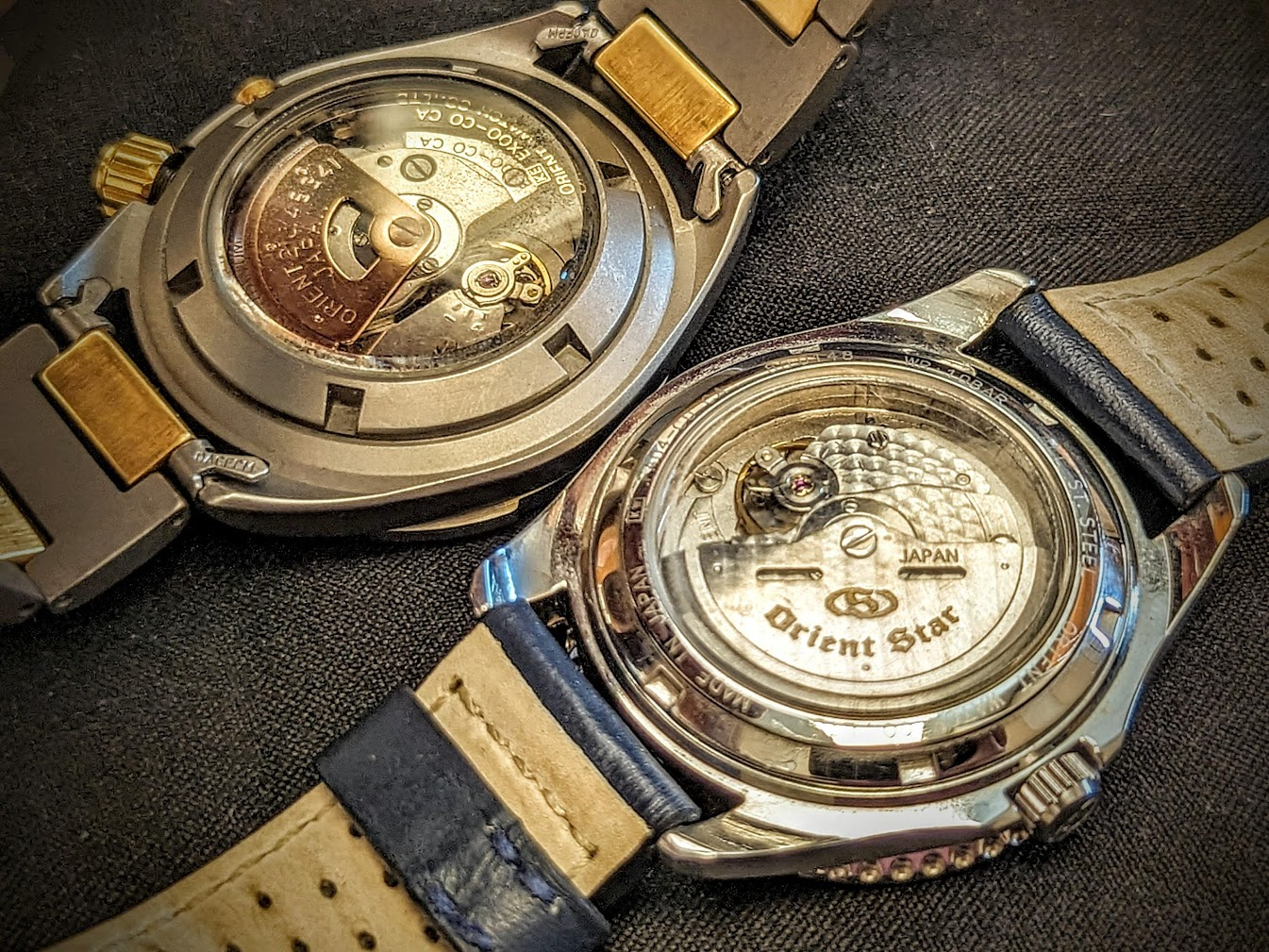
Orient's 46 family of automatic movements is perhaps the best-documented piece of this brand's history. This probably owes to both the importance of the 46, and to its extremely long life spanning all the way from 1971 until… well, pretty much today, actually!

So while there's not a lot I can write about factually that hasn't already been written and posted before by watch historians, this blog cannot be complete without offering the story of cal. 46, with some added personal perspective.

Origin

Throughout the first two decades of its existence, Orient used numerous mechanical movements. We've covered some of those on the blog, like the T-Type, N-Type, and L-Type. At some point, management must have realized that adopting one architecture and sticking with it, would be more profitable and allow them longer-term planning.

So, Orient turned to the Seiko, their older, bigger neighboring watchmaker, to source some know-how and designs. It has been said that Seiko at the time believed their future lies in the newly introduced quartz movement, and so they figured making a little extra money off of an aging technology made sense.

Orient happily licensed Seiko's latest movement, caliber 7006 (Seiko mechanical movement engineers apparently kept working arduously despite any mocking grins from fellow quartz people!). They added Seiko's old and proven Magic Level winding system and, hey presto, caliber 46 was born.


Iterations

During its five decades of production, the movement went through numerous updates, and spawned many variations. These variations offered different dial layouts, additional "complications", and occasional changes to the main plate and bridges, required to accommodate the various new parts.

Some of the functions presented with cal. 46 versions included Power Reserve indicators, World Time indication, 24-hour hands and AM/PM indicators, and more. Some versions included the day, the date, both – or none.

The top-level versions, used in Orient Star Royal and Royal Orient, such as the 46L, 46M, and 46T, were equipped with hand-winding and second-hand hacking. These were also regulated to a higher accuracy of +10/-5 seconds per day, compared to the usual +25/-15 of the regular caliber 46.

The following table contains the different versions of caliber 46.


Key Models

It's impossible to list all the significant watches released by Orient with caliber 46 inside. But here are a few highlights…

Orient HiAce, or HA, was one of earliest product lines using caliber 46 (as well as the similar spec cal. 48). Many versions of Orient HA were produced between the early to mid-1970s, offering a great variety of designs.


Another line of watches that's been around since the early 1970s is the SK (Sea King or Super King, depends on who you ask). This was the 46-based heir to Orient's earlier divers (World Diver and King Diver).


The ever so popular Orient "President" or "Day Date" Rolex homage was also a member of the family – specifically the 46E variant, with its full-weekday display.


In 2004 Orient launched its highly successful line of divers, with the release of the Mako and Ray. Both used caliber 46943.


In 2011, Orient paid tribute to its historic movement with the release of the 469 40th anniversary model. Two references were produced in limited numbers – one in stainless steel, and the other black coated.


And there were, of course many other significant releases. Like the EW00 series running Orient's first Power Reserve movement, cal. 46F; the first generation M-Force with its cal. 46G (and then, later generation); and so on, and so forth. Countless variations, in a line running more than forty years, an ongoing ode to a movement that might not have had the glory of Japan's foremost watches like Grand Seiko or Citizen Leopard, but made the Orient brand a staple of robust reliability.


Modern Reincarnations

Like all good things, the 46 lineage too had to come to an end. Perhaps, as no more letters were left in the alphabet (though they only reached the letter "Y" – there was no 46Z)… but more seriously, it was a case of an aging architecture that led to inefficient manufacturing.

In 2012, Orient began work on a new generation of movements, the 46-F6 (or "F6" for short). As the name hints, there was and still is much of the 46 heritage in the new movement. The F6, finally put to production in 2014, utilized the same barrel, third wheel, escape wheel, pallet fork, and balance wheel as the 46. However, Orient engineers produced a new modular "envelope" of plates and bridges that were designed to accommodate the different requirements of various complications without changes, resulting in more economical manufacturing.

Further updates to the movement led to the introduction of the 46-F7 in 2017 (with improved accuracy and power reserve, and even sharper decoration techniques), and the 46-F8 which finally saw the replacement of the aging cal. 46 steel balance wheel with silicon.


The top photo and table are copyright of the blog. The table includes info from of WatchManDan's list of Modern Orient Movements. Other photos in this post were taken from various sale ads.


Sunday, 15 March 2020

Orient's World Time and GMT Watches


World time watches are intended to allow one to check the time in different parts of the world. Orient's fascination with world timers goes back many decades, to some of the brand's oldest designs, like the world diver and SK.

At first, these were very simple devices, using a 24-hour bezel to allow one to check the time against a layout of world cities manually. Later on, smarter options popped up, like the "FE" line up, where caliber 46P operated a 24 hour hand (which still had to be checked manually against a world cities bezel).

However, in the early 2000s, Orient began introducing more useful movements and traveler watches. Today we will be looking at these proper world time and GMT watches.

The following table contains the different movements produced by Orient that included a functional 24-hour disk or hand. For each caliber, you can get an indication of the movement code (that is also part of specific watch references) and the sub-brand in which it was used: "regular" Orient, Orient Star, or Royal Orient.

Caliber

Code

Launch Year

Used in

Jewels

Hack-ing

Hand Wind

Seconds Indicator

Date Indicator

24 Hour

46L

FB

2003

ROYAL/ STAR

 21

yes

yes

center seconds

pointer @ 9:00

Disk

46T

FL

2003

ROYAL

23

yes

yes

sub seconds @ 9:00

pointer @ 6:00

Disk

46K

FA

2003

ORIENT/ STAR

21

no

no

center seconds

pointer @ 6:00

Disk

46H

EY

2007

ORIENT

23

no

no

sub seconds @ 6:00

pointer @ 9:00

Disk

48H

FZ

2008

STAR

 23

yes

no

sub seconds @ 6:00

pointer @ 9:00

Disk

40P

DJ

2010

STAR

22

yes

yes

center seconds

window @ 3:00

Hand

48K

DH

2012

ORIENT

21

yes

yes

center seconds

subdial @ 6:00

Disk

40H

JC

2013

STAR

24

yes

yes

subdial @ 6:00

subdial @ 9:00

Disk


The earlier movements (before caliber 40P of 2010) used a 24 hours disk that was synchronized with the time; however – as opposed to the simple 24-hour hand of caliber 46P – the wearer would be able to adjust the disk to a specific time zone, in half-hour intervals. This way, you could use the central hour as your local time, and the disk to check the time in other places. The typical design would also have a world city bezel that could be aligned with the disk so that you could tell the time in every city.

Here are some photos from a 2003 catalog, showing these early world timers:


A GMT watch would typically differ from a world timer in that it shows one additional time zone, allowing a much clearer observation of the time in that time zone compared to world timers.

Orient's first true GMT watch was introduced in 2010, featuring an adjustable 24-hour hand, in the shape of caliber 40P. The beautiful watch housing this movement became an instant classic, and received the much-inspired nickname "Star Seeker". Over time, a number of different watches used this caliber:

·         References WZ0011DJ (shown at the top of this post) and WZ0021DJ, the original star seeker GMTs with black and white dials respectively, with an internal rotating 24 hour bezel, a steel bracelet and a "cyclops" over the date window.
·         Ref. WZ0031DJ, with a black dial and leather strap.
·         WZ0041DJ and WZ0051DJ, introduced in 2011 with black and white dials respectively, were very similar to the 2010 release, however without the cyclops.
·         WZ0061DJ and WZ0071DJ, introduced in 2014, featured a simpler design and let go of the internal rotating bezel. The first featured a black dial, while the latter had a beautiful blue dial, both on a steel bracelet.
·         And then last but not least, came the limited edition WZ0081DJ, similar to the 2014 release, and featuring a fantastic grey dial and brown leather strap.


In-between the "DJ" models, Orient also presented a new line of world timer style of watches, the "JC" line-up. References WZ0011JC, WZ0021JC, and WZ0031JC featured black, blue, and white (or rather, ivory) dials, respectively. More variants were later introduced in 2017.


Since 2017, Orient did not introduce new World Timer or GMT models. Isn't it time for a new, caliber F6-based GMT watch from Orient? Many fans of the brand would surely love one! For now, we'll have to wait and see.


Some of the data in the table of movements was taken from Dan's (watchmandan.com) very useful list of movements. Photos of the 2003 catalog were taken from the archive of Yeoman Seiko's fantastic old blog. Other photos are from official Orient publications.


Wednesday, 22 May 2019

New Model Announced - Orient SK Reissue


Orient announces today the upcoming release of a new model: a faithful reissue of the 70's Orient SK (which was reviewed here on the blog a few weeks ago)

 
The new Orient SK reissue will be launched in June 2019 (very soon!) and production is planned to continue for less than a year, until March 2020. In other words, this will be a limited production.

Orient will be making three versions of the new SK – one (ref. RN-AA0B02R) in the radiant purple color very much associated with the original SK, another (ref. RN-AA0B01G) in greyish-green (also a well-loved original) and the third (ref. RN-AA0B03L) in dark navy blue.


All versions seem to be externally almost identical to the original, while internally the model will use an up-to-date movement, cal. 46 series F6, which hacks and hand-winds.

The case has the original model's asymmetrical shape, rounded on the left and straight lines on the right side, where the two crowns are – one for setting the time and date, the other for turning in the inner bezel. The classic's push button at 2, used for setting the day, is omitted here as it is not supported by the new caliber.

Case measures a healthy 45mm wide and 46mm lug to lug, and prices would be around 270 USD.

The blog's verdict: we like it! It is a fun, pure original Orient stuff, sporty and oozing with character. What do you think of the new SK re-issue?

Sunday, 5 May 2019

The Orient Sea King


The Sea King (SK for short) is one of Orient's most popular vintage dive watches. The SK dynasty has been running since the late 70s and well into the new millennium. While it has changed its shape a number of times, the SK retained a number of key features.

First of all, SKs use the Orient Caliber 469, usually the 21 jewel version. The 469 is super reliable, robust and shock-proof. A proper workhorse for watches built to last decades. While far from offering chronometer specifications, it can nonetheless retain reasonable accuracy for many, many years before requiring service.

Sea Kings typically feature two crowns and a push button. The push button would be for changing the weekday; the main crown at 3 would be adjusting the time and date (the cal. 469 does not hand-wind).

The crown at 4 would be for rotating the inner bezel. On some SK versions this would be a divers' bezel, often in very colorful form. Other SKs feature a GMT bezel. Some of the later models featured a navigation bezel.

All Sea Kings were made in sizable cases, generally measuring between 40-42 mm in diameter excluding the crowns, and with thick lugs, ensuring a good heft and wrist presence. Available in a variety of colors, it is very easy to find one that suits your mood.


The particular SK at hand appears to date back to the late eighties. While I do like the many colorful versions of the SK, I actually find this specimen to be a very cool piece despite – or possibly, because of – its mostly black dial.

The combination of the solid dial and smooth (i.e. not coined) bezel, makes this a very versatile daily wear. All this, in a generously sized case and packing the robust cal. 469, are making this Sea King much more wearable than most inexpensive vintage watches.


The watch you're seeing here in the photos is actually for sale, so if interested – get in touch, preferably via a message on the blog's facebook page. Asking price is a modest 180 USD, including standard international shipping and eBay fee. It also includes both the original bracelet and the great Martu Leather "Drakko" strap shown in the photos – which is thick, soft, uniquely textured, and fits the watch dial perfectly.


As you would expect from a well-kept Sea King, this specimen looks good, works well and does not look outdated at all. It appears that it was not worn many times, and probably spent most of its life at rest. Case size is 41mm width without the crown, 49mm lug to lug, and 20mm lug width.


So, there you have it – another fine Orient classic, this time with an opportunity to own it!