Orient Place

Orient Place

Thursday, 30 March 2023

The Hinomatic and the T-S Type Movement


We're now going back in time to the earliest documented history of Orient. We know some facts about its incorporation – how it launched as Tama Keiki Co. in 1950, and was renamed Orient a year later and launched its first "Orient Star" model – But there's very little record of the factory's watchmaking activity between then and 1955.

Then, in 1955, Orient launched its first documented in-house designed movement, the "T-S Type": a hand-winding, central seconds, 18,000 BPH caliber.

We do know it was not 100% made in-house, as some of the parts could not be manufactured by Orient at that time – it took two more years for Orient to accomplish the finishing of some of the finer parts of the mechanism. And obviously the design borrowed from an existing movement (I believe one by Citizen).


One of the interesting features of the "T-S" type was its hacking mechanism. This was not a very common feature at the time, and it seems its implementation by Orient had not been perfect.

Generally, when the second-hacking mechanism is engaged, it puts a sudden stop to the movement of the second hand, which can cause the balance wheel to stop abruptly as well. This sudden stop can cause additional wear and tear on the watch movement, especially if it's done repeatedly or incorrectly. Possibly, the "T-S" was not properly designed to withstand the additional stress caused by the second-hacking mechanism. Ultimately, many watchmakers removed the hacking mechanism when the "T-S" was brought in for repair.


Anyway, the movement was good enough to form the basis for the brand's new watch, the "Orient Star Hinomatic". It was not, of course, automatic – all Orients at the time were purely hand-winding machines – but it was manufactured at the brand's Hino factory in Japan. And it also became the brand's first export, as Hinomatics began selling in China.


Note that while some sources mentioned the Hinomatic as the first central-second Orient, it was in fact preceded by the Orient Star Center-Second (that used a non-Orient movement).

The Hinomatic Sports was produced in a number of versions until 1957, when the T-S type was replaced by the improved T type movement that spawned an abundance of new models. But – that would be the topic of a new post…


Pictures that appear in this post were taken from the 1999 Orient Watch Catalog book, and old Orient sale ads.


Sunday, 12 March 2023

The Orient M-Force "Beast 2 / Delta"


M-Force. Beast. Delta. The words alone make you think of a mighty dive watch. Now think 49mm diameter. In your imagination, this already takes shape of something worn by a Viking, or by Arnold Schwarzenegger. Well… you're not far from the truth.

We've covered the M-Force lineage here on the blog before. M-Force watches, first introduced in 1997, were named after three "M" words – Mechanical force; Maverick design; and, Massive. Since their re-introduction in 2011 they were also built to meet three important standards in watchmaking: ISO 6425 for diving, ISO 764 for anti-magnetic watches, and ISO 1413 for shock resistance.


The model we're looking at today is the 2014 model also known as the Delta version, or the Beast II (Beast "I" being the left-hand crown M-Force released in 2012). Specifically, the red dial model reference EL07002H, or JDM reference WV0161EL.

The Delta was, and to this date is, the biggest of all M-Force watches. Measuring 49.1mm across and 54.1mm long, it leaves behind models like the first Beast and the current M-Force, measuring 47mm.

The numbers could be a bit misleading though. Like many M-Force models, this watch has a somewhat irregular design. The crown guard is mirrored by a similar shape on the left side of the watch case, adding to the width; and it does not really have lugs, instead having an integrated bracelet dipping from the edge of the case, making it a lot more wearable than what 54mm might have you think.

Still, it's big.


Big, and tough. Taking photos of this piece with a toolbox wasn't so much a stylistic decision as much as being mandated by the watch (I swear, it demanded to be photographed this way!)

But, okay, enough with dimensions already. What else does this watch have to offer?

The first thing you'll note is the gorgeous deep red dial, shining below the sapphire crystal. Look at it closely, and you'll appreciate the intricate paint job. It has a non-industrial feel, which even reminds me of some "Urushi" lacquer-painted dials I have seen. That, along with the grooves and other marks and textures, makes the dial stand out – particularly, but not just, under direct sunlight.


It's not just the color, but the dial really works well. The applied markers are big and bold, and align perfectly with the minute track. The power reserve indicator is nicely designed, clear but not too intrusive, as is the date window. Other markings include the Orient and M-Force logos, "automatic" and "200m".

Legibility is aided by generous lume (as one would expect from a proper dive watch). Here, Orient even went the extra mile and added lume to the power-reserve needle.


The case is quite thoughtfully designed. As mentioned, its symmetry, other than mirroring the crown guard, adds character, and makes room for Orient to play with different finishing styles. So, while the top of the case, as well as the crown-guard surface and its left-side sibling are lightly brushed, the diagonal sides of the case are polished. This combination leaves the impression of quality and attention to detail.

The crown too is really nicely designed. It's big and super grippy, and fairly easy to screw and unscrew. The red ring is both aesthetically pleasing, and serves as a reminder for the wearer to keep the crown locked in. Note the slight wobble of the crown: it's not freely moving as in cheaper dive watches, instead requiring some minimal force to push around, but it's definitely noticeable. This feature is intended to prevent a knock on the crown from damaging the stem. Some people find this an unwanted behavior. Personally, I don't mind the wobble, and it has no effect while the crown is locked.


The black IP bezel is also worth mentioning, as it's among the better I've encountered – certainly at this price range – as good as Orient's legendary Saturation Diver. It provides a good grip and requires just the right amount of force to turn. It clicks into position securely, and stays there with practically zero back play.

The bracelet is solid, comfortable and well made. The clasp allows for micro-adjustment but does not include a diver's extension; and it is stamped, rather than milled, thereby becoming the only part of the watch which appears to have been compromised to meet a budget, with most other parts really punching way above its price point.

Overall, the Delta on its bracelet provides a well-balanced wearing experience, if you can pull it off. I'm not sure of its weight – clearly well over 200g – so other than size, this watch is intended for those who appreciate heft in a sports watch. But on my 7.25" wrist it felt good, the 14.6mm thickness is noticeable but proportional, and the case shape helps it sit nicely on the wrist. You never forget the watch is there – but you don't mind it either. In fact, you should very well like it!


The M-Force Delta is powered by Orient's automatic caliber 40N5A. It provides automatic winding and second-hand hacking, and well deserves to be called "workhorse movement". Its specs state +25/-15 seconds per day accuracy – mine does about +6 seconds.

The case-back, in case you're wondering, is solid and does not offer any view of the movement, nor does it offer any decoration. It simply bears the Orient and M-Force logos, and the usual technical info.


The M-Force Delta has been discontinued since 2016. You can find pre-owned ones, either with the red dial or other variants (black and blue) at around 450-600 USD, and once in a while a NOS/NIB one might pop up as well (not necessarily at a higher price). The rarer "Subaru STI" limited edition of the Delta is hard to find and likely to cost much more.

If you do buy a pre-owned watch, make sure you get enough bracelet links to match your wrist, as the integrated bracelet cannot be replaced with after-market substitutes.

If you like your watches big and tough, and got a wrist to match, you would very likely love this version of the M-Force. The combination of good looks, high quality, and durability, are hard to beat. And even if you do beat it, the M-Force can take the punch, easily.


Thursday, 23 February 2023

1976: When Orient Went Digital

1976 was an interesting year for Orient. It was a year when the brand's catalog exploded with digital innovation. So this post will diverge from the blog's usual penchant for the mechanical and the analog, and we'll look at some numbers that instead of being painted on a metal dial, are composed of seven segments.

That fateful year (just kidding, it wasn't really fateful, just technologically good) Orient introduced two models of particular interest, one a world's first – and the other a Japan first.


The world's first was the Touchtron – the first touch-operated digital watch, developed jointly with Sharp Corporation of Japan. The touchtron's display would turn on to show the time when touched, and then display the date when touched again. Normal buttons were used to set the time.


Orient presented a number of models, ranging in price from JPY 34,000 to 38,000. They were technically the same, only differing in size and construction. For comparison, Seiko's King Quartz would cost JPY 58,000 that same year, as would Casio's "Casiotron" – the first digital watch with an automatic calendar.

The first models introduced were ref. 680101, shown above, ref. 680102 – shown below, and 680103 beneath it. More models emerged later on.


Novelty aside, it appeared that owners complained about the watch lighting up inadvertently, as the touch sensors were, indeed, sensitive to touch. So not long after Orient introduced the "Touchtron II", where the touch display was replaced by a button below the LCD screen.


The other novelty presented in 1976 was a solar-powered LED watch – the first in Japan, and fairly novel globally as well. It should be mentioned that round about the same time, Citizen presented the Crystron, which was the first solar analog watch.

As you can tell from the ad above, Orient were quite proud of their digital quartz watches; so much so that they started selling the "quartz meter" – a device designed for timing and testing other quartz watches.


It's worth noting Orient also produced "normal" digital watches at the time, like this oh-so-seventies piece below, adorned in the brand's signature "Jaguar Focus" color scheme.

It's also interesting to see that LCD watches equipped with a internal lighting, to enable night-time viewing, were also priced at around JPY 38,000 – similar to the Touchtron. So, the true novelty was valued similarly to a standard LED light… Apparently, even back then Orient would price their watches almost too modestly.

Luckily the Touch and Solar watches had LED displays, that shone in red and did not require additional lighting, or their price might have risen close to a whopping JPY 50,000…


Pictures that appear in this post were taken from old Orient catalogs and sale ads.


Wednesday, 15 February 2023

New Diver and Classic Models From Orient


Last week Orient presented its first new Orient Star models of 2023, and today – it is announcing this year's first new non-Star models: a diver style watch (a.k.a Mako II), and a kind of Bambino with added sub-dials. Thankfully, Orient aren't playing the "limited edition game" and all the new versions are colors will be available in regular production.


"Classic and Simple"

Classic and Simple is the tagline Orient has attached to its line of dressy watches like the Bambino. The new model might be more Classic and Complicated, though, with the addition of two sub-dials, one for the week day, and another displaying the 24-hour time. The date window remains in its classic 3-o'clock position.

All these goodies are combined with a dial similar to the Bambino V2, with its roman numerals and thin hands, and placed inside a classic Bambino case measuring 40.5mm wide, 46.5mm lug to lug, and 12.6mm thick (only 0.3mm thicker than standard Bambino). The crystal is mineral glass, and lug width – still 21mm.


Five references are being introduced at this time:

·         RA-AK0701S (RN-AK0701S) with a white dial and a black leather strap

·         RA-AK0702Y (RN-AK0702Y) with an ivory dial and a brown leather strap

·         RN-AK0703E (Japan reference only) with a green dial and gold markers, and a brown leather strap

·         RA-AK0704N (no Japan reference) with a grey dial and a grey leather strap

·         RA-AK0705R (RN-AK0705R) with a red dial and gold markers, and a red leather strap

The new model uses Orient's automatic caliber F6B22. All references are similarly priced at around USD 280 – about 50 dollars more than the classic Bambino.

Will the Bambino's classic looks, and the charm of the domed crystal and dial, still work with the added complications? We'll need to see this one in person to judge!


"Diver Design"

Diver Design is how Orient refer to its models that are styled like dive watches but are not ISO-Standard divers, such as the Mako and Kamasu.

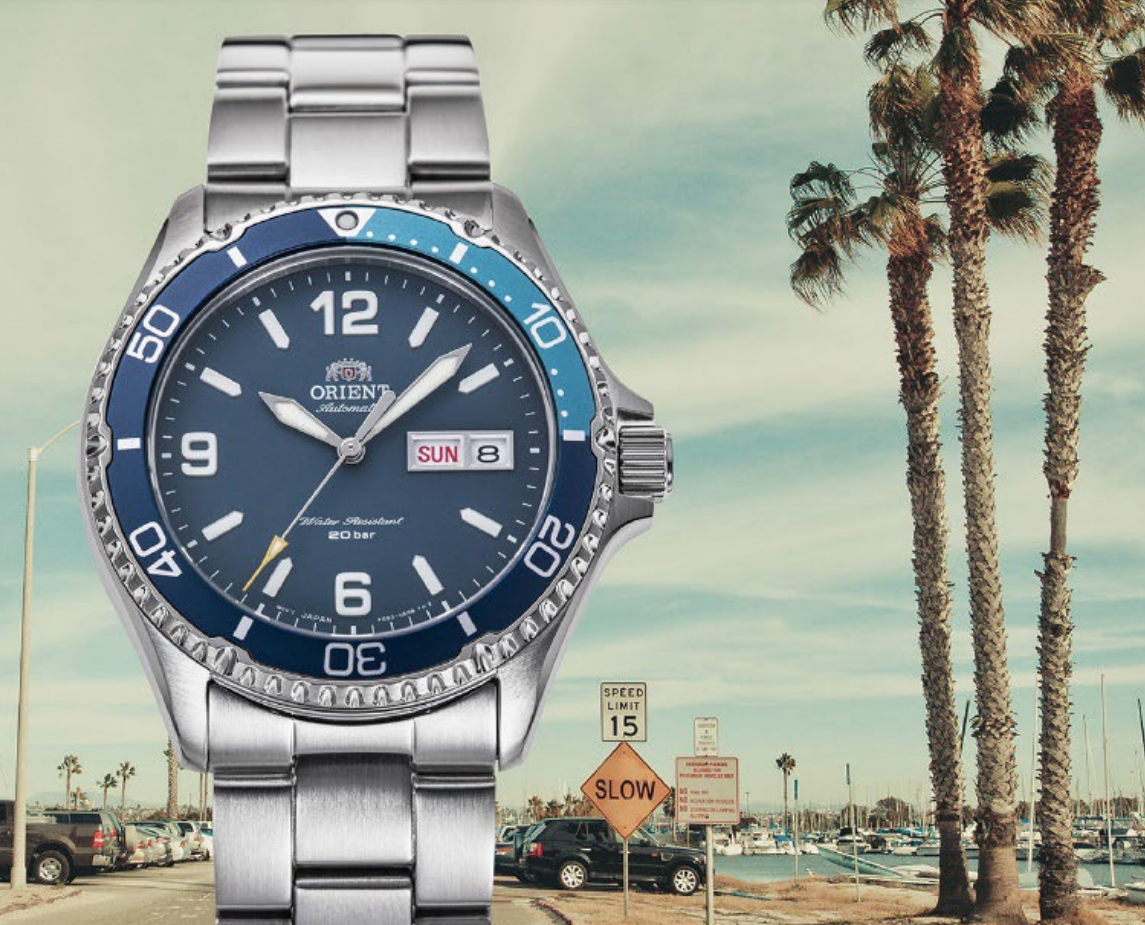
The new releases belong in the "Mako II" family, characterized by its big Arabic numerals at 6, 9 and 12. Other than the hour markers and hands, these are identical to the Kamasu, having its updated bezel and sapphire crystal.


Four references were introduced:

·         RA-AA0818L (RN-AA0818L) with a blue dial, and matching bezel in two shades of blue.

·         RA-AA0819N with a grey dial, and bezel with shades of grey

·         RA-AA0820R with a red dial, and bezel with shades of red

·         RA-AA0821S with a silver dial, and a grey and orange bezel

Indeed most of these models are not presented to the Japanese market – but then again, they already have their special editions available only on the JDM online store!

All references share the technical details: 41.8mm wide case with 22mm lug width, 20 bar water resistance, and lumed hands and markers. The movement is automatic caliber F6922, with its day and date display, hand-winding and hacking.