Orient Place

Orient Place

Tuesday, 21 December 2021

Happy New Year, Blog Readers!


And so another year draws to its end. 2021 was as interesting a year as its predecessor was – and while not all aspects of this similarity are positive, on this blog we remain optimistic and focus on the brighter sides; so for us, this was simply the 70th anniversary of Orient Star.

Orient too made every effort to remain positive and released plenty of new models, both Orient Star and "regular Orient". Some of these took inspiration from the brand's history, some continued the watchmaker's current design trends, and some – took on a new path.

Among those numerous new releases, I took the liberty of selecting my favorite three models to go on the blog's podium:

At third place – I have chosen the flamboyant MOP-dial limited edition moon phase watch. It is relatively complicated (compared to the brand's other models), well made, and unashamedly flashy. Honestly, it is the latter trait that earned it a place on the podium.

Second place goes to the new Orient Star Skeleton with its 70-hour movement. A technical achievement for the brand, the silicon-escape-wheel-equipped caliber F8B62/63 is likely only the first in a series of future 70-hour models (hopefully costing less than this flagship piece), hence its importance – and its place on the podium.

In what might seem a stark contrast to the above high-end pieces, my personal vote for first place goes to a much simpler model. Orient's World Dial re-issue captured the hearts of many fans of the brand with its cheerful colors and old-world charm, taken directly and very faithfully from the original 1960s model. Being true to the brand's DNA and history is why the World Dial watch is my Orient Of The Year 2021.


Needless to say, that is just one person's opinion… so what do you think? What are your favorite Orients of the year? And what are you hoping to see from the brand in 2022? Please leave your comments and voice your opinion.

…and most importantly – may all blog readers and followers, their families and friends, have a very happy new year!

Thursday, 9 December 2021

Orient Star 2021 Classic Semi-Skeleton Hands-On Review

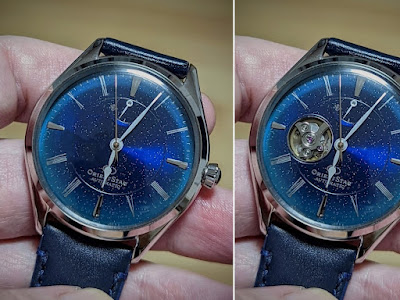
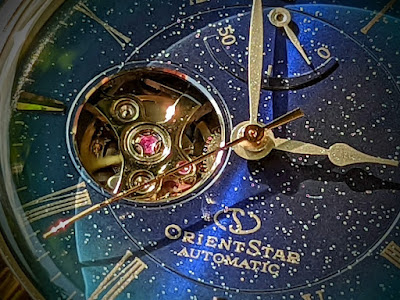
The latest generation of Orient Star Classic Semi-Skeleton watches was introduced about three months ago. Shortly afterward, Orient presented a limited-edition version of that model, featuring a deep blue dial adorned with little sparkles. This model, reference RE-AT0205L (or RK-AT0205L in Japan) is the subject of today's review.


How It Looks

The new semi-skeleton immediately stands out among other members of the Orient Star Classic line-up. Whereas the rest of the crop feature lugs that project very markedly from a round case, here the case and lugs flow together seamlessly.

Somehow, this flowing shape makes the watch look radically different from its predecessor. Despite the familiar Orient elements, like the power-reserve indicator and (obviously) the open-heart aperture, the overall feel of this timepiece is very un-orient-like.


More precisely, it is unlike most men's Orients. Its design makes more sense when viewed next to some of Orient Star's recent ladies models: that's where you will find more of these smoothly flowing cases. Now add the cabochon, set into the crown of the new Semi-Skeleton, and it becomes clear this isn't less Orient-ish than past models, it is just a little less masculine.

There's nothing wrong with having a watch that is more subtle in its gender specificity. Looking at many classic Swiss dress watches, you can appreciate that their styling is actually more unisex than either male or female. Quite possibly, it was this timeless European elegance that Orient's designers were aiming for.


And elegant it is. Polished all over, with that domed crystal covering the blue dial with its elongated markers and hands. The power reserve indicator is less pronounced than in most other Orient Star semi-skeletons, so there is no apparent need to counter-balance it with a small-seconds sub-dial at 6. The centrally mounted second hand is therefore well fitted here.

Now, many readers would, at this point, likely complain about the open-heart. A common claim is that many Orient watches would look better with a full dial. Well, I tried to simulate what this model would look like if it was not a semi-skeleton; well – I don't know, it just seems less interesting to me. More classic dress watch perhaps, but we've got plenty of those, right? And then it wouldn't be an Orient.


The dial looks particularly fine when some stronger light shines on it. Then, the navy blue dial becomes more vibrant, revealing lighter shades and even some greenish hues around the edges. The flat hour markers wear warmer tones, and those tiny dots begin to glitter.

The hands and applied markers aren't the sharpest I've seen on an Orient Star, but they are still nice enough. Overall, the dial just works – it is well balanced, and is as elegant as the case.


How It Wears

This Orient Star makes for very comfortable wear, thanks to its moderate dimensions, smooth case, and well-made strap and buckle.

It is a tad larger than the previous model: case width is 40.4mm without the crown, length is 46.6mm, and thickness is 12.8mm. The watch weighs 74g on the strap – considerably less than, say, the 90g of the layered skeleton on leather.


These dimensions make it a fairly versatile watch – it would wear perfectly on wrists 6.5"-7.5". I reckon it should still be comfortable on 6" wrists as well, though it would look a bit on the larger side, and therefore perhaps more sporty and less dressy.

The 20mm strap supplied with this watch is of good quality (and has a very strong leather odor when unboxed, which I like). It was initially a little stiff, but did not take more than an hour or two on the wrist to break down and become flexible enough – while being nicely padded and not overly soft.


The folding buckle attached is also well made. I've seen it before on Orient watches, and it really is good – it feels secure, easy to use, and very smooth and unobtrusive on the skin.


How It Functions

The Classic Semi-Skeleton is equipped with Orient's caliber F6R42. This movement offers a 50 hour power reserve, and declares an accuracy of +25/-15 seconds per day. On my review sample, the watch actually did a mere +5 seconds per day; and when being put to rest a couple of days, while its power lasted, only lost a couple of seconds per day.


Checking the time on this watch is a simple affair. The hour and minute hand contrast clearly against the dark dial. Thanks to this, low light legibility is more than acceptable for a dress watch, despite having no lume on the hands or markers.

Crown operation is decent, though a slightly larger crown would have been more convenient. Winding feels a little rough, as in some Orient watches, but setting the time is a breeze (as would be expected).


As far as everyday usability, this is a dress watch and should be treated as such. The highly polished case and non-sapphire crystal are not intended to be worn working in the silver mines, and the 5 bar water resistance means you are not going to go shark hunting with this watch, either (by the way, I strongly recommend against hunting sharks anyway).


The Bottom Line

The new Orient Star Classic Semi-Skeleton is a handsome watch that takes a slight diversion from the familiar design lines of the brand. It's not just the case that is more polished, it is the whole concept. In this respect it is somewhat reminiscent of the Orient Star Diver, as both watches do not ignore the traditional aspects and DNA of the brand, but instead deliver them in a more rounded package, possibly aiming to attract buyers outside the existing circle of fans.

Whether one likes the new design or not, and whether one prefers it over the old styling or not, is totally subjective. What is objective, is that the quality is definitely there – the mechanics are sound, the finishing is fine, and attention has certainly been given to little details such as can be found on the dial and crown.


The new model can be found online nowadays at around $500 USD, slightly below the official price. This is about 100 dollars lower than current asking prices for the previous model (ref. RK-AV0011L would be the closest in terms of dial color).

This represents good value, whichever way you look at it. Indeed the lack of sapphire may be offputting to some, but I understand that Orient were looking for a warmer, old-school vibe here with that purposefully domed mineral glass. Clearly, when Orient wants to put sapphire in their watches they do it, at almost any price point.

Bottom line is, if you find the new design attractive, you are likely to enjoy this watch. There is nothing wrong with it – it is comfortable, legible, and well-made. And if you find this limited edition's dial too glitzy for your liking, there are three other versions to choose from.


The blog would like to thank Orient – Epson Europe for providing us this limited edition Orient Star Classic Semi-Skeleton watch for review. 


Thursday, 25 November 2021

Orient Star Retrograde WZ0041DE Review

Earlier this month I wrote about Orient's retrograde watches. I usually like to follow such stories with some hands-on review of an actual model, and this one is no exception… So, without further ado, I give you the Orient Star reference WZ0041DE!


This watch does not need much time to impress, in fact – it only takes one quick look to start admiring it. Admiration that grows when you begin examining it more closely. We'll dive into the details shortly, but I think the thing about it that drives that immediate appreciation is a very precise, appropriate ratio of metal shininess to subtle dial space.

You can also talk about harmony and balance and proportions. But I guess another, even better way to put it would be: it's a pretty little machine, really.


The markers and other dial elements – most dominant of which is that arc secluding the retrograde weekday display – are beautifully executed, and reflect light in a near-Grand-Seiko-like manner of sparkle.

The hands are relatively simple, but just as well executed. The big hour and minute hands are lumed, as are the small dots next to each hour marker. Other, smaller hands, are not – and thankfully so, leaving the nighttime view uncluttered.


Behind, on the dial surface, Orient has provided plenty of intricate textures to keep matters more interesting. So, on the broad surface of the main dial you get wavy concentric shapes that change into circles around the hour track. The weekdays sub-dial is decorated with a flowerlike relief. The date and power-reserve sub-dials are adorned with simpler geometric shapes.

While looking very cool under the macro lens, these textures also have a positive impact on how the dial appears from a couple feet away. They do not just create a pleasant matte look, but because of the varying textures also produce differences in the shades of white around the dial. It's effects like this that make the Orient Star look more expensive than it is.


On the wrist, the WZ0041DE is very comfortable. It might be thicker than most dress watches at 14.3mm, but talking in absolute terms this is still very acceptable – similar to many dive, sports and chronograph watches.

The other dimensions of the watch are all very restrained, being 39.5 mm wide without the crown, and 46mm lug to lug – perfectly wearable on most wrist sizes. It would look good on smaller wrists, whereas the visual mass of the steel bracelet prevents it from looking lost on bigger arms. That said, it might be a good idea for people of larger wrists to stick with versions such as this reference, which come on a bracelet, and avoid the ones that come on a leather strap.

Speaking of bracelets – this one here doesn't just look good, but is really solid and well made. It definitely adds to the wearing comfort of the watch.


The movement, as mentioned in the previous post, is caliber 40A50. Other than the retrograde complication, it operates very much like other movements in the caliber 40 family, with both automatic and hand winding, and second-hand hacking. The date and day are both adjusted from the crown, in the second position, while time is set in the third (outmost) position.

One important thing to note, in case you buy this watch without its original manual: while most non-retrograde variants of the caliber 40 family allow you to set the date and day after 2am, here (and in other Orient retrograde models) you should not change the date between 10pm and 4am. Indeed the rule of thumb for most mechanical watches is, to set the date after 6am – but do take extra caution with this watch.

The movement offers no particular decoration, making the view from the back fairly unexciting. Don't expect to see any of the perlage and Geneva stripes found on later models.


To sum it all up – the Orient Star ref. WZ0041DE is a great example of the brand's retrograde watches. It looks great, is well made, and its myriad complications and decorations will ensure you won't get bored with it so quickly – or at all.


I would like to thank Orient fan and friend of the blog, Mr. Itzhak G., for allowing me some time to play with, and take photos of, his personal Orient Star Retrograde.


Thursday, 18 November 2021

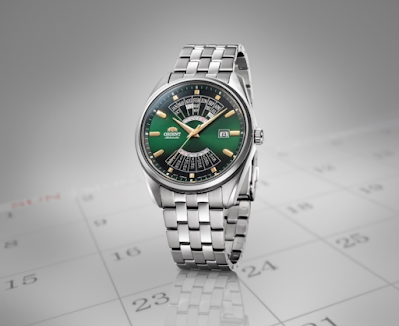
Orient Announces New Multi-Year Calendar Model

The multi-year calendar watch has been one of Orient's most popular, and recognizable, models since its first introduction in 1965. Also known, rather inaccurately, as the "perpetual calendar" (though it is not) the original design has been through numerous iterations over the years, some of which were reviewed here on the blog.

Despite seeing some different designs, the original one always wins – and now, Orient are returning to it with a brand new model. This time, on offer are a larger, contemporary case, a new movement based on the F6 family of calibers, and some functional and visual updates.


Inside, the new model uses caliber F6D22, an automatic movement featuring hand-winding and second hand hacking – two functions missing from the old cal. 46D40 that was driving the last generation of multi-year calendars. The new movement will be identified with "BA" in the reference, whereas the older models had "EU" in the reference.

The new mechanism allows the multi-year wheel to be moved using the crown, eliminating the need for an additional push button. While not mentioned in the press release, this is presumably done with the crown in the second position, when turned opposite the direction used to set the date.

The new case is a larger 43.5mm wide, compared to the 42mm case of the "standard" previous model – as opposed to the "GMT" version with the 24 hour ring, which was in fact more than 44mm in diameter. The new case measures 50.2mm lug to lug, and is 11.5mm thick.

One can see the evolution of the multi-year calendar design below: the leftmost is the first version from 1965, then follows the previous model, and on the right is the newest version.


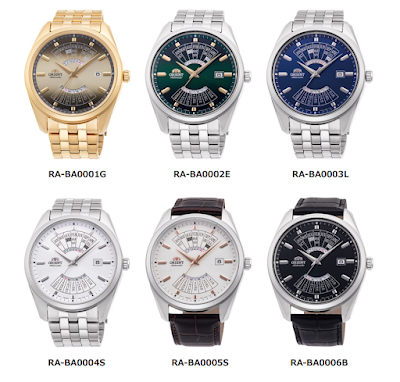
Today, Orient are presenting six references of the new model:

·         RA-BA0001G with a gold-colored steel case and bracelet, and a gradient "Jaguar Focus" dial (a very 70s combination isn't it!)

·         RA-BA0002E with a steel bracelet, a green dial, and golden markers and hands

·         RA-BA0003L with a steel bracelet and navy blue dial

·         RA-BA0004S with a steel bracelet and white dial

·         RA-BA0005S with a brown leather strap, ivory dial and golden markers and hands

·         RA-BA0006B with a black leather strap and black dial.


This is a nice addition to Orient's line-up, with a long overdue movement update. The new watches should keep fans of the multi-year calendar design happy for some years to come… prices have not been announced yet, but should not differ much from the previous model.