Orient Place

Orient Place

Wednesday, 31 May 2023

Orient Ana-Digi Models


A few months ago I posted an article here about Orient's digital watches. However, throughout most of its history, Orient stayed true to analog watch designs, even during the 1980s when much of the production went quartz.

Could the two worlds, the digital and the analog, converge? They sure could. A possible driver that accelerated this trend was the introduction of the Breitling B1 in 1998. An heir to the 1985 Aerospace, the B1 added a couple of chronograph-style buttons for a sportier look. Orient, as we know, was never late to pay homage to a successful design.


Orient adopted the Miyota T241 Analog-Digital quartz movement to form the basis for the new watch. The model was identified as a family of references starting with VZ00 (all T241-based models were identified by the VZ movement code).

The T241-based models featured all the goodies one could expect from a digital watch, including perpetual date correction, millisecond stopwatch and count-down, chime, and more.


The design proved a success – while immediately recognizable, it was different enough from the Breitling and its soon-to-arrive cheap copies, and definitely much better built than most lookalikes. And it was smaller than the B1, at 42mm vs 43mm, and lighter.

In a move also quite typical of Orient, it then took the design and evolved it to be less derivative and more unique, giving birth to four more variations, VZ01-VZ04, each of which can be found in a few colorways.


One thing that the T241 lacked was a backlight for its LCD display. Orient could (and did) add lume to the analog hands, but the digital display was thus rendered mostly useless in the dark. This might have been the main reason that Orient introduced a second line of Ana-Digi models, with the GX movement code.

The GX movement was probably also cheaper, having just one digital display instead of the VZ dual display, allowing a lower cost of these new models. It was also generally simpler, for instance only offering a "complete calendar" instead of perpetual – namely, the February month-end date had to be adjusted for leap years. But it did include backlight.


The GX lineage was much shorter than the VZ; admittedly, it was not as attractive. Orient also tried some other designs, but none was as popular as the VZ00, and the further the brand tried to distance its styling from the VZ00's, the less successful it was. In fact, while most of Orient's ana-digi watches remain fairly obscure, the long-discontinued VZ00 remains highly sought after to this day.

Orient's Japan-made lineup does not feature any new analog-digital watches. Yet, some consolation can be found in the production of sibling Orient Brazil.


Pictured above are two of the Brazilian branch Solartech models, featuring a single digital display. This watchmaker also produces Anadigi models under its Neo Sports line, with two LCD displays. As you can expect, these are beefy 45mm watches, not at all bad looking, and fairly hard – though not impossible – to obtain outside Brazil.


Pictures that appear in this post were taken from old Orient catalogs, user manuals, Orient Brazil website, and sale ads.

Sunday, 14 May 2023

Orient Star Retro-Future Bicycle Watch


Orient's "Retro-Future" family of models was the subject of not one but two stories I posted here not long ago: an overview article, and a list of references. This owes to the great interest these watches draw among Orient collectors, partly due to their peculiar but mostly attractive designs, and partly as they're just so many of them, so you're always likely to come across a nice one that you haven't seen before, up for sale.

It should therefore come as no surprise that shortly after posting those stories I came across a good looking Orient Star Retro-Future Bicycle – the very first reference WZ0011DK – and obviously, had to get it. And here it is!


Looking at this watch, you can notice both the distinctive, bicycle-themed design elements of the model, and some more unique, reference-specific aspects.

As mentioned in the overview article, the design of this model features a number of nods to bicycle components: the unique tube-like lugs, the bracelet that is reminiscent of bike chains, the dial cut-out resembling the wheel and the seat and chain stays, and other bits and pieces that look like bike parts.


One such piece is the unusual cogwheel, shaped possibly like the chain ring or sprocket (or any other toothed-wheel element in a bicycle, of which there are many!), which functions as a second "hand". A red line is painted on it to show the time, but it has no specific direction… well, it's too small to see anyway. This watch is not intended for people who need to know the exact time.

Other than that, the watch is actually pretty legible, at least considering it has a mostly skeletonized dial. If you just want to know the hour and minute, you're good. Even in low light, the lume is more than decent.


Another thing typical of this Retro Future model is the lefty crown position. Presumably, it makes wearing it with cycling gloves easier. It does feel a little strange at first, when winding the watch and setting the time. Once worn, however, it really makes no difference.


On the wrist this watch is incredibly comfortable. It's not small – 42mm wide, without the crown, some 56mm lug tip to lug tip, and 13mm thick. However, the secret sauce here is the unique lug structure. The lugs slope down sharply, making this model wear more like a 50mm lug-to-lug watch.

Another element contributing to comfort is the bracelet – and I believe this is particularly true of the rubber and steel version attached to this reference (as well as to WZ0081DK and WZ0091DK). The hardened rubber links feel very light – lighter than steel, and at the same time offer more "breathing space" than regular rubber bands. The unique design and comfort make the bracelet a real standout feature of this watch.


The yellow color, specific to this reference, adds much sportiness to the watch. Other versions of the Bicycle have their unique flavors, but the color scheme here is definitely my favorite – along with the matching yellow stripe around the case.

All in all, this is an Orient through and through, with its quirky looks and numerous little details that create a very enjoyable wearing experience. It's well made, and while not every bit here shouts out "Orient Star Quality" (no Zaratsu polishing here, mates!) it is by no means a cheap looking piece.


This takes us to the question of prices. You can find Orient Star Bicycle watches on eBay anywhere between USD 300-800, but dig a little into Japanese online shops, and you can get your hands on one for less than $200.

These are not super-rare watches; however, note that many used ones come with a shortened bracelet and may miss some links. You can get any 20mm aftermarket strap, but it would be a shame to miss on the unique original one. So it's worth waiting a little (or spending a little more) to buy one with the full bracelet, or at least having enough links for your own use.


Sunday, 30 April 2023

The Orient Star Dynamic and the T-Type Movement

A couple of months ago I wrote about the birth of Orient's T-S Type movement, and the "Hinomatic" watch built on it. Not long had passed since the 1955 launch of the Hinomatic, and in 1956 Orient introduced a new caliber, the T-Type, which would soon replace the T-S.

The T-Type, too, did not last a long time in production before it was replaced by the N-Type movement, in 1958. However, during its short life it provided the basis for numerous important models and new designs, some of which were later revisited in watches using newer calibers.


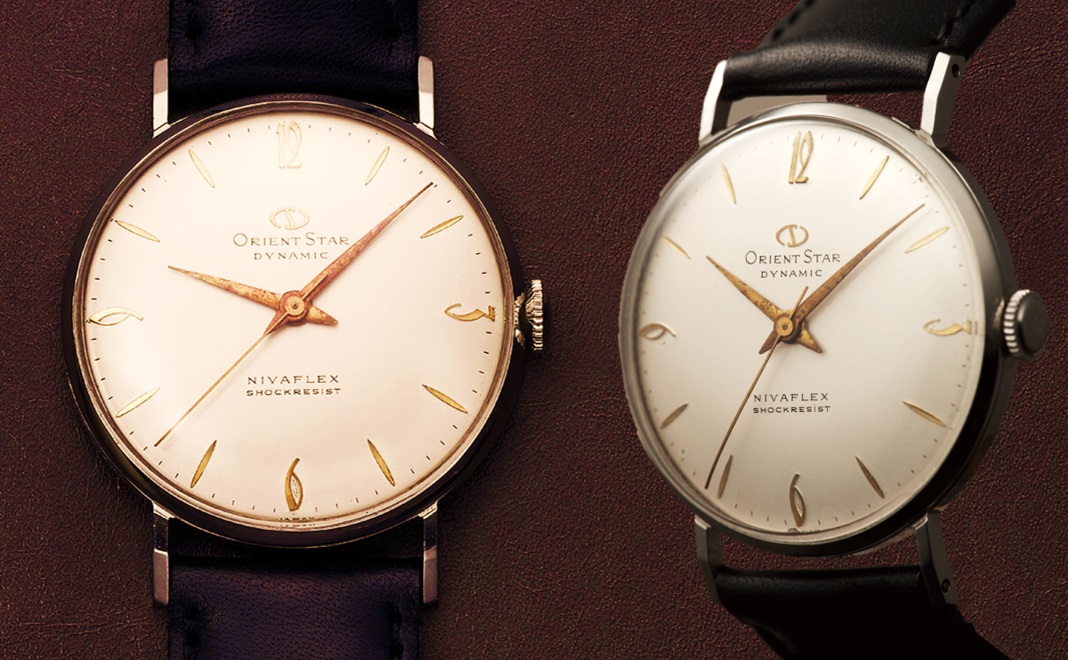
The first and most notable – and popular – model was the Orient Star Dynamic. The Dynamic started life as a fairly standard-looking watch, not much different in appearance from the Hinomatic it replaced.

Having similar looks and a movement that was, in essence, very similar to the T-S, one could be fooled into thinking this was little more than a minor update to the running production line.


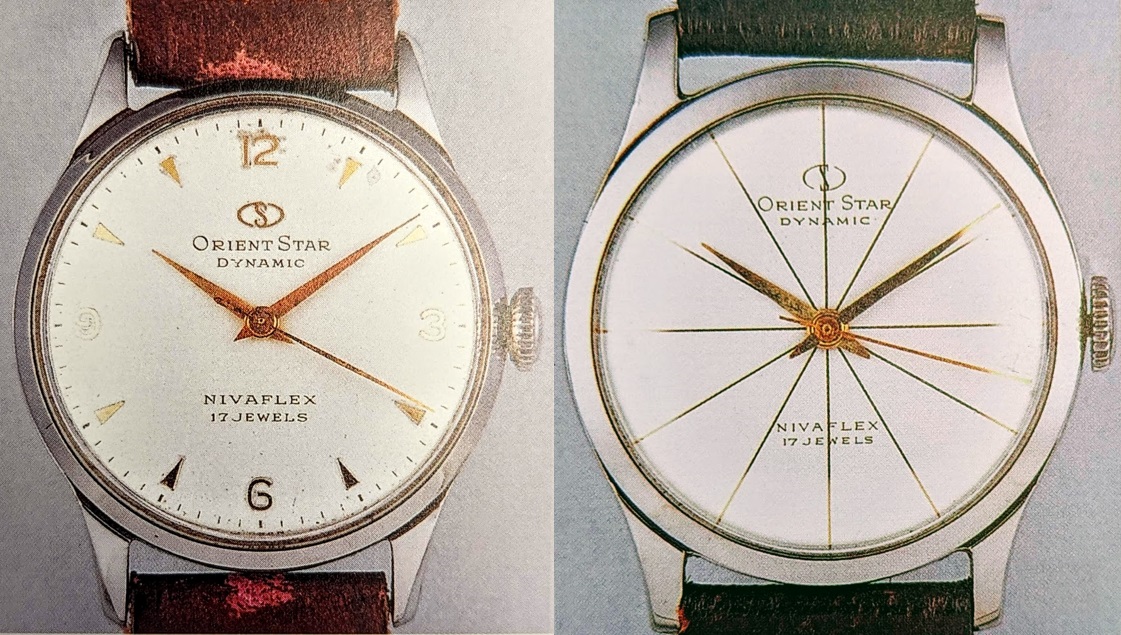
However, between 1957 and 1958, at which time the Dynamic line concluded, plenty of fresh and innovative designs emerged.

At first, Orient were to play with some fancier dial designs. These also presented a more modern dress-watch style, suitable to the end of the 1950s – as opposed to the Hinomatic's very "early 50s" looks. Differences may appear subtle to us now, but at the time they were probably appreciated for consumers looking for a more current design.


Then Orient produced some more daring creations that went beyond just dial and markers. One example is the "mysterious" watch, where the second hand was replaced with a rotating disc that hid the hour and minute hands, and created a special radiating effect. This design was later reproduced as a Royal Orient.

Another example is the "case within case" design, seen below on the right. This style too was very unique to Orient, and was reused by the brand for its Olympia Swimmer models in the 1960s.


If that wasn't enough, Orient then went on and put the T-Type inside a triangular case, to make its homage to the Hamilton Ventura. This was sold as both a wristwatch and a pocket watch version, as you can see here.

The case-in-case design also received its pocket-watch, or pendant version as you can see below; and an even more unusual product was this table-clock Dynamic, which resembles a lamp.


While the Orient Star Dynamic was the main product line at the time, Orient manufactured more models using the T-Type caliber.

The Jupiter model was presented in 1956, shortly after the Dynamic. It was initially intended as a more basic watch: using versions of the movement having as little as 9 jewels, while Dynamic models usually made use of the 17-jewel version. Later, however, things got a little mixed up with 11 jewel versions appearing in both the Jupiter and Dynamic lines.

In 1957 the Mars Orient was introduced, as a higher end model, with finer regulation and improved shock resistance. These watches used 19 and 21 jewel versions of the T-Type, and the 21-jewel model also featured a higher level of finishing throughout.

Another watch worth mentioning that made use of the T-Type movement was the 1958 "Luminous" with its battery and miniature light bulb, and the antimagnetic Para Aimant. Despite being introduced along with the start of the production of the newer N-Type caliber, these models took advantage of the smaller dimensions of the older movement to pack more "technology" into their cases.

Note, however, that most of the earlier models mentioned – the Dynamic, Mars and Jupiter – had fairly small cases, ranging between 32-34mm. Take this into consideration when looking to buy one of those.


Pictures that appear in this post were taken from the 1999 Orient Watch Catalog book, and old Orient sale ads.

Sunday, 16 April 2023

Orient Place Blog's 5th Anniversary


Happy birthday to me! It's the blog's 5th anniversary. Yes, five years have passed since the first post on the blog. And, 12 months since the last anniversary post…

Over the last year, the blog continued to grow in popularity, with some 141,000 new views – more than 15% increase over the previous year – and 179 new followers on Facebook, now totaling 839. So once again – a big thank you to all readers, followers, likers, sharers, and commenters!


To celebrate the event, I ran a quick survey through Instagram story polls to see how blog followers would respond to a few questions I thought would be interesting – to me, and possibly even to Orient itself.

First question I asked was to find out what modern Orient that has been discontinued would fans of the brand like to see reborn with a current movement? I listed three models that did not have F6 movement – the caliber 46K40-driven GMT model; the famed Saturation Diver, which used cal. 46/40; and the cal. 40A50 Retrograde watch.

As you can see below, the Orient Saturation Diver won by overwhelming majority of 53% – and it's not surprising! I keep seeing posts on forums and social media by Orient fans yearning for a new OSD…

Another question I asked was about the use of Seiko movements to add new complications or capabilities to the Orient range – we've had a few such examples in the past, most recently (but still a long time ago) with the brand's mechanical chronographs.

So, between the three options I gave, 46% wanted to see Seiko's hi-beat movement revive the Royal Orient moniker; 29% hoped to see a new Orient chronograph using Seiko's current automatic movement; and 25% preferred to see a true (traveler) GMT watch by Orient.

Finally, I asked about the fan's choice of a vintage Orient that should be re-issued next, following the very successful line of recent reissues. There are many options, I chose three and could also have picked three others, there are still plenty of old classics that Orient can turn to…

The winner by small margin, at 39% was the 1962 Olympia Calendar Swimmer, characterized by the "case-in-case" shape. 35% loved to see a remake of Orient's first watch from 1950; and 26% voted for the 1970 Chronoace King Diver, which is quite distinct from other vintage dive models previously reissued by Orient.


On a personal level, I've added four Orients to my collection since the last anniversary. Each one, I think, pretty unique: the mighty M-Force "Delta"; the lovely Olympia Calendar Speed Data; and the utterly exotic and rare "Polka Dots" Royal Orient. Oh yes, there's also that cool "Bicycle" Retro-Future, that story should be posted here next month.

These purchases, besides making me very happy and presenting the uniqueness of both Orient's sportier and dressier styles, and in both vintage and modern models, are also indicative of how accessible such a collection is. Yes, some of these models are very hard to find, and can take a long while to acquire a rare piece in good condition; but the prices are still super affordable, as these four pieces cost me between 200 – 400 USD each.


To wrap up this festive post, I thought it would be interesting to engage the hottest tech in town: Chat GPT.

The recent announcement of a new Orient Star Avant-Garde Skeleton and movement caused quite a stir on social media, so I provided GPT with brief info about the new release, and copied onto it every comment I found from the various groups and forums where I posted the announcement. GPT replied with the following insights:

"Thank you for providing the comments on the new Orient skeleton watch. It seems that there are diverse opinions about the new model, with some users praising its design, upgraded movement, and slightly smaller dimensions. On the other hand, some are concerned about the legibility of the watch due to the camouflage of the hour and minute hands, and some believe the price is too expensive. Here's a summary of the key points from the comments:

1.       The new movement with a 60-hour power reserve is seen as an attractive feature.

2.       Some users appreciate the slightly smaller dimensions compared to the previous model.

3.       Legibility is a concern, as the hour and minute hands tend to camouflage with the watch face.

4.       The price is perceived as expensive by some users, while others find it reasonable considering the upgrades.

5.       There are comparisons to previous models, with some users hoping that the older models won't be discontinued.

Overall, the reception of the new model is mixed, with some users excited about the upgrades and willing to purchase it, while others have reservations about the price or design aspects."


GPT further provided some recommendations to Orient, including these –

"Improve legibility: To address concerns about the legibility of the hour and minute hands, Orient could consider adding more contrast or color to the hands. For instance, they could use blue hands, as suggested by one commenter, or any other contrasting color that enhances visibility without compromising the design;

Maintain availability of previous models: Some users expressed interest in the older models, so Orient should ensure they remain available, at least for a certain period, to cater to those customers who prefer the previous designs or lower price points.

Encourage user reviews and testimonials: By showcasing real-life experiences of users who appreciate the watch's design, performance, and upgrades, Orient can foster trust and generate interest in potential customers."

Well, I thought that was interesting. Oh, and the picture of the robot above was also done by Open AI Dall-e, in response to "a friendly robot checking the time on his wristwatch"...

That's it for now. Thank you all for following the blog, and keep sending in questions and providing feedback!